 Author: Leanne Boucher Gill, PhD
Publisher: Magination Press
Publication Date: 2021
ISBN: ISBN 9781433830457 / ebook ISBN 9781433835780
Pages: 224
Price: $24.99 (hardcover)
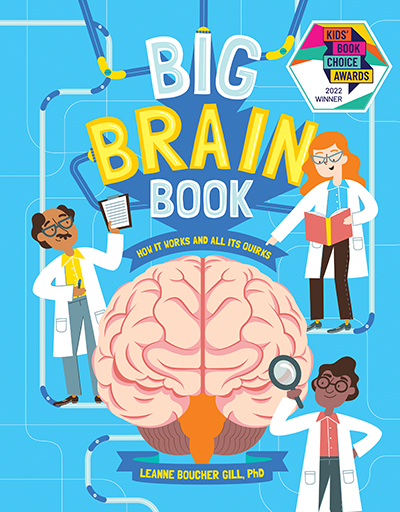
For those curious about why individuals can get an ice cream headache or why we can’t tickle ourselves, the Big Brain Book: How It Works and All Its Quirks offers short, informed answers. But it is more than an answer-filled reference text. The Big Brain Book asks and answers questions, bringing readers along on a journey of discovery.
For example, the Big Brain Book’s table of contents doesn’t list topics to be covered; instead, it lists a series of questions, like Why Can’t We Hear Dog Whistles?; How Do I Learn Things?; and What Does it Mean When Someone Has a Stroke? The questions relate to many students’ lived experiences.
In essence, the book encourages individuals to wonder at and wonder about. The Big Brain Book invites students to admire our human cognitive development and abilities (How the brain functions is a wonder!) by encouraging them to think about and to speculate about our functioning (I wonder why that happens?).
Published as part of APA’s quest to share psychological science with a wider, younger audience, the book is marketed for young readers, their parents, and teachers though the APA’s Magination Press Children’s Books. But Magination Press’s statement “books for kids” is, in some ways, limiting. I suggest thinking of the book as a resource for individuals who are seeking information about human development and functioning, regardless of their age.
Sections of the book can also be useful for young adults seeking to understand new concepts or for an overview of some key psychological concepts. The activities in the book (part of each chapter) provide a means of practicing concepts. They also offer parents and instructors ideas for options and a foundation for creating additional activities targeted to the needs and learning levels of family members/students. I use the assignment of constructing neurons (using pipe cleaners, straws, and beads) as a means of reminding my mostly second-year health-career college students of nervous systems functioning – material they covered in introduction to psychology. Most of the students find the hands-on activity engaging, fun, and helpful for recalling information. The assignment also allows me to quickly assess student abilities and needs. I can identify areas where students need additional guidance – such as the placement and role of neurotransmitters.
I turned the nerve assignment (described above) into a small-group assignment, asking students to think of how they can explain elements of the nervous system to their future patients, many of whom will very likely have limited knowledge of the nervous system and its functioning. This adaptation affirms the relevance of the material, prompts readers to think about how others might understand the concepts, and prompts readers’ own metacognitive development. The activity also fosters great class cohesion. But, most importantly, it is the form of active learning The Big Brain Book wants its readers to practice.
As a resource for students, parents, and teachers, this book uses an engaging, conversational style to explore such concepts as classical conditioning, operant conditioning, sympathetic and parasympathetic nervous systems, consciousness, and types of memory. As such, it covers some of the material typically found in introductory psychology courses, but its structure is different.
The structure of the book provides predictability. Each chapter follows a common format: asking a question; offering a paragraph or two setting the context, providing foundational psychological information; summarizing the material with a review (always titled “Final Notes for Your Noggin”); and proposing a learning activity.
To illustrate, Chapter 9 opens by asking “Why Does Learning How to Ride a Bike Seem So Hard at First?” It then offers a paragraph-length story about two kids trying to teach a younger child how to ride a bike. The two older children are puzzled about why the one kid’s younger brother is having difficulty learning to ride a bike on his first try. The short chapter then provides foundational information about types of memory, including procedural, long-term, episodic and semantic memories. The review highlights the challenges associated with helping individuals learn how to do things. Finally, the learning activity asks individuals to duplicate the loops and lines of a signature – first by having someone describe the signature to be duplicated, next by having a visual model to use.
The book’s chapters do not need to be read in sequence, nor does one need to use the whole book. This book provides individuals (general readers, parents, and teachers) with options, they can pick and choose relevant areas of interest to read and explore. These options can help teachers who are seeking activities to support deeper learning.
Finally, to borrow a phrase from the book, here are some “Final Notes for Your Noggin.”
The Big Brain Book offers at least a little something for just about anyone wondering why we humans do and think some of the things we do. By asking interesting questions, offering short explanations that answer those questions, and providing activities to apply the topics, The Big Brain Book uses psychological science to promote exploration, deep learning, and critical thinking for individuals coming to the subject.