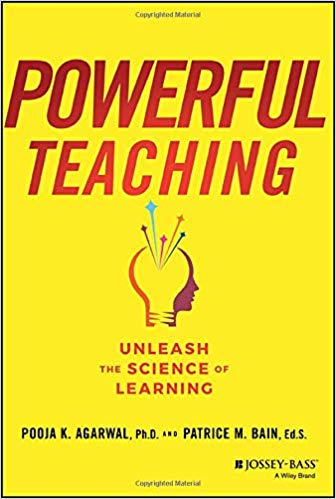
 Title: "Powerful Teaching: Unleash the Science of Learning"
Authors: Pooja K. Agarwal, PhD & Patrice M. Bain, EdS
Publisher: Jossey-Bass, A Wiley Brand (2019)
ISBN: 9781119521846
Pages: 340
Price: $32.95 (hardback)
"Powerful Teaching" is a call for teachers to come back to the basics written by Pooja Agarwal, cognitive psychologist, and Patrice Bain, longtime K-12 teacher. Agarwal and Bain review prior research on effective teaching and chronicle their findings from in vivo research conducted in Patrice’s 6th grade history classroom. From this wealth of research, they provide accessible, scientifically grounded suggestions for implementing effective teaching practices.
Throughout "Powerful Teaching", Agarwal and Bain circle back to this overarching message: effective teaching does not have to be fancy. It does not have to be novel. It does not even have to be complicated. At its core, they argue, effective teaching is rooted in sound empirical findings. As such, they highlight four highly supported teaching strategies (their “power tools”): retrieval practice (recalling previously learned information), spacing (spreading retrieval practice over time), interleaving (mixing retrieval of similar information to promote discrimination), and feedback-driven metacognition (reflecting on what one does and does not know). Focusing on these well-supported teaching strategies, and the improvement in students’ learning as a result of educators’ implementation of these tools, "Powerful Teaching" counters the notion that effective teaching must be elaborate or elusive.
"Powerful Teaching" is a well-researched, well-written book — the messages are straightforward, the recommendations are both tangible and explicitly applicable, and the content is based on research. The book is also well-organized, structured in a way that takes the reader on an educational journey. Agarwal and Bain begin by recounting their genesis as researchers together, which segues into why they embarked on their research journey in the first place: to figure out what the science says about effective teaching, and to bring those findings to the general teaching audience in an accessible, applicable way (chapter 1). Next, they review each of the four power tools — explaining how they work, reviewing others’ and their own research findings on the ways the strategies improve student learning, and then providing myriad specific suggestions for how to implement the strategies in a real classroom (chapters 2-5). After discussing each of the power tools separately, they offer suggestions for combining power tools to maximize student learning (chapter 6). Further, they proactively address the potential drawbacks of implementing new teaching strategies (e.g., increased time commitment for lesson planning) and review how the use of these strategies can actually break down barriers, rather than pose new ones (chapter 8). Digging deeper than typical metrics of student learning (e.g., grades), they also discuss how these tools can help boost student confidence through decreasing learning- and performance-related anxiety as well as improve the classroom community environment (chapter 8). Beyond simple execution of these tools, Agarwal and Bain go the extra mile and provide ways teachers can bring students and parents on board with these methods of learning (e.g., keeping retrieval low-stakes, communicating scientific findings with parents and suggestions for using these tools at home; chapters 9-10). Finally, they conclude with a guide for incorporating continued education on these power tools in teacher professional development (chapter 11) and a guide for practicing the power tools (chapter 12). These guides are a particularly unique and beneficial aspect of the book, as educators and/or administrators could easily structure workshops and continuing education content related to these tools, and all the resources one would need could be found in "Powerful Teaching".
Another unique aspect of "Powerful Teaching" is that suggestions cover a vast range of classroom settings: from 6th grade history classrooms to upper-level university psychology courses. As such, the recommendations and ideas truly are applicable to a wide range of courses, ages, and developmental levels. These suggestions, including “Retrieval Warm-Ups,” “Two Things,” and “Brain Dumps” were well-described and multiple examples of various forms of implementation were provided.
Another powerful aspect of this book was the explanation that these scientifically backed teaching strategies can be implemented intentionally through pre-planning but can also be implemented spontaneously. In fact, many instructors already facilitate spontaneous retrieval practice (e.g., asking students a spontaneous question in the middle of class about a previously covered topic). In this vein, Agarwal and Bain’s work validates educators’ existing efforts and encourages continued commitment to fostering an intentional classroom environment. "Powerful Teaching" also helps the reader practice these power tools throughout the book, as there are prompts to retrieve in each chapter, sometimes spaced and sometimes interwoven, as well as prompts to engage in reflective metacognition. Through these practices, the authors demonstrate the simultaneous brevity and weight these strategies can hold.
"Powerful Teaching" could be a helpful resource for educators teaching a variety of psychology courses in higher education. In the context of introductory psychology courses, teachers can reinforce learning of an array of psychological concepts through using these strategies in their teaching: asking students to regularly retrieve in low-stakes ways, spacing this retrieval between topics, asking students to retrieve related content while needing to differentiate, and structuring time for students to reflect on their learning. If teaching courses related to cognitive psychology, the psychology of learning, educational psychology or even during some of those topics in introductory psychology, this book could serve double-time as an accessible resource for students to read to further understand the science of learning. Ultimately, "Powerful Teaching" can serve educators and students alike as an exceptional resource for building a foundational understanding of learning-related research and immediately translating this research to the classroom, and to life.