skip to main content

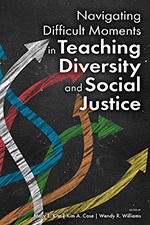
Review of Navigating Difficult Moments in Teaching Diversity and Social Justice

This book provides a toolkit for teaching (and using) diversity and social justice in the higher education classroom.

APA Style leaf logo Cite This Article in APA Style
Shane-Simpson, C. (2021, August 23). Review of Navigating Difficult Moments in Teaching Diversity and Social Justice. https://www.apa.org/ed/precollege/psychology-teacher-network/activities-books/teaching-diversity-social-justice

Navigating Difficult Moments in Teaching Diversity and Social Justice Editors: Mary E. Kite, Kim A. Case, and Wendy R. Williams
Publisher: American Psychological Association
Copyright: 2020
ISBN: 978-1-4338-3293-2
Pages: 248
Price: $29.99 (members) $39.99 (nonmembers)

Given recent outcries for social justice in the U.S., it becomes increasingly important for educators to prepare for and effectively engage with “difficult conversations” in the higher education classroom. In their new book, Navigating Difficult Moments in Teaching Diversity and Social Justice, the authors provide a social justice toolkit designed to help educators face challenging conversations and use those conversations as teachable moments. The ideas in this book were derived from a three-day workshop retreat for educators and scholars passionate about teaching social justice in the higher education classroom. Consequently, the voices in each chapter reflect years of experience in college and university classrooms, while also providing practical (and tested) solutions to social justice teaching dilemmas.

Most chapters begin by identifying a potential problem in the classroom. The authors provide examples illustrating when/how that problem might originate, propose opportunities that could prevent, intervene, or resolve the problem, and end with a discussion of best practices in handling the issue. As a bonus, many of the chapters are sprinkled with self-reflection assignments that educators can use to evaluate and enhance their own teaching practices. Given the wealth of information provided in this publication, this review was organized to highlight content that supports professional development and well-being of social justice educators and then identifies effective social justice teaching approaches and potential implementation issues in the classroom.

Supporting the educator

The editors introduce us to “pedagogical humility” early in the book (Chapter 1) by encouraging educators to learn from their students, while educators reflect on their own teaching experiences without self-judgement. Unfortunately, many social justice educators experience pedagogical isolation, where only one member of a department infuses social justice into their course(s). The editors propose a peer mentoring model as one solution to this isolation and highlight the ways in which this publication can be used to support the mentoring process. Chapter 12 extends social justice work beyond the classroom, explaining how educators frequently support students after class, support peers when discrimination has occurred, and may confront biased institutional practices. To prevent social justice burnout (Chapter 3), self-care should occur at the individual, social movement (or cause), and institutional level. The authors of Chapter 3 (Eaton and Warner) remind us that, “social justice work is a marathon, not a sprint.”

Inside and outside of the classroom, educators may also experience threats to their well-being (see Chapters 5 and 6) and career advancement (Chapter 17) by including social justice learning outcomes in their courses. Chapter 17 explains how biases that appear on student evaluations can negatively impact career advancement. Consequently, the author (Boysen) advocates for the development of valid evaluation instruments, the use of “valid” “analytic strategies,” and increased opportunities for “formative” evaluation that occur before the end of the semester. The latter strategy allows educators to continuously evaluate and respond to student feedback throughout the semester.

Classroom activities and social justice implementation issues

In Chapter 4, each author (Kite, Colbert, and Barrera) discusses a teaching mistake and then proposes ways that we can prevent or intervene in a similar situation. For example, educators can acknowledge their personal errors and allow students to respond to particularly hurtful remarks made by a classmate. Other chapters build on this theme, explaining how classroom discussion ground rules created with students (Chapter 2) can help guide discussions around social justice topics. When establishing discussion ground rules, student characteristics and course format are also important considerations. As noted in Chapter 7, educators are tasked with understanding their student population and minimizing harm during classroom discussions. Chapter 9 extends this theme by suggesting that educators grant students agency when controversial topics arise. In practice, students can be presented with multiple pathways by which to discuss current events in the classroom, based on their level of comfort and investment in the topic.

Many of the chapters also highlight some “classic” difficulties that arise in teaching about diversity and social justice. For instance, social justice educators may encounter issues when addressing in-group stereotypes (Chapter 10) and white privilege (Chapter 11), when students respond with hurtful speech (Chapter 7), encountering structural equality (Chapter 8), and handling student prejudice disguised as “freedom of speech” (Chapter 16). The discussion of ways in which “outsiders” (e.g., those with white privilege) can effectively teach diversity issues was particularly compelling. The author (Goldstein) suggests that educators reflect on our own privilege and encourage “insider” voices in the classroom. Educators can develop more effective ways to communicate with students and introduce social justice issues. For example, Chapter 14 explains how ageism is severely neglected as a form of diversity in classrooms (and beyond), while Chapter 13 proposes ways in which we can modify gendered language in the classroom (e.g., using gender-inclusive language in lectures). The last chapter in the book unifies these issues, while also emphasizing the ways in which educators can work together to create a just learning environment.

Overall, I enjoyed reading (and re-reading) the chapters in this book. As a social justice and early career educator, I appreciated hearing the lived experiences of the authors in each chapter and found myself physically nodding my head in agreement with many of their recommendations (e.g., we need to engage in more self-care). This book is written in an approachable tone that allows the reader to feel connected with the authors and their teaching experiences. From a practical standpoint, this book could serve as a valuable peer mentoring or community of learning resource in any academic department and I’m happy to add this book to my own resource library.

Recommended Reading

You may also like