


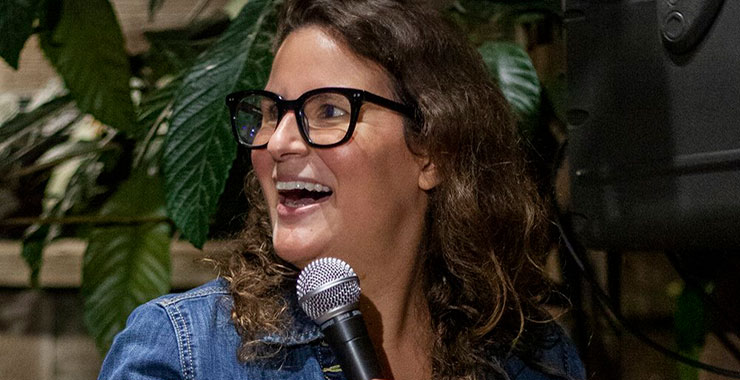
Leslie Berntsen, PhD, is the director of education and research at The Story Collider, a non-profit organization dedicated to highlighting the human side of science through the art of personal storytelling.
American Psychological Association. (2023, December 4). Teacher Spotlight on Leslie Berntsen. https://www.apa.org/ed/precollege/psychology-teacher-network/spotlight/leslie-berntsen
What do you hope students take away from your class?
I hope that each student leaves one (or more) of my classes knowing two things:
- They, too, can be a “science person,” especially if someone has tried to convince them otherwise.
- They can use their newfound scientific knowledge to improve their own lives and the world around them concretely.
Name a fun fact about your teaching style or classroom approach.
In my teaching, I strive to make complex scientific concepts accessible, relatable, and maybe even fun by integrating many current events, pop culture references, and personal stories amidst key terms and findings.
Even though there are well-documented educational benefits (Vansteenkiste et al., 2018) to making course material self-relevant, it has been instructive to notice how some people—students and colleagues alike—have willfully chosen to view this approach. Put simply, I’ve learned that certain teaching techniques can be taken as evidence of innovation or incompetence, depending on who is implementing them.
So, if you are reading this and you have the privilege of being presumed competent (Muhs et al., 2012), please use it in the service of colleagues who do not share that privilege. While we can advocate for ourselves, it can get very tiring to fight that uphill battle alone.
What is your favorite class or lesson to teach?
I love teaching about just-world beliefs because they explain so much about social injustice, and it’s just a matter of putting the scientific term to the phenomenon that I know my students have noticed.
If you understand why someone might feel compelled to blame victims (Berntsen, 2017) of sexual violence, police brutality, or the like, you’re in a much better position to have a productive conversation that might change someone’s mind about these issues. That’s huge.
Is there a teacher or colleague who especially inspired you?
I can’t speak highly enough about the fellow advocates for inclusive teaching that I’ve been fortunate enough to meet at conferences and on Twitter over the past seven years.
If you’ve ever felt like you’re independently fighting the good fight at your own institution, please know a whole community of folks is waiting to welcome you and validate exactly what you’ve been experiencing.
Getting involved with STP as a graduate student remains one of the best things I’ve ever done, and this year’s Annual Conference on Teachingopens in new window will feature in-person and online offerings for maximum accessibility. However you can attend, I can’t recommend it highly enough.
What is the most memorable moment in your teaching career?
True, personal stories are incredible teaching tools, so I habitually integrate as many as possible throughout my lectures. One of these stories comes in the form of a TED talk (“How to Talk (and Listen) to Transgender People,” 2017) from Jackson Birdopens in new window, a writer, speaker, advocate, and dear friend of nearly two decades.
In February 2020, Jack happened to be in Los Angeles on the same day I would lecture on sex and gender to my introductory psychology class. So, we did exactly what you’d expect and hatched a plan at 10 p.m. the night before. The following day, he snuck into the back of the auditorium right before I introduced his TED talk, and then I got to tell my class, “For the sake of time, I can’t show you this whole TED talk right now, but I can do something a bit better. Hey Jack, come on up here and say hi to everyone.” It was awesome.
What advice would you give to newer and/or veteran psychology teachers?
You deserve to be treated right—by your students, colleagues, and institution—and it’s never too late to advocate for yourself if you are not being treated the way people deserve to be treated.
I’ve noticed that many academics, myself included, consider their profession an essential part of their identity, and I’ve recently realized this. Teaching is about helping other people learn new information, develop new skills, achieve their goals, and maybe even experience meaningful personal growth. These things can happen in many different ways and in many different settings; you do not have to be a college professor to do these things.
What does it mean to you to receive this award?
It means the world and could not have come at a better time.
Is there any additional information you would like to add to this interview?
I love giving faculty development talks focused on inclusive pedagogy and teaching social issues, so if you’d like me to speak at your school, please feel free to reach outopens in new window.
References
Berntsen, L. (2017). The science of victim blaming. Huffpost. https://www.huffpost.com/entry/the-science-of-victim-blaming_b_58d07585e4b07112b647311aopens in new window
Bird, J. (2017). How to talk (and listen) to transgender people [Video]. TED Conferences. https://www.ted.com/talks/jackson_bird_how_to_talk_and_listen_to_transgender_people?language=enopens in new window
Muhs, G. G. y, Niemann, Y. F., González, C. G., & Harris, A. P. (Eds.). (2012). Presumed Incompetent: The Intersections of Race and Class for Women in Academia. University Press of Colorado. https://doi.org/10.2307/j.ctt4cgr3kopens in new window
Vansteenkiste, M., Aelterman, N., De Muynck, G.-J., Haerens, L., Patall, E., & Reeve, J. (2018). Fostering personal meaning and self-relevance: A self-determination theory perspective on internalization. Journal of Experimental Education, 86(1), 30–49. https://doi.org/10.1080/00220973.2017.1381067opens in new window