

 This resource was developed by a Working Group on Diversity and Access from the APA Summit on High School Psychology Education, July 2017: Yadira Sánchez, co-chair; Tammy L. Hughes, co-chair; Nicole Bardoulas; Nora (Berdelle) Clark; Wayne Ha; Steve Jones; Carlos Montalvan; Sylvan Tauber; and Linda Woolf.
Goal: Help Teachers Reflect on Diversity Instruction in their Classroom and School Community
This resource aims to boost interpersonal and cultural sensitivity in both students and teachers.
Objective
To create teacher evaluation for self-reflection regarding diversity inclusiveness in their classroom.
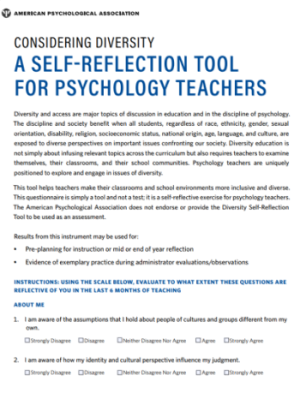
Diversity and access are major topics of discussion in education and in the discipline of psychology. The discipline and society benefit when all students, regardless of race, ethnicity, gender, sexual orientation, disability, religion, socioeconomic status, national origin, age, language, and culture, are exposed to diverse perspectives on important issues confronting our society. Diversity education is not simply about infusing relevant topics across the curriculum but also requires teachers to examine themselves, their classrooms, and their school communities. Psychology teachers are uniquely positioned to explore and engage in issues of diversity.
This tool is designed to help teachers make their classrooms and school environments more inclusive and diverse places. The Diversity Self-Reflection Tool is a self-reflective exercise for psychology teachers. The American Psychological Association does not endorse or provide this tool to be used as an assessment. Furthermore, school administrators should not use this tool for administrative assessment purposes.
The Self-Reflection Tool
The online version will allow you to print your responses after before you submit it. If you use the PDF, please be sure to print the PDF or save it as a separate file if you would like to keep a copy of your responses.
Background Information
Initially, the Working Group on Diversity and Access identified 47 questions for potential consideration in the instrument from the literature referred to below as well as personal experience. The questions were then sent to six subject matter experts selected for their expertise in: (1) teaching and learning, (2) high school psychology, and (3) diversity topics. Following their review and subsequent analysis, thirty-eight questions were found to have appropriate content validity and support in the literature for considering awareness of diversity issues in the classroom. Finally, a pilot administration of these items was sent to randomly selected TOPSS members to determine if the constructs identified by the subject matter experts were consistent with how actual teachers would view the tool. The overall reliability of the tool was excellent, and the self-reflection tool is reported to be psychometrically sound.
Caution: the data for the self-reflection tool is based on the tool as written. Any modifications to these questions, compromise the integrity of the tool and therefore the categories which direct teachers to seek resources. Should (any) reader/s wish to modify the items, they need to be aware that they can no longer reference the psychometrics (or certainty of usefulness). It is not recommended to modify the wording of these items.
Results and Data Comparison
Results from this Instrument may be used for:
- Pre-planning for instruction or mid or end of year reflection
- Evidence of exemplary practice during administrator evaluations/observations
Data comparisons
For researchers seeking to use this self-reflection tool for comparisons, the demographic information below is recommended for formal data collection protocols.
Demographic questions
Where is your primary place of employment? (High school; Community College; Baccalaureate-granting institution; Other)
What is your race? (African American/Black; American Indian or Alaska Native; Asian; Caucasian/White; Native Hawaiian or Pacific Islander; Spanish/Hispanic/Latino(a); Other)
What is your highest level of education? (AA/AS; BA/BS; MA/MS; EdD; PhD; PsyD; Other)
How many years have you been in your current position (at your primary place of employment)?
How many years have you been at your current place of employment?
How many years have you been in the field?
Have you previously been trained on including diversity in the classroom? (Yes; No; Uncertain)
Teacher Resources
We've compiled a large collection of resources to help psychology teachers improve their knowledge and understanding of the following topics related to diversity:
- Individual perceptions of diversity
- Diversity among students
- Diversity in curriculum and instruction
- Diversity in the school environment

The format and questions of the self-reflection tool were adapted from:
- Central Vancouver Island Multicultural Society. (2015). Cultural competence self-assessment checklist. Retrieved from https://www.coloradoedinitiative.org/wp-content/uploads/2015/10/cultural-competence-self-assessment-checklist.pdfopens in new window
- Matsumoto-Grah, K (1992). Common bonds: Anti-bias teaching in a diverse society. Wheaton, MD: Association for Childhood Education International. Retrieved from https://eric.ed.gov/?id=ED348152opens in new window
- TeachAway (2017). Diversity in the classroom: A checklist for culturally responsive teachers. Retrieved from https://www.teachaway.com/blog/diversity-classroom-checklist-culturally-responsive-teachersopens in new window
Thanks to Mary Kite, PhD, Celeste Malone, PhD, Melanie Wilcox, PhD, and the APA TOPSS Committee for their reviews of and suggestions for the resources provided on this page.