Regeneron International Science and Engineering Fair Winners
2026
May 9–15, 2026, Phoenix, Arizona
Photo Credit: Lisa Fryklund/Licensed by Society for Science
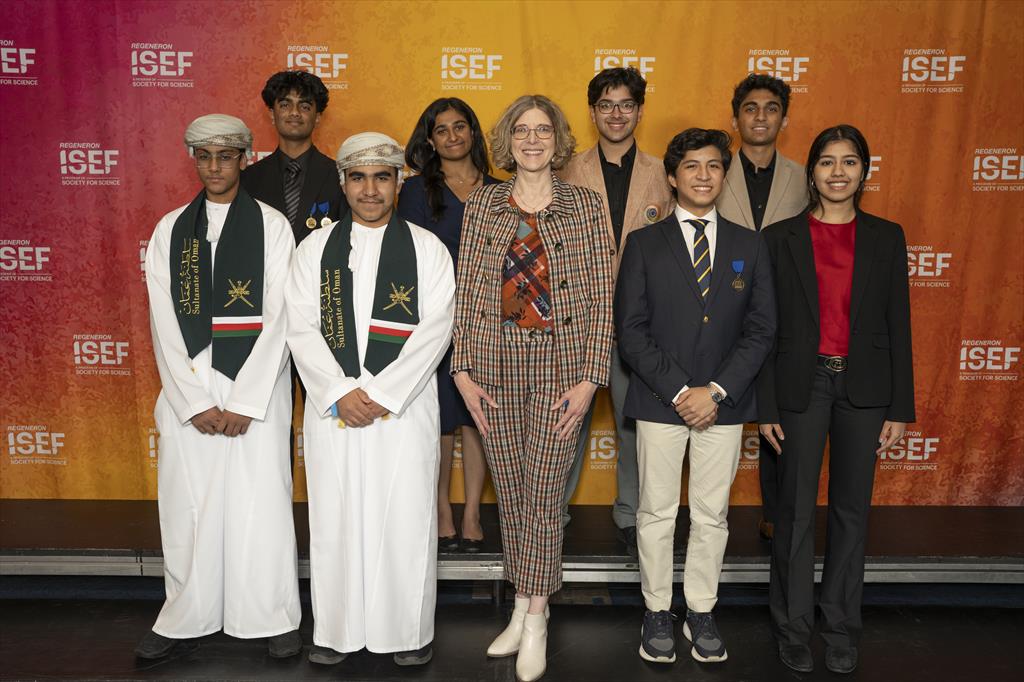
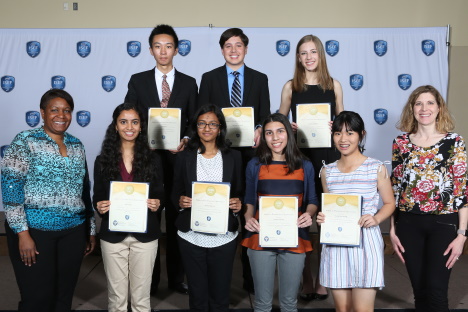
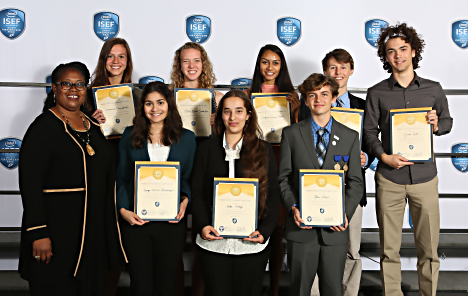
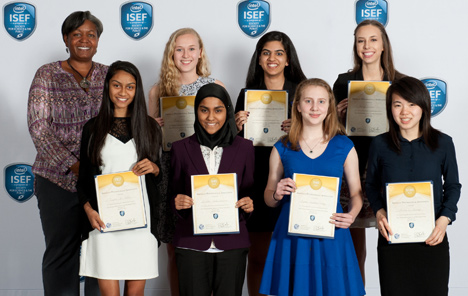
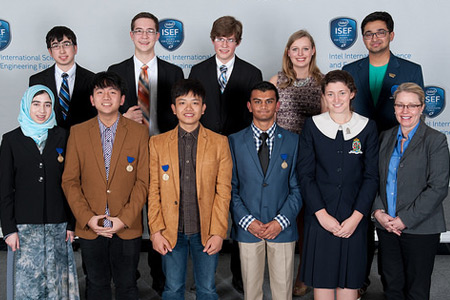
Each year, APA participates as a special award organization at the Regeneron International Science and Engineering Fair (ISEF), the world’s largest pre-college STEM competition, which brings together nearly 2,000 finalists from about 70 countries. As a special award organization, APA recognizes the top seven psychological science projects.
The 2026 APA Special Awards at ISEF recognized student projects spanning key themes, including human-AI interaction and its implications for moral reasoning, links between debate experience and creativity, and the use of AI to enhance classroom engagement. Additional awarded work highlighted technology-based approaches to attention and fatigue, multi-sensory cognitive stimulation for neurodegenerative conditions, strategies to reduce smartphone use and improve social presence, and the effects of accent familiarity on memory and social perception.
First award of $1,500
How AI speaks changes how people think: Framing AI advice to keep moral reasoning human, Aadi Mishra, The Waterford School, Salt Lake City, UT
Second award of $1,000
Debaters and creators: How debate experience relates to creativity, Aadith Kacholia, American School of Bombay, Mumbai, India
Third award of $500
The neurocognitive and social impact of accent familiarity: An investigation into memory recall and perceptual bias, Amanat Jain, Garden City High School, Garden City, NY
Designing for presence: A randomized controlled trial comparing incentive structures to reduce smartphone use during social interactions, Atiksh Bhan, Charles J. Colgan Sr. High School, Woodbridge, VA
Cognitive stimulation via multi-sensory integration: Testing the impact of childhood multimedia tools on engagement in Alzheimer's and dementia patients, Victor Ramos, John B. Alexander High School, Laredo, TX
AI companion for attentional fatigue: Detection of facial features to anticipate attentional fatigue coupled with sonic stimuli to mitigate inattention, Mahie Patil, Orlando Science High School, Winter Garden, FL
AI-based system for analyzing and supporting student engagement in the classroom, Abdul Rahman Al Balushi & Ibrahim Al Zarouni, Saad Bin Abi Waqqas School, Shinas, Oman
2025
May 10–16, 2025, Columbus, Ohio
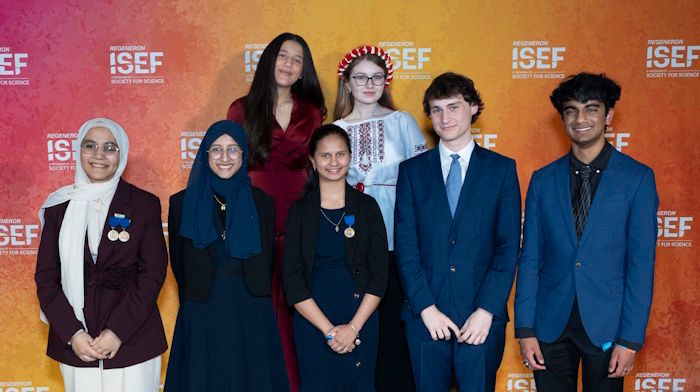
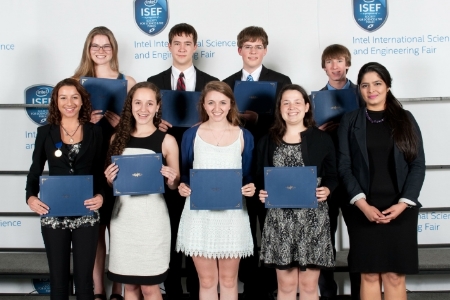
Photo courtesy of Society for Science. Top row, left to right: Sima Omar Saleh Al-Shaghnobi, Iryna Korynevska. Bottom row, left to right: Sahar Ashraf Mahmoud Ahmed, Nazifa Arna, Vanya Lavu, Matthew Hutcherson Casavant, Aadi Mishra.
First award of $1,500
Engaging minds, Debunking lies: Using moral foundations to fight misinformation, Aadi Mishra, The Waterford School, Salt Lake City, UT
Second award of $1,000
Healthy gut! Healthy you! Preclinical validation of a novel enzyme therapy for improving generalized anxiety disorder and overall gastrointestinal health in Rattus norvegicus, Vanya Lavu, The Classical Academy–North, Colorado Springs, CO
Third award of $500
Harmony Plus: A user-adaptive system for neurocognitive rehabilitation with genetic personalization and real-time cognitive load monitoring in bipolar disorder, Sahar Ashraf Mahmoud Ahmed, City Schools, Sohag, Egypt
Developing a screening instrument for Arabic speaking children with reading dyslexia, Sima Omar Saleh Al-Shaghnobi, Bunat Alghad Academy, Amman, Jordan
The impact of puzzle-solving on memory retention and concentration: A study of cognitive enhancement, Nazifa Arna, Upper Darby High School, Upper Darby, PA
Personalized nature virtual reality (PnVR): A novel personalized virtual reality nature therapy via a triple combination computational software for worldwide mental health benefit, Matthew Hutcherson Casavant, John Jay High School, Cross River, NY
Memory board: An eidetic neuro-training complex with digital integration for cognitive development, Iryna Korynevska, Boryspil Academic Lyceum, Boryspil, Kyiv, Ukraine
2024
May 11–17, 2024, Los Angeles, California
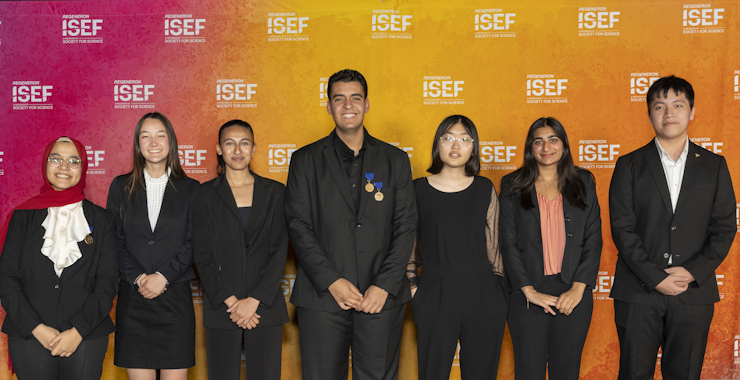
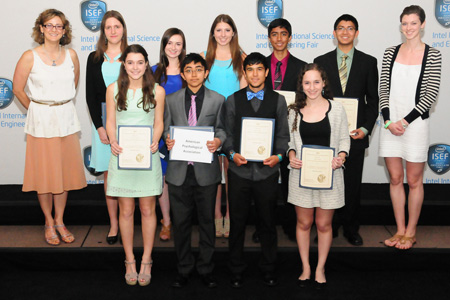
Photo courtesy of Society for Science/Lisa Fryklund. (Left to right) Sahar Ashraf Ahmed, Sierra Anne Sun, Aanya Gupta, Mohamed Ahmed Sakr, Olivia Saun So, Rania S. Lateef, Shao-Chieh Fu. Not pictured: Yu-Pin Tsao.
First award of $1,500
Harmony: A remote AI-based monitoring and prediction system for manic and depression episodes in bipolar disorders, Sahar Ashraf Ahmed, City Schools, Sohag, Egypt
Second award of $1,000
Differential empathy, social dominance orientation, and the limitations of social science research, Sierra Anne Sun, The Waterford School, Sandy, UT
Third award of $500
Concentration-dependent effects of dietary niacin and NAD+ in longevity, memory, and motor function of Drosophila melanogaster, Olivia Saun So, Harvard-Westlake Upper School, Studio City, CA
Rhythms and blues: Examining potential health hazards of blue light-induced circadian disruption in Drosophila melanogaster, Rania S. Lateef, Governor’s School at Innovation Park, Manassas, VA
Searching for “magic pill”: A novel adenosine modulator in the treatment of schizophrenia and stress-related disorders, Shao-Chieh Fu, Taipei Municipal Chien Kuo High School, New Taipei City, Taiwan; Yu-Pin Tsao, Taipei Municipal Chien Kuo High School, New Taipei City, Taiwan
ArabLexify: Elevating early dyslexia diagnosis in Arabic-speaking children ages 6–12 by utilizing accessible digital screening tool, Mohamed Ahmed Sakr, Obour STEM School, Cairo, Egypt
The recursive relationship between personalized music choice and adolescent mental wellness: An empirical study, Aanya Gupta, Horace Mann School, New York, NY
2023
May 13–19, Dallas, Texas
First award of $1,500
Assessing abnormalities in spatial awareness of patients with Alzheimer’s disease through the line quadrisection test, Yurim Jin, Korean Minjok Leadership Academy, Hoengseong-gun, Gangwon-do, South Korea
Second award of $1,000
Occupational stress and mental health outcomes among the emergency medical services population, Mikayla Schwartz, Paul D. Schreiber High School, Port Washington, New York
Third award of $500
DysDiag: A novel risk assessment and screening tool for learning disorders in children, Spurti Nimbali, Delhi Public School, R. K. Puram, New Delhi, India
Little mermaid: Improving social communication level for mildly autistic children using video call-based mobile application game, Sama Nooh and Shahd Nooh, Sharkya STEM School, Belbies, Sharkia, Egypt
The effects of environmental disparities on the environmental awareness of high school students in the greater Birmingham area, Joscelyn Kalani and James Peterson, Alabama School of Fine Arts, Birmingham, Alabama
Die Verwante Woord Project: Learning Afrikaans using HD-tDCS, Garrett Michael Goulstone, Hellgate High School, Missoula, Montana
Determining whether the onset age of bilingualism enhances cognitive control, Michelle Choi, Iolani School, Honolulu, Hawaii
2022
May 7–13, Atlanta, Georgia and Virtual
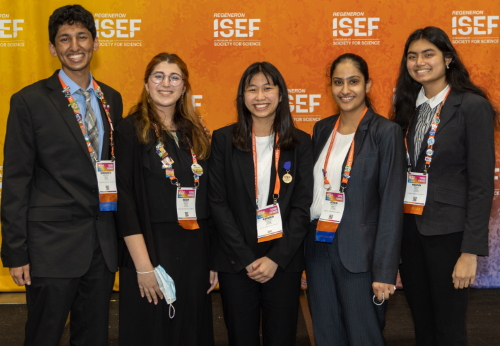
2022 APA ISEF Award winners. From left to right: Siddhanth Pachipala, Sarah Garfield, Natasha Kulviwat, Kosha Upadhyay, Meghan Pasala. Not pictured: Carolyn Clebsch, Malcolm Owusu.
First award of $1,500
SuiSensor: A novel, low-cost machine learning system for real-time suicide risk identification and treatment optimization via computational linguistics: Siddhanth Pachipala, College Park High School, The Woodlands, Texas
Second award of $1,000
BREATH analysis: Improving community readiness outcomes for native Hawaiian students in K-12 education: Carolyn Clebsch, Kealakehe High School, Kailua-Kona, Hawaiʻi
Third award of $500
The effect of virtual learning on student long term self-esteem: Sarah Garfield, Palm Beach Central High School, Wellington, Florida
Neurocognitive tasks: Novel markers to predict and prevent adolescent suicidal behavior: Natasha Kulviwat, Jericho High School, Jericho, New York
Cognitive profiling and personalized therapy recommendation for dementia through a language-aware multi-model artificially intelligent system: Kosha Upadhyay, Bellevue Senior High School, Bellevue, Washington
The transgenerational effects of the synergy of nicotine, atomoxetine, and buspirone on egg laying habits, gene expression, and oxidative stress levels in C. elegans: Malcolm Owusu, American Heritage School, Plantation, Florida
High school students’ psychological difficulties in online learning: Meghan Pasala, Spring Valley High School, Columbia, South Carolina
2021
May 2021, Virtual
First award of $1,500
Autest: Culturally adapted risk assessment game for autism spectrum disorder: Anwesha Das, Delhi Public School, Kalyanpur, Kanpur, Kanpur, Uttar Pradesh, India; and Aranyo Ray, Kalyani Public School, Kolkata, West Bengal, India
Second award of $1,000
Digital phenotyping sutism: Investigating objective vocal and movement quantification for characterizing autism severity: Emilin Maria Mathew, American Heritage School, Davie, Florida
Third award of $500
Jewish identity formation processes within reform adolescents: Rachel Elizabeth Buksbaum, Wiregrass Ranch High School, Wesley Chapel, Florida
Optimizing students’ working memory capacity with binaural beats: An experimental study on SMA Negeri 28 Jakarta students: Athifah Qonita Millati and Noor Naila Imtinan Himam, SMA Negeri 28 Jakarta, Jakarta Selatan, Jakarta, Indonesia
Using response times to investigate the face recognition mechanism in developmental prosopagnosia: Tanvi Palsamudram, The International School of Bangalore (TISB), Bangalore, Karnataka, India
SMART CUBES: Interactive tactile and sound set for blind children: Aleksei Shremzer, Gymnasium #32, Nizhnekamsk, Tatarstan, Russian Federation
High school students’ psychological difficulties in online learning: Mai Phuong Vu and Phuc Viet Hoang, Lao Cai High School for Gifted Students, Lao Cai, Lao Cai, Viet Nam
Honorable mention
Video game reward systems and their impact on players’ behavior in the Iterated Prisoner’s Dilemma: Madeline Audrey Santoso, West Linn High School, West Linn, Oregon
Don’t trip; TRIPP! The effect of a virtual reality meditation environment on stress and mindfulness: Stefan Alek Salaices, Colleyville Heritage High School, Grapevine, Texas
Application for screening attention deficit disorder (Inattentive ADHD (ADD)): Jood Faisal Mohammed and Zeina Ahed Al Sharavdeh, Jubilee School, Amman, Jordan
Seeing through the scan: The impact of fMRI evidence on juror satisfaction and verdicts: Isabella Souza, Syosset High School, Syosset, New York
2019
May 12–17, Phoenix, Arizona
Bottom row (left to right): Ladonna Lewis, PhD, APA lead judge; Divya Nori; Shreya Ramesh; Annika Huprikar; Tsung Tien-Hsiung; Julie Morrison, PhD, APA judge.
Top row (left to right): Ronald Xu; Cameron Diehard; Jessica Goldstein.
First place award of $1,500
iSense: Artificial intelligence based early detection tool to identify linguistic biomarkers of mood disorders and recognize at-risk individuals: Divya Nori, Milton High School, Milton, Georgia
Second place award of $1,000
Real-time analysis of emotions for neurological disorder patients: Shreya Ramesh, Milton High School, Milton, Georgia
Third place award of $500
Combating stuttering via an empowered multi-modal neural network based on facial and audio recognition data: Ronald Xu, Winter Springs High School, Winter Springs, Florida
The neural mechanisms underlying the other race effect for expression perception: Tsung-Tien Hsiung, Taipei First Girls High School, Taipei, Taiwan
Effect of bilingualism on stroop interference: Cameron Niedhard, Carroll High School, Dayton, Ohio
Fruggie: Building healthy food pyramids with technology: Annika Huprikar, Deerfield High School, Deerfield, Illinois
Treating Parkinson’s neurodegeneration in diabetic, paraquat-exposed Drosophila by increasing caffeine intake: Jessica Goldstein, Plainview-Old Bethpage John F. Kennedy High School, Plainview, New York
Honorable mention
Clinical approach to predict cognitive disorders in multiple sclerosis: The use of biomarkers generated by eye movement disorders: Lana Alakhras and Raseel Scwaiki, Al-Hasaad Al-Tarbawi School, Amman, Jordan
DRAWIT: Predicting children physiological state, behavioral tendencies and personality characteristics using guided drawing: Dania Almubiden, Al Ridwan Schools, Amman, Kalda, Jordan
Sensory integration in adolescents with a history of multiple concussions: Giovanni Santucci, Ossining High School, Ossining, New York
Diagnosing autism with machine learning: Binary classification for eye movement in virtual reality environment: Rhythm Garg, Texas Academy of Mathematics and Science, Denton, Texas
Evaluating the relationship between concussion knowledge and reporting tendencies in high school athletes: Joseph Atherall, Yorktown High School, Yorktown Heights, New York
A card and board game to reduce gender-based implicit biases using perspective-taking and counter stereotyping and other methods of influence: Prena Magon, Police DAV Public School, PAP, Jalandhar, Punjab, India
Anxiety disorder detection and EDMR treatment using optical PCCR eye tracking: Abhinav Gundrala, Nicole Gunderson, and Rachel Freeman, Olympia High School, Olympia, Washington
2018
May 13-18, Pittsburgh, Pennsylvania
Bottom row (left to right): Emma Bilton Hannah Bilton; Taala Aboalnaja; Daniella Feistritzer, PhD; Ara Schmitt (APA judge and presenter).
Top row (left to right): Natalia Murillo; Rebecca Volkov; unidentified student; Ephraim Oyetunji; Adam Rilatt; Matthew Mullahy.
First place award of $1,500
Alterations in Oligodendroglia Lineage Cells and their Impact in Major Depressive Disorder: Matthew Ryan Mullahy, Smithtown High School, East St. James, New York
Second place award of $1,000
The Effect of Altering Drosphila Gut Microbiata on Mate Choice, Immunity, Memory, and Aggression: Natalia Nicole Murillo and Rebecca Volkov, Pascack Hills High School, Montvale, New Jersey
Third place award of $500
A Rapid Prediction Method for Epileptic Seizures Using Machine Learning Algorithms: Suraj Modi, Mountain View High School, Lawrenceville, Georgia
Using Python to Develop Twitter Personas: Adam Joseph Rilatt and Daniella Feistritzer, Central York High School, York, Pennsylvania
Improving Communication for the Visually Impaired Through an Innovative Arabic Writing System: Taala Fahad Aboalnaja, Third Intermediate School in Dhahran, Dhahran, Saudi Arabia
The Effect of Metformin on Post Traumatic Brain Injury Learning and Learning Disabilities: Emma Elizabeth Bilton and Hannah Rose Bilton, Yorktown High School, Yorktown Heights, New York
Treating Parkinson’s Neurodegeneration in Diabetic, Paraquat-exposed Drosophila by Increasing Caffeine Intake: Ephraim Oyetuni, American Heritage School, Miramar, Florida
Honorable mention
Better Decision Making: Forecasting or Surrogation?: Alyssa Knowles, Friendswood High School, Friendswood, Texas
Externality Framing Effects on Cognition: Emma Grace Sun, The Waterford School, Sandy, Utah
Assessment of Fall Risk Associated with High Heeled Footwear Utilizing Computerized Dynamic Posturography: A Two-Phase Study: Alexis McFeely, St. John Paul II Catholic High School, Hampton Cove, Alabama
A Quantifiable Method to Detect and Monitor ADHD: The Use of Facial Motion-Based Behavioral Cues Analysis Using Deep Neural Network and RGBD Data: Ishaan Maitra, Ardrey Kell High School, Charlotte, North Carolina
The Impact of Emotionally Targeted Branding on Social Behavior: Phoebe Mae Yates, Institute for Collaborative Education, Brooklyn, New York
Investigating the Relationship Between Polling Building Type and Voting Results: A Study in Priming: Noah Ball Robinson, Bangor High School, Bangor, Maine
Improving Facial Expression Recognition in Parkinson’s Disease Using Meditation: Ben Weiss and Kaitlynn Weiss, Kalaheo High School, Kailua, Hawaii
Unplugged: Quantifying the Effects of Technology on Adolescent Sleep and Mood: Louise Aehyun Hostrup Kim and Spencer Lee Yueh, Breck School, Golden Valley, New Mexico
Can a Preventative Social Media UI Break “Fake News?”: Ryan Miles Beam, Scotts Valley High School, Scotts Valley, California
2017
May 14–19, Los Angeles, California
Bottom row (left to right): Pamela Scott-Johnson, PhD, (APA presenter); Deepa Bhuvanagiri; Hiba Muhy; Ben Weiss.
Top row (left to right): Makenna Gabel; Karen Scharlau; Sapna Patel; William Snyder, Jacob Hall.
First place award of $1,500
Education on Stereotypes: Are Children More Receptive than Adults?: Deepa Bhuvanagiri, Eureka High School, Eureka, Missouri
Second place award of $1,000
The Effect of Highway Font Type on Readability of Text Under Blurred Conditions: Jacob Hall, H-B Woodlawn Secondary Program, Arlington, Virginia
Third place award of $500
RoboGlove: A Design for Engagement and Hedonic Motivation with Visual-Spatial for Deaf and Hearing Impaired Children, Phase II: Hiba Muhyi, Arrowhead Park Early College High School, Las Cruces, New Mexico
Effects of Cellular Devices on Teen Driving: Karen Scharlau and Makenna Gabel, Cochrane-Fountain City High School, Fountain City, Wisconsin
Evaluating Autism Connectivity Abnormalities Through Functional Fingerprinting: William Snyder, Severna Park Senior High School, Severna Park, Maryland
Suggested Memory Therapy: A Novel Treatment for Psychological Inflexibility: Ben Weiss, 17, Kalaheo High School, Kailua, Hawaii
Kemotions: Keys to Emotional Cues: Sapna Patel, Oviedo High School, Oviedo, Florida
Honorable mention
Self Image of Athletes with Disability: A New Meaning: Isabela Dombrady, Colegio Giordano Bruno, Brazil
2016
May 8–13, Phoenix, Arizona
Bottom row (left to right): Sapna K. Patel; Kashfia Rahman; Sophia Hawley; Jessica Li Huang.
Top row (left to right): Ladonna Lewis, PhD, (APA lead judge); Sarah Fendrich; Divya Vatsa; Emily Wood. Not pictured: Nikhil Patel.
First place award of $1,500
MeEmo: An Autism Destroying Avatar, Year Two: Sapna Patel, Oviedo High School, Oviedo, Florida
Second place award of $1,000
Redefining the Neurological Basis of Fluid Intelligence: Investigating Connection Strength and Network Strength of Resting State functional Connectivity: Jessica Huang, Jericho High School, Jericho, New York
Third place award of $500
Making the Mind Matter: Stress Mindset Effects on Sleep Quality, Stress Response, Emotion and Cognition in the Developing Adolescent Brain and the Role of the Prefrontal-Amygdala Circuit: Kashfia Rahman, Brookings High School, Brookings, South Dakota
Individual Neural Network Activity Patterns Underlie Complex Cognitive Task Performance: An fMRI With Clinical Implications: Sarah Fendrich, Ossining High School, Ossining, New York
CRANIOMETRIX: Developing Innovative Cognitive Tests to Diagnose Alzheimer's Early, Year Four: Nikhil Sanjay Patel, Oviedo High School, Oviedo, Florida
A Study of Biases in Perception: Sophia Alexandra Hawley, West Salem High School, Salem, Oregon
Cognitive and Brain Measures in Middle-Aged Autistic Spectrum Disorder Individuals: Where Are the Differences?: Divya Vatsa, BASIS Scottsdale, Scottsdale, Arizona; and Emily Wood, Xavier College Preparatory, Phoenix, Arizona
2015
May 10–15, Pittsburgh, Pennsylvania
Top row (left to right): Yousuf Asfari; Colter Norick; Colin Norick; Margaret Steiner; Arsh Shah Dilbagi.
Bottom row (left to right): Sarah Asfari; Tran Minh Hieu; Le Hoang Nhat; Aansh Shah; Alexandra Garth; Tammy Hughes (APA).
First place award of $1,500
Sticks and Stones May Break My Bones: Middle School Students' Perceptions of Bullying: Aansh Shah, Roslyn High School, Roslyn, New York
Second place award of $1,000
Stay Tuned! Comparing the Effects of Long and Short-Term Auditory Stimulation for Increasing the Sensitivity of a Person’s Hearing: Alexandra Zoe Garth, Redeemer Baptist School, North Parramatta, Australia
Third place awards of $500
The Effect of Multitasking on Reading Comprehension in Teens: Colter Norick and Colin Norick, Columbia Falls High School, Columbia Falls, Montana
Game Theoretic Model of Genetic Discrimination: Margaret Caroline Steiner, Academy of Science and Technology, The Woodlands, Texas
Constructing a Carcinogen Indicator Application Based on Statistical Analysis of Statewide Cancer Incidences in Relationship with Graphical Consumer Data: Sarah Asfari and Yousuf Asfari, Al-Huda School, College Park, Maryland
Intranasal Insulin Enhances Spatial Memory and Cognitive Adjustment: Tran Minh Hieu and Le Hoang Nhat, Lam Son High School for the Gifted, Thanh Hoa, Vietnam
TALK—An AAC Device: Converting Breath into Speech for the Disabled: Arsh Shah Dilbagi, DAV Public School, Panipat, India
2014
May 11–16, Los Angeles, California
Top row (left to right): Petra Grutzik; Colter Norick; Colin Norick; Timothy Renier.
Bottom row (left to right): Michelle Marquez; Leighton Braunstein; Chloe Sherry; Ashley Hamlin; Maha Khalid (APA).
First place award of $1,500
Adolescent Loss of Lis1 Results in Defective Hippocampal Morphology and Distinct Behavioral Deficits Resembling a Schizophrenic-Like Phenotype: Leighton Braunstein, The Dalton School, New York
Second place award of $1,000
Hand Hygiene Gone Viral? A Study of Student Involvement in a Social Media Campaign as a Method of Bringing Hand Hygiene to the Masses: Timothy James Fossum Renier, Duluth East High School, Duluth, Minnesota
Third place awards of $500
Linking Expression and Function of FoxP2 in Adult Songbirds Using Operant Preference Testing: Petra Luna Grutzik, Redondo Union High School, Redondo Beach, California
Light Speed: A Measure of Ocular Phototransduction Using Pulsed Light Emitting Diodes: Ashley Maye Hamlin, Hilton Head Island High School, Hilton Head Island, South Carolina
The Paradox of Emotional Dimensionality: The Effect of the Dimensionality of Audio Stimuli on the Brain's Electrical Activity, a Neuroscience Study: Michelle Maria Marquez, Math and Science High School at Clover Hill, Midlothian, Virginia
The Correlation Between Docosahexaenoic Acid (DHA) and Cognitive Function in Health Teens: Colin Norick and Colter Norick, Columbia Falls High School, Columbia Falls, Montana
A Study of the Effects of Transplantation of Tissue from Planarian Flatworks Conditioned with Light-Shock Therapy into Naïve Planarian Flatworms: Chloe Sherry, John Adams High School, South Bend, Indiana
2013
May 12–17, Phoenix, Arizona
Top row (left to right): Cheryl Conrad, PhD (APA judge); Adelina Cozma; Jessica Joyce; Heidi Smith; Tejas Dharmaraj; Manav Sevak; Caitlin Crowley (APA).
Bottom row (left to right): Abigail Orlando; Avinash Pandey; Ryan Silva; Leighton Braunstein.
First place award of $1,500
The Effect of Emoticon Stimuli on Human Facial Muscle Activation and Social Evaluation using Electromyographic Technology: A Novel Determination: Abigail Claire Orlando, Eastchester High School, Eastchester, New York
Second place award of $1,000
Neural Plasticity: Novel Language Learning through Digital Technology: Adelina Corina Cozma, Bayview Secondary School, Richmond Hill, Ontario, Canada
Third place awards of $500
A Model of Medial Entorhinal Cortex Grid Cell Remapping: Ryan Silva, University High School, Tucson, Arizona
Improving Long-term Compliance to Life Saving Medications: Avinash Kumar Pandey, Waterloo Collegiate Institute, Waterloo, Ontario, Canada
Developmental Gene Lis1 in the Adult Brain is Necessary for Spatial But Not for Novelty Memory: Leighton Anne Braunstein, The Dalton School, New York
Investigating the Roles of A2A and TrkB Receptor Proteins in Response to the Cholesterol and Brain-derived Neurotrophic Factor in an Alzheimer’s Disease Model: Heidi Marie Smith and Jessica Leigh Joyce, Loudoun County Academy of Science, Sterling, Virginia
Indicting Alzheimer’s: Novel Methods of Preventing Glial Scarring through the Downregulation of Cerebral Vimentin and Glial Fibrillary Acidic Protein: Tejas Dharmaraj and Manav Sevak, Chandler High School, Chandler, Arizona