

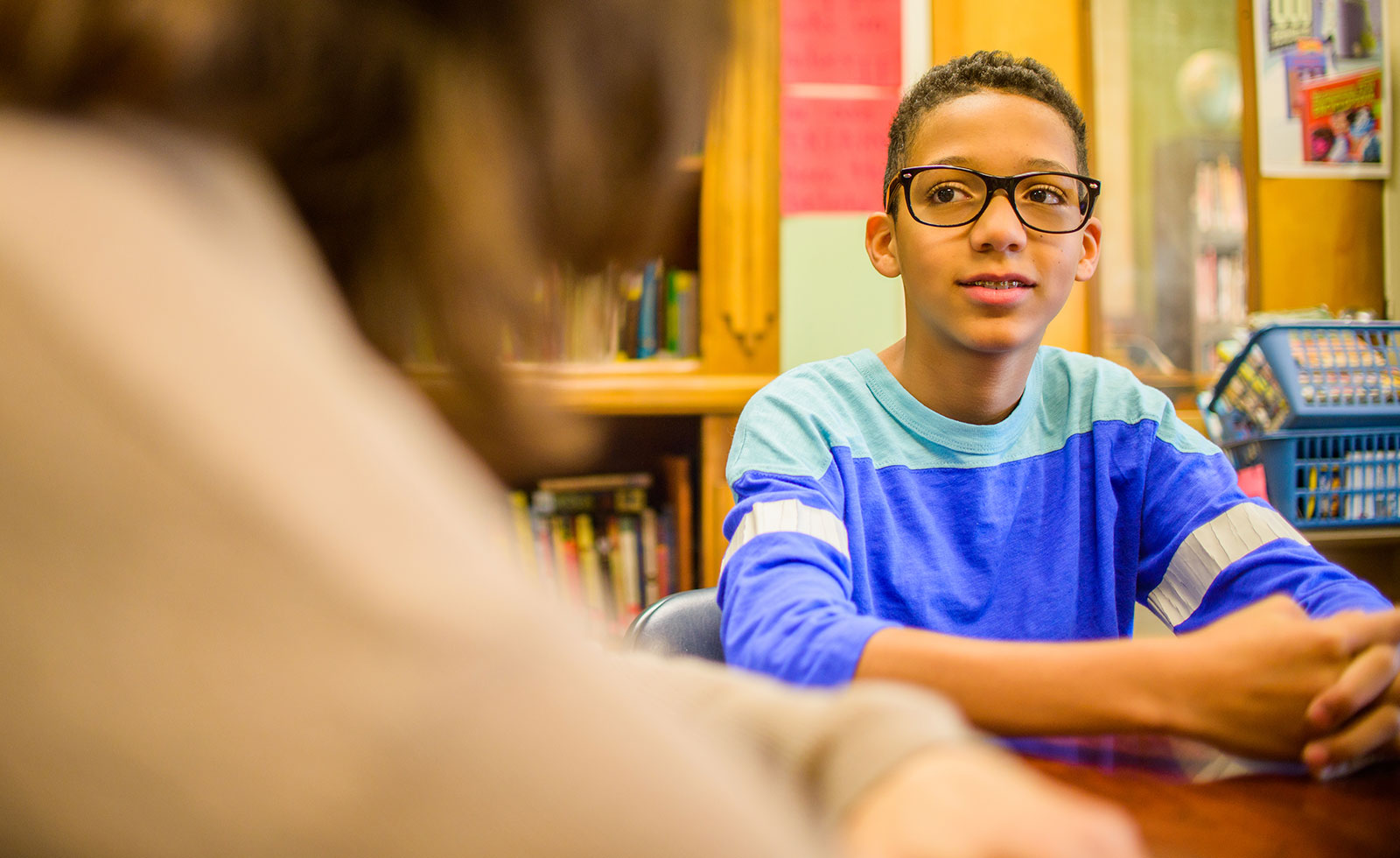
Teachers are an important part of establishing and maintaining healthy environments for children to learn and grow. Teachers can help students who are less confident in themselves, or who are afraid to make a mistake, to build their feelings of self-compassion and competence. Teachers can also play an important role in referring students to professionals in the building who can be of assistance.
Disclaimer
This information is designed to help teachers respond to students who may be in need of support. It is not intended to be used as a diagnostic tool or to replace the use of formal assessments employed by mental health professionals. Additionally, it is important to consider the context of the situation, individual differences, and cultural and linguistic factors.
What is self-esteem?
Self-esteem is the degree to which students feel satisfied with themselves and feel valuable and worthy of respect.
Perceived competence is a belief that one has skills in a particular area (e.g., math, spelling, peer relationships). Self-esteem and perceived competence are necessary for students to take risks in their learning and to bounce back after failure or adversity. Low self-esteem or lack of confidence leaves students doubting their ability to succeed, making them hesitant to engage in learning or take appropriate academic growth risks. Self-esteem is often built and buttressed through estimable acts and achievements—even small ones.
How might low self-esteem be expressed by students in school?
What can teachers do?

Do: Give specific and genuine positive feedback on effort rather than outcome, when warranted. For example, “You made a lot of progress on that project in just an hour,” or, “The topic sentence of that paragraph is really strong.”
Don’t praise excessively or vaguely or provide generic praise like, “Good job.”

Do: Point out concrete signs of progress, even if they are small.
Don’t give repeated, general pep talks that include, “You can do it!”

Do: Showcase accomplishments by displaying students’ work in class or calling parents to tell them how proud you are of the students’ efforts.
Don’t focus solely on suboptimal behaviors or performance.

Do: Engage students in a conversation about their interests, and point out students’ skills privately.
Don’t address the behavior publicly or assume a student is just like other students.

Do: Engage the students’ interests by setting them up for success: give them specific tasks at which they will excel, such as caring for the class pet or running things to the front office. In a VLE, this may look like choosing music for the virtual classroom, posting a math question on the discussion board, or reflecting on their strengths on a particular assignment with a peer in a breakout.
Don't ignore or avoid the students or the issues they’re facing or assume they aren’t up to a task.

Do: Be mindful of ensuring equity in terms of acknowledging and providing positive feedback to all students.
Don't continually affirm certain/the same students or compare achievements between students.

Do: Remember that students transitioning from the classroom to VLE, or vice versa, may experience different levels of success depending on the environment.
Don't base feedback upon historical achievements, expectations, or successes; the transition between learning environments impacts many students.
When to act
- If the student continues to exhibit a significant shift in behavior occurring over several weeks, or the frequency or severity increases, seek extra support from administration or school mental health professionals.
- If the student displays similar patterns of behavior with other subject teachers.
- If you have concerns about the student engaging in self-harming behaviors.
Refer students to further help if needed
- Be sure to follow relevant school and district policies regarding students experiencing inattention and distractibility in school.
- Contact school counselors, psychologists, social workers, and other mental health or relevant personnel.
Resources
Empirical research
Beghetto, R. A. (2007). Factors associated with middle and secondary students' perceived science competence. Journal of Research in Science Teaching: The Official Journal of the National Association for Research in Science Teaching, 44(6), 800-814.
Guay, F., Boggiano, A.K., & Vallerand, R.J. (2001). Autonomy support, intrinsic motivation, and perceived competence: Conceptual and empirical linkages. Personality and Social Psychology Bulletin, 27, 643-650.
Kamins, M. & Dweck, C.S. (1999). Person vs. process praise and criticism: Implications for contingent self-worth and coping. Developmental Psychology, 35, 835-847.
Pesu, L., Viljaranta, J., & Aunola, K. (2016). The role of parents’ and teachers’ beliefs in children’s self-concept development. Journal of Applied Developmental Psychology, 44, 63-71.
Zentall, S. R., & Morris, B. J. (2010). "Good job, you're so smart": The effects of inconsistency of praise type on young children's motivation. Journal of Experimental Psychology, 107(2), 155-163.
Related Mental Health Primers
The Mental Health Primers are developed by the Coalition for Psychology in Schools and Education. This resource was updated in October 2021 with support from cooperative agreement NU87PS004366 funded by the Centers for Disease Control and Prevention (CDC). Its contents are solely the responsibility of the authors and do not necessarily represent the official views or endorsement of the CDC or the Department of Health and Human Services.