

skip to main content

This page has been archived and is no longer being updated regularly.

Robert G. Frank, PhD

Clinical Psychologist
Robert G. Frank, PhD
“My training as a clinical psychologist forms a lens through which I analyze and consider every issue, problem and person I encounter, even though it has been a long time since I have seen patients.”

Presiding Over a University

A degree in clinical psychology can take you to the top of many fields – including academia. Robert G. Frank, PhD, is one such leader. Since 2012, he has been president of the University of New Mexico, the state’s largest institution of higher education, serving more than 35,000 students across five campuses. With an annual budget of $2.7 billion, UNM is a comprehensive university with a renowned health sciences center, and offers degrees in everything from liberal arts to law, natural sciences to engineering.

“Psychology has been a fantastic platform for my career and has allowed me many career opportunities,” Frank says. “In the early phases, I had the great fortune to use my training as a clinical psychologist to help many people when they faced enormous challenges, such as spinal cord or brain injury. Later in my career, my training in psychology has helped me as I have led very large, complex institutions dedicated to educating our next generation.”

Going Full Circle

Frank earned his PhD from UNM, after which he was hired as an assistant professor by the University of Missouri-Columbia’s School of Medicine, becoming the first psychologist to work in the department of physical medicine and rehabilitation. Over time, more psychologists were hired and Frank found himself leading a team serving the entire Health Sciences Center. “We began training programs for interns and post-docs and worked with students from the department of psychology and department of counseling psychology,” he says.

In 1991, he was accepted as a Robert Wood Johnson health policy fellow and went to Washington, D.C., to work on Capitol Hill in the office of Sen. Jeff Bingaman, D-N.M., a member of the Senate Health, Education, Labor and Pensions Committee. When he returned to Missouri, Frank was asked to serve as his dean’s advisor on health policy. He continued to work with Bingaman on health reform for the next three years.

“Not many steps in my career were planned in advance,” he says. “I would not have predicted anything I now do.” In graduate school, he was interested in academia and clinical work but later found he liked administration and sought leadership positions. In 1995, he accepted the dean’s position at the College of Public Health and Health Professions at the University of Florida, where he served 12 years. That was followed by a five-year stint as provost of Kent State University in Ohio.

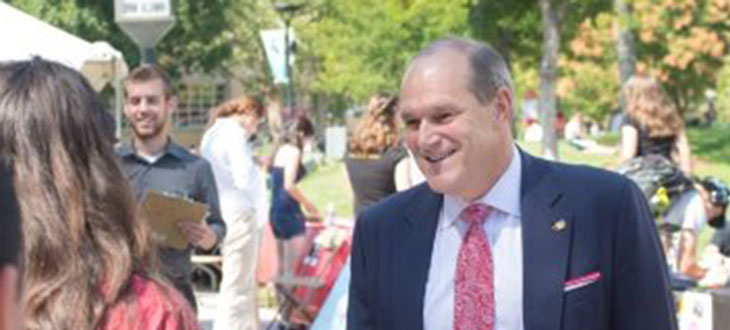
As president of UNM, he is often the public face of the institution. “The most interesting part of being president is there is no typical work week,” he says. “There is enormous variety in the issues I address and the people I meet. As president, I am involved in every issue in the university, from the design of buildings, unhappy faculty, changes in curriculum, raising money for great causes, meeting legislators, working with business leaders, meeting university neighbors, talking to students … and the list goes on.”

Applying Psychological Science to University Administration

“My training as a clinical psychologist forms a lens through which I analyze and consider every issue, problem and person I encounter, even though it has been a long time since I have seen patients,” Frank says. “My program trained scientist-practitioners, a model that still guides my approach to management and leadership.”

Because of his background, Frank insists on seeing data before making decisions about university business.

“For example, we have revised our budget to assure more data is available to everyone in the organization, making behavioral expectations clearer in our huge organization,” he says. “While you can take me out of the clinical situation, it seems I am always using the science of psychology.”

Clinical Psychology

Psychologists who provide clinical or counseling services assess and treat mental, emotional and behavioral disorders. They use the science of psychology to treat complex human problems and promote change. They also promote resilience and help people discover their strengths.

Date created: 2014
The content I just read: