What can a teacher do to maximize the positive effect of practice?
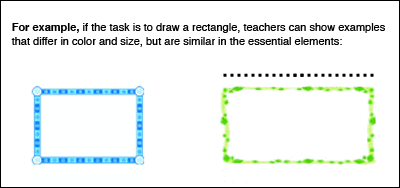
When teachers assign students to complete practice problems that are structurally similar but different in surface features, it helps them discriminate between relevant and irrelevant information in a given problem. This outcome makes it more likely that students will be able to transfer knowledge gained from practice to new and more complex problems (Paas, 1992). As with all scaffolds, they should be diminished gradually as learners become increasingly more independent.
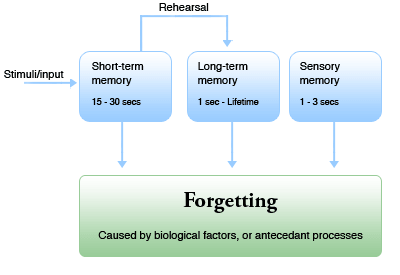
Students' problem-solving skills also increase when teachers distribute practice over time rather than "cramming" practice into short periods (Bahrick & Hall, 2005). Assignments involving practice are more effective when they are shorter, more frequent and distributed over longer periods of time (Cooper, 2007; Cooper, Robinson, & Patall, 2006; Epstein & Van Voorhis, 2010). This distributive effect is particularly important because it also makes it more likely that students will recall information over longer periods of time. Therefore, distributed practice helps students transfer information into their long-term memory.
Teachers should also have students begin homework during class. By doing so, teachers can monitor students to ensure they understand and can solve practice problems correctly before they practice independently. If teachers are unable to monitor this initial practice, they should explain to their students where they can obtain the information (textbooks, web sites, handouts, etc.) they need to complete the assigned practice problems correctly.
Reviews and tests are a form of practice that can improve learning. Tests provide opportunities for practice that enhance learning. Open-ended test questions also provide practice in retrieving information. Both reviews and tests are most effective when they are well spaced and frequent (Dempster, 1991).
Teachers can train students to reflect on their thinking when solving problems by providing them with lists of questions. This kind of "strategy instruction" helps students to construct schemas more efficiently by facilitating a metacognitive awareness of the problem-solving process. That is, students learn more about how they learn and this helps them with new learning.
Teachers can increase students' abilities to transfer existing problem-solving knowledge to new problems when they prompt students to deliberately reflect on problem-solving strategies they have used before. (Renkl, Stark, Gruber, & Mandl, 1998; Rosenshine & Meister, 1992; Stark, Mandl, Gruber, & Renkl., 2002).
Is homework always effective practice?
There is no question that homework can provide students with opportunities for practice but there are more and less effective homework assignments. Research on homework (Cooper, 2001, 2006; Epstein & Van Voorhis, 2010) suggests that the relationship between time spent on homework and students' academic achievement varies with grade level. When parental involvement is well structured it can also enhance the effectiveness of homework on learning (Epstein & Van Voorhis, 2010; Marzano & Pickering, 2007).
How much time should be spent on homework?
Although high school students appear to benefit from at least two hours of homework per night, there is little or no relationship between time spent on homework and academic achievement for young (grades 1-3) students (Marzano, & Pickering, 2007). Younger students may benefit more from supervised in-school practice than from homework. Middle school students may benefit from one to two hours of homework per night (Cooper, 2007).
Will practice activities negatively affect students' motivation? Aren't practice activities the same as "drill and kill" instruction?
Although deliberate practice is often confused with rote learning, researchers emphasize that there is a difference between mere repetition and deliberate practice. For practice to be effective, appropriate instruction, guided practice, as well as descriptive and timely feedback must all be present.
Does practice with "authentic" problems increase learning?
Due to their relevance, "authentic" problems or "real-life" problems may motivate students. However, the positive effect of practice is only realized when teachers provide instructional supports that address the limitations of students' working memories (Anderson, Reder, & Simon, 1996, 2000; Sweller, van Merrienboer, & Paas, 1998; van Merrienboer, Kirschner, & Kester, 2003). If there is cognitive overload and the working memory is taxed beyond its capacity, students will lose motivation even if a problem is highly relevant to them.
Although "authentic" practice problems sound like they would motivate students with their real-world context; they may also include too many variables at the same time. Students' working memories are thus required to manage too many bits of information, and many of these bits may not be directly involved with the construction of the desired schema (Sweller & Chandler, 1994).
Is there such a thing as too much practice?
Merely repeating a task will not automatically improve performance. Deliberate practice is most effective when it involves intense concentration, rehearsal and reflection. For that reason, students are more likely to benefit from frequent, short practice sessions than from long "cramming" sessions. Teachers can foster this meta-cognitive learning process by providing students with frequent opportunities to discuss their problem-solving strategies (National Research Council, 2005).
Even in early grades when students are acquiring foundational knowledge, practice should not be confused with rote learning. For example, phonics instruction is most effective when it is practiced alongside more complex skills like identifying main ideas in stories (National Institute of Child Health and Human Development, 2000).
Does practice work for all academic subjects?
Practice is correlated with student achievement across all developmental levels and across all subjects. NICHD's (2000) analysis of strategies for reading instruction suggests that several kinds of practice activities are beneficial to students. Phonemic awareness practice, phonics practice and read-aloud practice all showed significant positive effects on student achievement in the early grades. Teachers should always keep long-term goals in mind when they are designing practice activities. The ultimate purpose of phonics instruction is not for students to identify phonemes, but rather, to improve their reading comprehension. The goal of practice is to transfer acquired skills to new and more complex problems. Therefore, practice activities should always be designed with that transfer process in mind.
Studies in mathematics education show that practice is effective when teachers design appropriate practice problems, distribute them over time, and provide students with sufficient feedback. Practice is ineffective when it is not appropriately designed, not well distributed, and when adequate feedback is not provided.
Deliberate practice is also effective in learning complex skills from musical fluency to athletic expertise.