


School violence is a global epidemic that affects educators and school personnel in pre-K through 12th grade. The APA Task Force on Violence Against Educators and School Personnel conducted three national surveys to assess teacher, school administrator, school psychologist, school social worker, counselor, and staff perspectives and experiences of school violence from 2019 to 2023. Over 35,000 people from all 50 states and Puerto Rico participated in these surveys.
Key findings
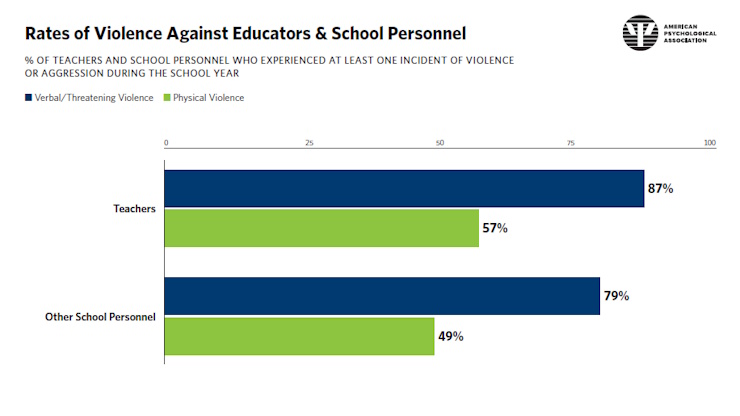
National survey data reveal high rates of verbal/threatening (e.g., verbal attacks, verbal threats, sexual harassment, intimidation, public humiliation, bullying) and physical violence (e.g., objects thrown, objects used as weapons, physical attacks) against educators and school personnel from students, parents, colleagues, and administrators. Rates were initially high, lowered during the pandemic, and surged back to pre-pandemic or higher levels once in-person teaching resumed. Teachers experienced the greatest increase in violence after the pandemic, compared to other roles, and the highest rates of violence from students; whereas, administrators reported the highest rates of violence from parents.
Verbal/threatening and physical violence and aggression directed against educators are contributing to high workplace stress and turnover. Workplace stress and anxiety also contribute to educators’ intentions to transfer or quit (McMahon et al., 2024).
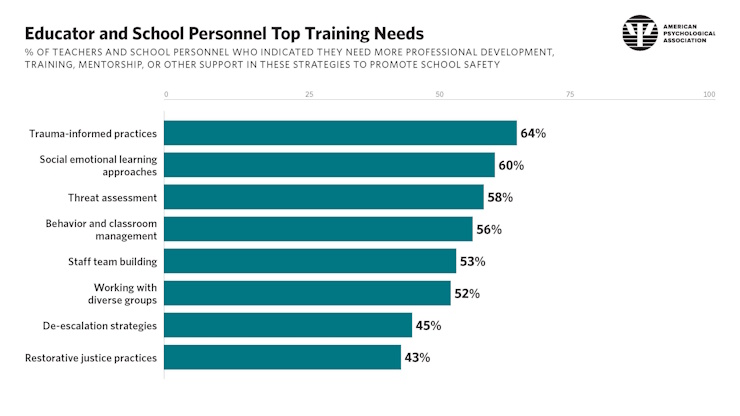
Educators and school personnel report a strong need for training in trauma-informed practices, social and emotional learning, threat assessment, classroom management, and team building. These skills are essential to preventing violence, supporting staff well-being, and fostering positive school climates.
Addressing violence and aggression requires school-based and systemic solutions—comprehensive pre-service and in-service training, support for educator and student mental health, ongoing assessment, community engagement, and effective practices and policies. The graphs below highlight both the growing rates of violence and the top training needs identified by educators as critical next steps.
Violence and aggression against educators negatively impact the quality of our schools and the next generation of learners, educators, and school leaders in the nation.
We need research-based solutions

Support school personnel and student mental health
- Support educator and student mental health and well-being.
- Support the social-emotional needs of educators through preparation curricula.
- Provide support for self-care, coping with stress, and mentoring.

Enhance school organizational functioning
- Include educator voice in decision-making.
- Increase resources to build school capacity.
- Provide evidence-based programming.
- Enhance teacher and parent collaboration.
- Assess and improve discipline, placement, staffing, and school climate.

Conduct assessment
- Assess student, teacher, parent, and school personnel perspectives annually.
- Conduct anonymous reporting.
- Assess educator experiences with violence and training needs.
- Assess evidence-based prevention and intervention programs designed to address violence against all school stakeholders.

Improve educator and leadership training
- Provide additional training in working with diverse groups, social emotional learning approaches, de-escalation strategies, trauma-informed practices, restorative justice practices, threat assessment, and classroom management.
- Provide effective preservice and in-service training.
- Connect with higher education institutions and community organizations to enhance training.
- Engage in staff team building and mentoring new educators.
What you can do
- Practical recommendations (PDF, 1MB)opens in new window
Explore evidence-based strategies to reduce violence against educators and create safer, more supportive school environments.
- Get involvedopens in new window
Have your voices heard with your members of Congress on ways to improve conditions for educators and school personnel. Sign up for APA Services’ Washington Update and the action network to stay up-to-date on how you can get involved.
- National Center for School Safety (NCSS)opens in new window
Explore the self-paced trainings, webinars, and workshops available through NCSS, an organization focused on improving school safety and preventing school violence.

Practice and policy recommendations
School administrators and educators play critical roles in creating safe learning environments, yet research shows that violence against school personnel is widespread and underexamined.
Two APA policy briefs provide key insights and actionable guidance.


In the news
Research publications
Current task force publications
Previous task force publications
Contributors
APA Task Force on Violence Against Educators and School Personnel:
- Susan D. McMahonopens in new window (chair, DePaul University)
- Eric M. Andermanopens in new window (The Ohio State University)
- Ron Avi Astoropens in new window (UCLA Luskin)
- Dorothy L. Espelageopens in new window (University of North Carolina, Chapel Hill)
- Andrew Martinezopens in new window (Center for Justice Innovation, NYC)
- Linda A. Reddyopens in new window (Rutgers University)
- Frank C. Worrell, PhD (University of California, Berkeley)
In collaboration with APA: Rena Subotnik, Maha Khalid, Kenneth Polishchuk; DePaul University: Kailyn Bare, Safa Asad, Yesenia Garcia, Kayleigh Zinter, Cori Cafaro, Marlo Knapp-Fadani, Catharine Ryan; Rutgers University: Christopher M. Dudek; The Ohio State University: Andrew H. Perry, Seung Yon Ha; UCLA: Hector Palencia, Gordon Capp, Laura Liévano-Karim, Natalie Fensterstock, Chaoyue Wu, Kate Watson, Sawyer Hogenkamp; University of North at Carolina Chapel Hill: Alberto Valido Delgado, Luz Elizabeth Robinson, Anne Drescher, Ashley Brianna Woolweaver.
With support from APA, (DePaul University): Kailyn Bare, Safa Asad, Yesenia Garcia, Kayleigh Zinter, Cori Cafaro, Marlo Knapp-Fadani, Catharine Ryan; (Rutgers University): Christopher M. Dudek; (The Ohio State University): Andrew H. Perry, Seung Yon Ha; (UCLA): Hector Palencia, Gordon Capp, Laura Liévano-Karim, Natalie Fensterstock, Chaoyue Wu, Kate Watson, Sawyer Hogenkamp; (University of North at Carolina Chapel Hill): Alberto Valido Delgado, Luz Elizabeth Robinson, Anne Drescher, Ashley Brianna Woolweaver.
Participant recruitment in collaboration with the National Association of School Psychologists (NASP), the National Education Association (NEA), the American Federation of Teachers (AFT), the National Association of Social Workers (NASW), the School Social Work Association of America (SSWA), and MCH Strategic Data.
For more information, contact Nicole Barnes, PhD, senior director, child and adolescent learning and well-being.