


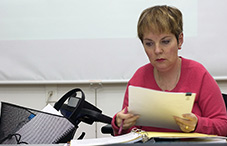
Morton Ann Gernsbacher, PhD, a psychology professor at the University of Wisconsin-Madison, suspected that students with disabilities were widely misunderstood on university campuses. To test that hypothesis, in 2013 she surveyed students, instructors and staff at the University of Wisconsin-Madison, as well as collecting data from other Big 10 schools.
Her results — presented at APA's convention last summer — point to surprising discrepancies among people's perceptions of disability and the reality. Everyone — students with or without disabilities, administrators and faculty — tended to underestimate the number of students with psychological disabilities.
Perhaps more surprising is that study participants also overestimated the number of students with mobility impairments. But on college campuses these days, "the greatest majority of students with disabilities have psychological disabilities," emphasizes Gernsbacher. Although the study didn't distinguish among particular psychological disabilities, she says this category includes depression, anxiety, eating disorders, phobias and the like.
These invisible disorders can cause silent struggles. Rhoda Olkin, PhD, a clinical psychology professor at the California School of Professional Psychology, notes that students with psychological disabilities may be reluctant to identify their disabilities and therefore miss out on accommodations that would help them, such as more time for tests or flexibility in meeting deadlines.
The stigma that keeps students with psychological disabilities silent can also prevent others from seeing the need for such accommodations. For example, Gernsbacher's study found that because people are less aware of the struggles that students with psychological disabilities face, most participants agreed that it's fair for deaf students to have sign-language interpreters and blind students to have course materials in Braille. But respondents didn't see it as fair for students with psychological challenges or chronic health disorders to have flexible deadlines or extended test time.
Meanwhile, although all students may want flexible deadlines or extended time for a test, certain students need them. Gernsbacher likens these accommodations to elevators. Everyone might prefer to ride an elevator rather than taking the stairs, "but if you don't have an elevator and you have someone with a mobility impairment, they're really screwed," Gernsbacher explains. "The people who really need them need them."
Flexibility is an accommodation that greatly benefits students with psychological disabilities, such as depression, anxiety or chronic health issues. It's important for these students to be able to work ahead, to anticipate there may be days when coming to class is impossible, and to have a bit more leeway, just in case.
The biggest barriers
Unfortunately, asking for such accommodations can pit students against mentors. Based on her research, Utah State University doctoral student Emily Lund, MEd, who has a physical disability, says faculty and supervisor attitudes are one of the most common barriers for students with all types of disabilities. Although also indicative of a larger social issue, Lund thinks faculty and supervisors sometimes have "difficulty viewing trainees with disabilities as colleagues and future colleagues instead of clients." Olkin agrees. Surveys of students she's done have consistently identified supervisors as one of the biggest struggles.
Olkin says sometimes the responsibility supervisors feel toward their client may cloud their judgment about a trainee. She recalls one supervisor who would force a trainee to reveal her blindness to potential clients so they could decide whether or not to work with her.
"That was so wrong — ethically, morally, strategically, clinically," says Olkin. Instead, says Lund and others, faculty and supervisors should have open conversations with their students and ask about accommodations that have worked well in the past.
Another major barrier appears when trainees must administer tests, such as those that require the trainee to have visual acuity, for example, to administer and analyze. But because clinical assessment is standardized, when students require accommodations to conduct one, its validity can be challenged. But Olkin thinks administering tests may be unnecessary as long as the process and resulting report are understood. "If we take away the idea that everybody has to do everything everyone else does, and we really ask what are the essential functions [of training], then we come up with different answers for students with various disabilities," she says.
Checking our attitudes
The bottom line, say students and researchers, is that all students, administrators and faculty should explore their own biases about people with disabilities.
"Even psychologists and rehab professionals are not immune to biases and prejudice about disability," says Carrie Pilarski, PhD, a psychologist at the Origami Brain Injury Rehabilitation Center and chair of APA's Committee on Disability Issues in Psychology (CDIP).
She suggests questioning reactions and treating disabilities with the same respect as other types of diversity. If it were a difference of race or gender, would a catastrophizing attitude be appropriate? On the other hand, would an overly positive or sensationalizing attitude be appropriate? Both extremes are demeaning.
Despite a push for diversity in other areas, "disability is often treated as a problem or burden rather than an important dimension of diversity," says Lund. During her graduate school application process, she remembers many programs stressing the importance of diversity in race, ethnicity and sexual orientation, but not including disability in the discussion.
Phillip Keck, a counseling psychology doctoral student at Ball State University and the APAGS liaison to CDIP, cites stats from the U.S. Census Bureau that list people with disabilities as the nation's largest minority group. But Keck was surprised when he first attended APA's biennial National Multicultural Conference and Summit. Although the summit's host divisions represent women, culture, ethnicity, race, LGBT issues and counseling psychology, Div. 22 (Rehabilitation), while typically a high-level sponsor, is not a host division.
After talking to his colleagues, Keck learned, "It's been an ongoing battle for 20 years or more to figure out how to break the mold in terms of the diversity discussion and disability," though he says that with persistent advocacy, psychology can move in the right direction toward inclusion of disability as diversity.
One way to promote advocacy is to celebrate 2015 as the 25th anniversary of the Americans with Disabilities Act, a law banning discrimination based on disability. APA and CDIP will be recognizing the act by "bringing awareness to disability rights as civil rights," wrote Pilarski in an email.
Olkin notes that recognizing disability can help everyone by making it more ordinary and self-identifying less scary. It should be talked about at orientation, in meetings and with colleagues. She also calls for more role models and emphasizes that students without disabilities can be one of the greatest sources of support for their peers with disabilities.
Places to turn
For students with disabilities, the first step is to go to the disabilities office on campus. Staff there can help identify potential accommodations and help students practice the best ways to ask for them. Gernsbacher remembers that, in her first faculty position, she was one of the first few women hired in the department. Years earlier, when women had not been on the faculty, there were no female bathrooms, so they had to request one. Gernsbacher tells this story to remind students that asking for any accommodation for any type of disability is just as valid.
The good news, according to Gernsbacher's study, is that once requested, most accommodations are granted. So, students who want such services should start making requests before the semester begins: order textbooks, sign up for early enrollment, and ask for syllabi prior to the first day of class.
Olkin also encourages students with disabilities to reach out to others. Feeling alone can be discouraging and dampen motivation to ask for needed accommodations.
"So find someone," says Olkin.
APA has a mentoring program that matches trainees with disabilities with psychologists with disabilities (see "Resources" box). Finding sympathetic faculty members, reaching out to other students with disabilities (even if they are in different programs), or interacting with similar students via social media can also help.
"There are lots of us out there," Olkin says.
To get involved in the celebration of the 25th anniversary of the Americans with Disabilities Act, contact Philip Keck or Carrie Pilarski.