


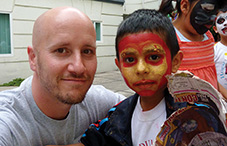
Born and raised in a small middle-class white community in Utah, it might seem unlikely that Jason Platt, PhD, would develop a passion for providing bilingual mental health services. But when Platt was 8 years old, his parents added to their family by adopting seven children from all over the globe, a decision that would alter the course of Platt's life. His siblings — who were from Brazil, Colombia, El Salvador, Mexico and South Korea — had started their lives amid civil unrest and violence, and more than one had seen family members killed.
"They had significant mental health needs when they came to the United States," Platt says. "We sought out mental health professionals, but none of the therapists knew anything about their native languages, let alone the national contexts from which these children came."
One of his brothers continued to struggle with violence throughout his life, and to this day has not fully shared with counselors or family members what he witnessed as a child in El Salvador. Now he is in prison facing the death penalty.
The struggles Platt's family members faced ignited his desire to train more culturally competent, bilingual psychologists. He learned Spanish, earned his doctorate from Syracuse University in New York in 2003, and then moved to Mexico City to connect with local Spanish instructors. Later the same year, he established the International Counseling Psychology program at Alliant International University in Mexico City, which offers a summer Spanish language and cultural training experience as well as a more in-depth two-year curriculum.
"For me, creating a program that trains bilingual mental health workers has been an act of social justice," Platt says. "The program tends to draw the kind of people who care about humanity and want to help underserved and often marginalized populations, and I deeply enjoy relating to these students on a daily basis."
Platt is one of a small cadre of Spanish-speaking psychologists who are pioneering programs to train mental health practitioners to meet the rapidly increasing demand for their services in the United States. According to the U.S. Census Bureau, the Hispanic population in this country as of July, 2013 was 54 million, or 17 percent of the nation's population. The Unites States has the second highest Hispanic and Latino population in the world second only to Mexico. By 2050, Hispanics and Latinos will make up 28 percent of the nation's population.
Unfortunately, too few U.S. psychologists have the training to provide mental health services to this population. "The APA's ethical principles mandate that psychologists provide assessment and therapy in the client's native language, but there are few programs that provide the training to be able to do that," says Brieanne Kohrt, PhD, founder of a Spanish psychology immersion program in Peru, called PASEO, that trains American psychologists. "There are a lot of people who study Spanish, but that does not mean you know the culture or the psychological terminology. These are critical aspects of providing quality bilingual mental health care."
A case for change
Numerous studies have documented the negative impact of having too few bilingual mental health professionals. Studies have shown, for example, that when patients are assessed in their second languages, they are more likely to be diagnosed with severe mental illness.
"If someone is speaking in their second language, they may sound more disorganized," Kohrt says. "This might make it look like a patient's symptoms are more severe than they really are."
Other research suggests that bilingual patients have improved autobiographical memory retrieval when therapists can speak their native language (Memory, 2014). "If someone grows up in the United States in a family that speaks Spanish at home, and suddenly a family member is deported, that memory will most likely be encoded in Spanish," Kohrt says. "If someone in the family were to come to therapy as a result of this trauma, one critical form of treatment is recounting the narrative. If a patient cannot do this in Spanish, it is difficult to make progress."
In addition to knowing a patient's native language, bilingual psychologists also need to understand a patient's cultural context, Platt says. "It gives us a framework to make sense of the problem. Without this background, behaviors may be pathologized."
To address this issue, classes in Platt's Mexico City program cover topics including critical issues in Latin America and clinical theories for serving impoverished and oppressed communities. Participants who complete the five-week summer immersion experience earn a certificate in Latin American therapy. Students who opt for the two-year program earn a master's in international counseling psychology, which includes 500 hours of client contact in an onsite clinic.
Leticia Gonzalez Pileski, PsyD, LMFT, who completed the master's program in 2007, supervises interns who work with Latino clients at the Center for Community Counseling and Engagement at San Diego State University. While in Mexico City, she absorbed aspects of the Latino culture that influence her practice today.
"I saw how family members turn to each other before anyone else, so they are less likely to open up to psychologists about their private lives," Pileski says.
To build rapport with her clients, she starts therapy by talking about herself and asking general questions about how they are feeling or about family traditions.
She continues to learn about different cultures in her practice. Recently, for example, Pileski was working with a 16-year-old Latina who had been harming herself and struggling with suicidal thoughts. As part of therapy, Pileski asked the girl about her future goals. For the first time, the girl responded positively and shared her dreams about going to college and moving to New York. The girl's mother, however, grew angry because her daughter came home from the session talking about her dreams of leaving.
"I had to take a step back and apologize for failing to consider how this could impact the family," Pileski says. "I started doing a lot more family sessions and less individual work."
Ultimately, she says, this helped the girl feel supported by her parents and siblings instead of feeling different and estranged.
A new program in Peru
Kohrt's foray into bilingual mental health began in 2008 when she signed up for a summer immersion program in Guatemala. She volunteered as a psychologist at an HIV/tuberculosis clinic, and a year later, spent a summer working as a psychology coordinator for SKIP, a charity that assists children in poor areas of Peru.
Each time she returned to the United States, she was shocked by what she saw while working with Latino clients during practicum and clinical training: children who had been on waiting lists for up to two years for bilingual neuropsychological and psychoeducational testing.
"These children had often been tested in English," Kohrt says. "Some had been incorrectly placed in special education, while others were denied additional services because learning difficulties were attributed to being a second language learner."
Convinced that psychology students needed more opportunities to learn how to leverage their expertise in Spanish, Kohrt used her connections at SKIP to establish a psychology immersion program. Last year, she founded PASEO LLC, Psychology and Spanish Elective Opportunity, a program that offers a three- or six-week immersion experience in Trujillo, Peru. Mornings are dedicated to formal language training in Spanish for mental health. In the afternoons, students practice their skills by working at SKIP. This may include co-leading violence prevention groups or parent classes about behavior management strategies, or conducting diagnostic interviews or cognitive assessments.
Training in the United States
A handful of U.S. universities and schools also offer bilingual training. Among them is a program at Our Lady of the Lake University in San Antonio, Texas, where Latinos and Hispanics make up 63 percent of the city's population. The university was the first graduate psychology program in the United States to offer language and cultural training for services geared to Spanish-speaking clients, says Joan Biever, PhD, professor and associate dean of the school of professional studies.
Biever and her colleagues had an inkling that the university needed to develop the program when they noticed that graduate students fluent in conversational Spanish were nevertheless uncomfortable providing psychological services in Spanish because they had not learned the counseling terms in Spanish.
In 1997, the school launched the Psychological Services for Spanish Speaking Populations (PSSSP) certificate program. To earn the certificate, students complete language and cultural competence courses, as well as three semesters of supervised practicum in which students work with Latino clients. The program also includes a 10-day immersion experience in Mexico.
Since the program's inception, five to 10 students have earned the PSSSP certificate each year, and roughly 90 percent of these recipients have been Latino. Blanca Moreno, who graduated with the PSSSP certificate in 2012, works as an intern at a clinic for undocumented children in San Antonio and hopes eventually to open a private practice to serve Latino clients.
"I have learned that therapy is stigmatized in Central America and seen as something for crazy people," says Moreno. "When undocumented immigrant children from this area come to the clinic, they are usually very distrustful and unsure why I am being nice to them."
With her training, Moreno helps clients push through this stigma and understand the true meaning of counseling. "It's amazing to see the transformation," she says. "These children start to smile and understand that they are not being judged."
Hope for the future
While the demand for more trained bilingual psychologists may seem overwhelming, application and enrollment numbers suggest that there is increasing interest in the necessary training.
The Ecuador Professional Preparation Program (EPPP), a summer psychology immersion experience in Quito, Ecuador, received more than 100 applications last year — five times the number when the program started in 2008. To accommodate demand, the organizers increased enrollment from eight the first year to 28 last year.
"Linguistically our culture is changing. We are coming to a crossroads where we cannot ignore these populations because they are no longer the minority in certain parts of the country, and we are trying to fill the psychologist's toolkit to serve this population," says Tara Raines, PhD, one of the program's founders.
Enrollment is also increasing in the Lucero Latino Mental Health Program at the Massachusetts School of Professional Psychology in Newton. In 2014, 15 students were accepted into the program, approximately double the number from when the program started 13 years ago.
"We still have a long way to go as far as training more clinicians to serve the Latino population, but the number of training options has significantly improved in the last decade," explains Mari Carmen Bennasar, PsyD, director of the program.
Bennasar's ultimate goal is to diminish health disparities to allow everyone to receive the highest possible quality of service, regardless of race or ethnicity. Although this may seem like a lofty aspiration, Platt believes it is possible if schools begin to recognize that bilingual, multicultural training should be more than an optional elective.
"Many psychologists may not even realize that language and culture are relevant to quality of care," Platt says. "Right now it is not a requirement to participate in an immersion program, but what if it were to become a requirement and central to the mission of psychology programs throughout the United States?"
Platt has communicated this message to more than 500 students who have completed the program in Mexico City since its inception 11 years ago. His hope is that others will take a risk as he did and launch new programs to train the nation's future bilingual psychologists.