


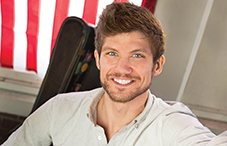
Name: Jeritt R. Tucker
Raised in: Nevada, Iowa
Attending: Iowa State University
Studying: Counseling psychology
Expected to graduate: May 2016
What my fellow students don't know about me that would surprise them: I think at this point it's probably no longer a secret, but I am in an indie-rock/electronica fusion band called Supertree. I sing and play the synthesizer and saxophone. We're by no means rockstars, but we've got a few gigs coming up soon.
Dream career: I'm interested in a clinical role in an integrated-care environment, helping clients attain whole-person health. Working in an outpatient hospital would give me direct contact with underserved groups where help-seeking stigma may be high. I would feel unfulfilled, however, without continuing to research, teach and consult.
If I could choose to have any superpower, it would be: Clairvoyance — that would take being a psychologist to a whole new level. If everyone had superpowers. we'd need persons whose sole job is organizing people into high-performing super-powered groups. Maybe that could be a new field of psychological study and specialization.
The psychologist or historical figure I like most: Viktor Frankl. I credit reading his book, "Man's Search for Meaning", with forcing me to transition from philosophy to psychology in my undergraduate major.
If I could clone myself, my other self would: Read every possible work of classic and modern fiction he could get his hands on; I think I'm missing out on the vast majority of novel ideas and theories by sticking to nonfiction.
What I learned from my latest research project: My latest research projectopens in new window involved disentangling mental illness and help-seeking stigma. With support from my professor, Dr. Nathaniel Wade, I found the two stigmas impact different components of one's self-view — as socially inadequate, blame-worthy or shameful — and that they offer unique and combined influences on the decision to seek help. Extending this finding, my colleague, Daniel Lannin, led a study in which I participated examining how mental illness and help-seeking stigma are internalized. We found strong evidence to support different pathways for the two stigmas (The Counseling Psychologistopens in new window, 2014).
What's most interesting about my research: The process of contextualizing my ideas and data in past findings; I'm very interested in how theory can be dis/confirmed or become more nuanced through each new study. For my thesis, I really enjoyed adding to a long legacy of great stigma research by people like Erving Goffman, Bruce link, Patrick Corrigan, David Vogel, Georg Schomerus, and Matthias Angermeyer. Knowing that I'm a part of something larger than myself is very rewarding.
How studying psychology has changed me: I relate to others in a more self-aware way. I tend to recognize my own resistance and defensiveness in interactions, note my own biases and worldview, and am generally able to relate to myself in a more authentic way. This helps me to bounce back from setbacks more quickly, take myself less seriously, have more fulfilling relationships and generally enjoy my life to a greater extent.
Title of my grad school autobiography: "Mundane Philosophy: The Search for Meaning Among Too Many Emails, Too Little Time, and Too Much Caffeine."
The annoying habit I wish I could change: Caffeine addiction. I have an approach-avoidance conflict with coffee. It is just so warming in so many ways during these cold Iowa winters. Yet it's a constant internal battle as I struggle with my own willpower to resist.
Greatest frustration: Statistical syntax.
What I treasure most (besides family, friends and world peace): After breaking my collarbone on it, I traded my moped for an acoustic-electric guitar in the seventh grade. I don't even play the guitar all that well, but making music with it is like escaping to a world beyond graduate school for a minute or two.