


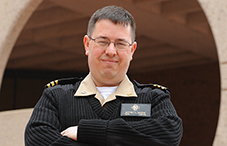
When U.S. Public Health Service (PHS) psychologist Jeffrey L. Goodie, PhD, went to New York in the days after Superstorm Sandy to counsel emergency personnel, the most common stressor he noticed among volunteers was the location. Goodie found that many were making their first trip back to the New York area since they volunteered there after 9/11.
"They were struggling a lot with not as much what they saw during Sandy, but with reminders of 9/11," recalls Goodie. "They were walking around these areas that had just been destroyed [by the storm] and all of these memories were coming back."
Helping them manage their stress and anxiety was Goodie's assignment that week as a member of the PHS's Commissioned Corps, the branch of the uniformed services that deploys experts in behavioral health, medicine, engineering and other areas as part of the federal public health response to disasters and other public health emergencies.
Since joining the Commissioned Corps five years ago, Goodie has provided support following the Boston Marathon bombings and the Sandy Hook Elementary School shootings. His responsibilities vary according to the crisis: He might counsel local behavioral health providers or work with local leaders and health providers to identify the mental health and other resources the community needs.
"Our role is not to take over care, but to provide support so the community can start to rebuild as quickly as possible," he says.
In the field
Goodie's most draining deployment was the two weeks he spent in Newtown, Connecticut, after the Sandy Hook shooting, assisting the local behavioral health experts and PHS Corps members who provided direct care to grieving parents, school staff and families.
During such assignments, being accessible is important. "You don't create a space where people need to come find you, you go to the places where they are and make yourself available," he says. "These folks are hearing horrific stories that are unlike stories they are hearing in their day jobs."
Another tough deployment took him to a Native American community that had experienced multiple youth suicides. After asking local leaders what kind of help they needed, Goodie and other members of his team developed a pocket card to help community members identify the signs of suicide. The guide was translated into the community's native language and distributed among case management staff, law enforcement and other public service agencies. He also presented talks about self-care and stress management to local schools, health providers and law enforcement.
His path to service
Before the PHS, Goodie served as an Air Force psychologist for nine years; he began his first official Air Force assignment on Sept. 10, 2001. "The following day, the world changed," says Goodie. The Air Force sent him to the Middle East for four months in 2003 at the start of Operation Iraqi Freedom. With small children at home, Goodie sought a job that would offer more work-family balance while continuing to serve the nation. That led him to PHS, which tends to keep officers in one location longer and sends officers on shorter assignments of one week, two weeks or one month.
Between deployments: Goodie's day job is serving as the director of clinical training in the medical and clinical psychology department at the Uniformed Services University of the Health Sciences in Bethesda, Maryland, where his supervisors know he could be called up any time. While corps members on mental health teams are most likely to serve during their on-call months — one out of every five — emergencies often require a bigger response, and none of Goodie's deployments have happened when he was on call. During quiet on-call stints, corps members stay busy by checking in by phone with peers returning from a deployment.
Goodie also works on prevention projects
His corps team went to rural Kentucky and assisted a community struggling with childhood obesity. The group offered talks on childhood obesity prevention at local schools, provided support on school-based interventions promoting physical activity and helped area schools analyze data they had been collecting on the effectiveness of their interventions.
Giving back to such needy communities and offering a fresh perspective on their biggest health challenges is rewarding work, says Goodie. "There is always a deep feeling that you are contributing to something much bigger than yourself," he says.