



Prepare for takeoff
A longtime struggle with general anxiety had made Claire* afraid to fly for most of her life. Her phobia made travel tedious and time-consuming because she and her husband had to take trains from their home in Marseille, France, to visit his family in Greece and Turkey. Frustrated, Claire resolved to conquer her fears by signing up last spring for the Air France Fear of Flying program run by psychologist Philippe Goeury, PhD.
Soon after she completed the two-day program, Claire flew from Marseille to Istanbul anxiety-free.
"She called her 102-year-old mother back in Marseille once she got there, who asked her how many days it would take her to get back to France," says Goeury. "She was proud to answer, ‘I will be back in only four hours.'"
Goeury has helped more than 5,500 people conquer similar flying fears since he joined the Fear of Flying program in 2007. A cognitive psychologist with expertise in human factors, Goeury is also a certified flight attendant with Air France who sees the toll fear of flight can take on passengers and crew. While some people's anxieties manifest as in-flight panic attacks, others' fears manifest as anger toward flight attendants about a lack of leg room or an irritating seatmate. "We often call it ‘air rage,' but when you scratch at it a little bit, you often find the person actually has a fear of flying problem," says Goeury.
Behind the curtain: Many of the people Goeury helps are referred to his program by Air France flight crew members who have learned from Goeury how to spot signs of flight anxiety and assist anxious passengers. Participants meet first with Goeury at Air France headquarters in Paris to talk about their fears and complete questionnaires about their mental health. On a separate day, participants meet him at the pilot training center at nearby Charles De Gaulle Airport or Orly Airport to learn such stress management techniques as slow breathing, muscle relaxation and imagery, and to learn more about what could be triggering their fear. Participants also hear from cabin crew and pilots about what goes on behind the scenes during a flight, and what causes such problems as turbulence — people's No. 1 fear, according to a survey Goeury conducted in 2012.
Test flight
Next comes the real test — each participant takes an hour-and-45-minute ride in an Air France cabin flight simulator, a replica of an Airbus 320 cockpit that can reproduce most flight scenarios, including lightning and an aborted landing.
"We start with a regular flight — take off, a short cruise and landing," he says. "Gradually, we introduce things like turbulence or engine failure or taking off in the fog."
Throughout the virtual flight, the pilot explains what he or she is doing and a flight attendant helps the passenger practice his or her breathing, relaxation and imagery exercises. After, Goeury debriefs participants and assesses whether they need more counseling or are ready to try to fly on their own. He also gives each graduate documents he or she can use on all future flights to alert flight crew of his or her history of flight anxiety.
A brief layover
Goeury started working as a flight attendant for Air France right after graduate school because, at that time, "all the jobs for human factors psychologists were about making computers more like humans," he says, while he wanted to work with people. He worked his way up to the chief purser position — the cabin crew leader who communicates with the pilot — before Air France asked him to dust off his psychology training and take over the Fear of Flight program when the former director had to step down due to family illness. He still works three international flights each year to maintain his qualifications and skills.
Those flights also inform his day job: Air France often asks him to design and lead professional development workshops for Air France crew on such topics as improving communication among flight crews. His dual skills also came in handy in June 2009 when a plane headed to Paris from Rio de Janeiro crashed in the Atlantic Ocean, killing 228 passengers and crew members. Air France tapped Goeury to join the crisis team, and he offered support to the family of the crew members who died.
Now he's involved in a project that could put air travel on a whole new trajectory. Goeury is consulting for an airline manufacturer that aims to enhance people's "psychological comfort," on airplanes. "They are trying to [envision] the plane of the future," he says.
*Name withheld on request.
Keeping the airways safe
Most people who show up for work on any given day do not worry about jeopardizing the lives of hundreds with a single mistake. Airplane pilots, however, shoulder that level of responsibility each time they enter the cockpit.
No one understands the magnitude of a pilot's job more than Diane Damos, PhD, a psychologist in Gurnee, Illinois, who specializes in pilot selection. Twenty years ago, this aviation expert formed her own company, Damos Aviation Services, to consult with flight schools and air carriers saddled with the important task of determining who is fit for a job in a cockpit — and perhaps more important, who is not. While there are a handful of psychologists who do similar work for the military, Damos is the only civilian in the United States who specializes in pilot selection, she says.
The need for such effective screening tools came to the fore in March when the co-pilot of a Germanwings flight deliberately crashed the plane into the French Alps, killing all 144 passengers and six crew members. As it became clear that the co-pilot, Andreas Lubitz, had kept information from his employer about previous treatment for suicidal tendencies, news organizations sought out Damos for interviews.
Lufthansa, which owns Germanwings, "has one of the best selection systems in the world," Damos says. "They have clinical psychologists who interview their pilots, in addition to the aptitude tests, and this man got through that process."
A new direction
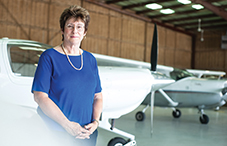 Damos discovered psychology as a junior at the University of Illinois. She had been majoring in physics in the late 1960s, but realized it would be difficult to find work after graduation due to a glut of engineers and physicists at the time. During one of her courses, a classmate mentioned he was working in the university's aviation research lab. He offered to take her to the lab for a tour.
"The lab was way ahead of its time because it was interdisciplinary with a team of engineers and psychologists who were working together," she says. "They were researching displays for aircraft, new methods for training pilots and pilot selection."
She switched her major to experimental psychology and accepted a job as a researcher at the aviation lab, where she studied pilot selection methods. When she finished her undergraduate training, Damos transitioned to a graduate program in aviation psychology at the University of Illinois. As part of her training, she learned the cognitive science of human abilities, skills and training processes — and how to fly.
Finding a niche
Damos's career in pilot selection started with a faculty position at the State University of New York at Buffalo, where she taught courses in human factors, organizational management and aviation psychology. Later, she moved on to Arizona State University and taught similar courses, and then joined the Institute of Safety and Systems Management at the University of Southern California, where she taught courses and conducted research related to time sharing. When the university closed the institute in 1995, Damos decided to start a business focused on pilot selection — one of only a few of its kind at the time in the United States.
She knew there was a demand for better tests to assess abilities such as time sharing and perceptual speed, so she developed new tools. Time sharing — also known as multitasking — is the ability to shift back and forth efficiently between two or more activities or sources of information, and this information can be in the form of speech, signals, sounds and touch. To assess perceptual speed, Damos developed tests to measure the ability to quickly and accurately compare letters, numbers, objects, pictures or patterns.
Damos has created computer-based pilot selection tests for both the U.S. Navy and Air Force. She also started working with domestic and foreign air carriers and training schools to help these organizations select whom to train as a pilot and which pilots had enough experience to fly larger passenger planes.
She also works as an expert witness for both plaintiffs and defense attorneys on litigation related to issues such as commercial pilot lifetime earnings, hiring and performance.
Winds of change
Today, the demand for pilot selection tests is at an all-time low in the United States because fewer people are interested in becoming pilots. "Young people in this country are not interested in aviation as a career like they used to be," she says. "It's lost its glamour …. It is also very expensive to learn how to fly."
With fewer applicants, airlines are less inclined to use pilot selection tools that would weed out potential new hires, Damos says. As a result, her business has shifted to Canada, Asia and Africa, where there are more pilot applicants. There, salaries can be higher or flight school fees are covered by the government.
Although the Germanwings tragedy may call into question the effectiveness of pilot selection processes, the reality is that flying is still one of the safest modes of transportation. Last year, the Aviation Safety Network recorded only 105 fatalities nationally in three accidents, which includes data from corporate jet and military transport accidents. Incidents like the Germanwings crash are still extremely rare, and Damos hopes to help keep things that way.