


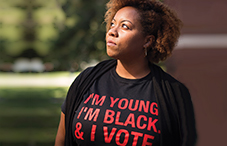
Della Mosley, a counseling psychology doctoral candidate at University of Kentucky in Lexington, has always had a strong sense of social justice. But last year, after the shooting death of Michael Brown in Ferguson, Missouri, "I finally decided to call myself an activist and speak out."
"I started a support group for students struggling to process issues of racial injustice and to give students a place to share feelings, express pain and brainstorm actions," she says.
Merging her psychology training and social justice advocacy, Della continued to seek opportunities to engage in scholar-activism. After hosting a workshop on student-led resistance during APA's 2015 Annual Convention in Toronto last summer, she created the Student Led Activism: Mobilizing for Justice Post #Fergusonopens in new window website to "facilitate discussions about how to intervene against racism and advocate for Black lives," she says.
"People often get stuck because the problem is so big and systemic, but I think the site helps people feel hopeful and gives them a starting place to get their minds going about how they can personally be involved," Mosley says.
Mosley is just one of many students who are becoming actively involved in national campaigns, such as Black Lives Matteropens in new window, local movements, and efforts to address racism on their university campuses.
"The greatest benefit of committing to #BlackLivesMatter activism is the feeling of empowerment it provides," says Mosley. "These groups give students a sense of power and encourage conversations that increase a sense of community and purpose," she says.
Conversations are a crucial step in the process toward direct action. "The more we make these issues a part of the dialogue, the more we see it as normal," says Jeritt Tucker, a predoctoral intern at Cambridge Health Alliance and chair of the APAGS Advocacy Coordinating Team (ACT). "There is an importance in personal advocacy. Students talking within their own circles make a measureable impact," he says.
Several APAGS members have come together independently to create a space for students to discuss issues that affect them personally and as future psychologists. One way they've come together is through town hall discussions organized via Grad Students Talkopens in new window, a website that enables students to "process their thoughts and hear the views and opinions of other students," says Grad Students Talk member Ashley Oliver, a counseling psychology doctoral candidate at Cleveland State University.
"Students who participate in the calls may not be provided with the opportunity to engage in dialog with their own faculty or departments. The calls provide opportunities for students from different geographic areas to come together for a unified purpose."
In addition to talking about general racial inequality, some students have started to examine discriminatory treatment on their own campuses. Among them are students at Boston College, who noticed inconsistencies in their institution's racial policies and practices and decided to research institutional racism on their campus. "It evolved into a movement," says Sriya Bhattacharyya, a counseling psychology doctoral candidate at the college.
At first, her efforts met with resistance when she, along with two other PhD students, attempted to hang posters that provided data about racism on their campus. "We ran into red tape from the university," says Bhattacharyya. "But, we hung up the infographics despite the resistance and got a lot of attention and positive feedback, especially from faculty and alumni."
Their campaign, Eradicate #BostonCollegeRacismopens in new window has gained attention and local publicity, most notably when outside funders paid airplane pilots to fly over a commencement ceremony displaying an Eradicate #BostonCollegeRacism banner.
Get involved
You don't have a start your own campus campaign to make a difference, Mosely and others say. "There are a variety of ways people can contribute to a cause," says Bhattacharyya. "People have different comfort levels — some want to be out in front while others would rather work behind the scenes."
For example, students can work behind the scenes to create social media and campaign graphics, research issues on their campuses, and build support within and across campuses, she says.
Mosley advises students to do Web searches to find people involved in aspects of movements that align well with their own interest.
Tucker recommends exploring APA's list of advocacy topics and training tools. "This site has information about what is being done and what resources are available," he says. "It's important to start with your passion, the thing that hits home for you."
For those who do want to start a social justice campaign, it helps to have a specific incident to focus on, says Bhattacharyya. "It's hard to appeal to general racism. A clear example gives people something to organize around," she says. An incident could be a student experiencing racial profiling or a faculty member who gets fired.
A movement should also have clear and measurable goals along with strategies to reach them. "Goals give you a way to know you're successful," says Mosley. "They help you stay motivated and help guide the people you're working with."
Also, it's important to be creative with your message, particularly when encountering resistance, Bhattacharyya says. University administrators might resist efforts that shed a negative light on their practices. "We reframed our message to emphasize that Boston College could be a leader in examining institutional racism, which happens on every campus."
"As an academic community, we welcome discussion on any issue of importance," says Boston College spokesperson, Jack Dunn. "Our expectation is that those discussions will be civil and respectful."
Initially, the Eradicate #BostonCollegeRacism group did not meet this expectation, according to Dunn. But, after feedback from faculty, the discussion became more productive. "Advocacy is important and mutual respect is paramount to successful dialog in any academic setting," says Dunn.
The right mentors can help students shape their message. "Advocacy is hard to do on your own," says Tucker. "Sometimes mentors are not in your own programs. It depends on faculty interests and time commitments."
He recommends tapping APAGS resources or reaching out to advocacy coordinators in state psychology associations.
"Alumni are also particularly helpful," says Bhattacharyya. "You also want to reach out to existing organizations to leverage work that has been done and build a coalition."
Relationships within a movement are also critical, she points out. "Without relationships within the group, people burn out." Group members can check in with each other to talk about issues, share ideas and discuss individual goals, she says.
To keep morale and energy up, be sure to celebrate big and small victories, says Mosley. "Publicize activities and successes, post photos of events on social media. It's the fuel that keeps activists going."
Overall, don't give up, even when faced with the fear of upset faculty, says Danelle Stevens-Watkins, PhD, a practicing psychologist and associate professor in counseling psychology at the University of Kentucky. She became vocal about racism at her university, providing an example to her students of how to speak up for a controversial cause.
"Organizing isn't easy," says Bhattacharyya. You will get pushback and not everyone will agree with you, she says. But, she found motivation when one of her professors told her, "When you piss people off, you know you are doing something right."