


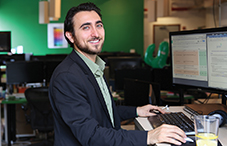
Andreas Michaelides, PhD, discovered his job at the health-care app company Noomopens in new window more or less by accident, spotting an ad on a job search site while working as a researcher at the VA Medical Center in the Bronx.
"All I saw was that it was a tech company that was looking to do something with virtual groups," says the clinical psychologist, a self-professed tech geek who started working at Noom in 2014. "That was enough to pique my interest, so I reached out to learn more."
The job was a short-term, part-time contract position intended for a college undergrad. But by the time Noom executives had finished interviewing him, "they realized there was a real need for a permanent, experienced psychologist" to ensure that Noom's app users were receiving products that effectively incorporated validated psychological theories, says Michaelides, who is now the startup company's chief of psychology.
Noom, which has about 80 employees, is headquartered in Manhattan, with small but growing offices in Korea, Japan and Germany. It was created in 2007 by Saeju Jeong, a Korean entrepreneur, and Artem Petakov, a former computer engineer at Google, who wanted to combine business, technology and health care in ways that would significantly improve people's well-being.
When Michaelides met the two executives, he knew it was a good fit.
"We overlapped in the sense that we are passionate about the same things," he says. "We are really interested in how you help people make lasting changes" with weight loss or other behavioral health plans.
Noom's core product, called Noom Coach, provides users with three levels of app-based weight-loss support. The basic version is free and allows people to track their eating and exercise routines. A "pro" version, which costs $9.99 per month, matches members with small groups of peers who have similar weight-loss goals and connects them in virtual support groups. Finally, a $39.99 per month "platinum" version gives members all of the features of the pro version plus direct access to a personal coach who helps keep them on track with regular phone calls and in-app messaging.
Noom also makes its behavior-change platform available to health-care clinics and other medical entities to help clients prevent, manage or reduce the impact of such chronic conditions as prediabetes, diabetes and high blood pressure. Payers provide Noom with groups of users who have the same condition, and similar to the "platinum" version of the weight-loss app, they are coached by phone and through app messaging with strategies specific to their condition. Users also receive a didactic component that teaches them about their condition and how to manage it, and providers get regular reports on patient progress.
"We want to help people become masters of their own condition so they can manage their chronic disease for a lifetime," Michaelides says.
In his first months at Noom, Michaelides was given two big projects. The first was determining how to make the peer-support aspect of the company's weight-loss apps more successful. At the time, people were joining the groups for short periods of time but quitting just as quickly. To improve on these dynamics, Michaelides made several changes based on research showing that people who were more engaged in the groups and who adhered more fully to the program did in fact lose more weight. A key tweak was switching from a "revolving door" model where people could come and go as they pleased, to establishing set groups where people could come to know, trust and rely on each other.
The second big project was running a randomized controlled trial to compare results from one of Noom's weight-loss apps with a manualized weight-loss program without a technology component, called LEARN (Lifestyle, Exercise, Attitudes, Relationships, Nutrition), developed by Duke University psychologist Kelly Brownell, PhD.
And though the data are still being analyzed, the trial showed that people lost more weight when they used the app compared with those who used the manual, Michaelides says.
Such skills proved his worth to the company, which as a culture is fast-paced and entrepreneurial.
"It's like nothing I had experienced before," Michaelides says. "We really do things fast — we like to say we fail fast and we learn quickly. It's very exciting."
Rapid growth
As the company has zoomed (noomed?) forward, so have Michaelides's responsibilities. He now oversees academic research, the behavior change content for Noom's chronic disease apps, and the hiring and training of employees for the coaching component of the program, which he also built from scratch.
To help train coaches, Michaelides is teaching them reinforcement techniques he gleaned from his earlier work on support groups — validating users' efforts, for example, and asking them what their next steps will be. He also spends a lot of time interviewing potential coaches to make sure they have the right combination of people skills, the ability to respond quickly and effectively if users have problems or need support, and that they fit with the Noom culture.
Michaelides and his colleagues at Noom have also conducted several pilot tests looking at whether and how coaching adds value to the apps. So far, they have found that human interactions remain critical to behavioral change — that technology can't do it all.
"A strong [coaching] relationship is really key when things get tough and the coach needs to challenge the user," he says.
In addition, Michaelides is conducting studies with researchers in several New York-area hospitals, including psychologist Tom Hildebrandt, PsyD, who heads the eating and weight disorders clinic at Mt. Sinai Hospital. With a $1 million grant from the National Institutes of Health, they are testing a modified version of an app created by Hildebrandt and another colleague, to be used with people in the Kaiser Permanente health-care system who have binge-eating disorder or bulimia.
Michaelides is excited to be part of what he perceives as the wave of the health future: patient-empowered care with a heavy assist from technology.
"Most people have smartphones, and it just makes sense that integrating their health care into that routine would be the way to go," he says. "It's health care trying to catch up with how we're evolving as a society, and I'm lucky to be at the forefront of it."