


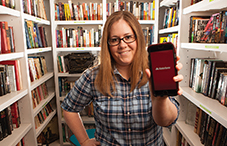
Looking back, Kelsi Lenz, MA, believes it is no small miracle that she landed a job as a user experience researcher at State Farm.
Her story starts in Drummond, Oklahoma, population 460, when Lenz was a junior in high school in the late 1990s. She was deciding between chemistry and German for one of her courses, and she picked the latter (learning a new language seemed far more compelling than memorizing more formulas). One day the German teacher mentioned that her daughter worked as a user-experience (UX) researcher at Sprint.
"When she gave examples of what her daughter did at Sprint, it seemed like a very interesting mix of psychology and computer science," Lenz says. "And when she told us the salary was $70,000 or higher, that certainly was not a downside."
The teacher introduced Lenz to her daughter — a connection that would prove invaluable. Lenz wanted to follow the same career path, and her newfound mentor encouraged her take computer classes in college and major in psychology. After Lenz graduated from Oklahoma State University in 2005, the daughter introduced her to a woman enrolled in the human factors graduate psychology program at Wichita State University in Kansas. Lenz was accepted into the program and joined the school's Software Usability Research Lab (SURL), where she worked on a project for a defense contractor that produced unmanned aerial vehicles, or drones. She was tasked with designing a touchscreen to replace the physical keyboards pilots were using to remotely control the drones.
"It was really good experience because it was like a full-time job," Lenz says. "That is where I learned how to do usability testing. I gained experience with interviewing users, and discovered the fine art of eliciting information without leading an interviewee."
Launching a career
When one of her former SURL colleagues started working at State Farm, Lenz heard that the company was hiring user experience researchers. She applied and was hired in 2011 for a position at the company's office in Bloomington, Illinois, where she started using her expertise to improve mobile applications.
"My job is to make sure the features will be things that consumers want, and when a design comes to fruition that people can understand how to use it," Lenz says.
One way she does this is through usability testing. "I love testing a new product and discovering things that you would have never thought would be a problem," she says.
When she started working on Pocket Agent — State Farm's mobile app — she discovered users were confused about how to move back and forth between screens when transferring money. They were expected to enter several pieces of information, and the original design required that they touch a "back" button after doing this task. Users were afraid that the information would be lost if they went back, and as a result the State Farm design team switched to a "continue" button.
To run a usability study, Lenz begins by writing a script for the interview with each participant. Then she identifies a recruiting firm that will find 10 to 20 participants. She takes notes while each user navigates a prototype, and follows up with an interview to further identify areas for improvement. Then she submits a report summarizing her findings.
When Lenz worked on an app that provided auto insurance quotes, she knew it was critical to design a process that was easy and fast for consumers while also providing the important information they needed.
"I watched people go through the auto quote process to see if they had trouble understanding any of the questions," she says. "People often had a hard time answering the question about annual miles driven, so we added the industry averages as a way to help users estimate their miles."
A growing field
Lenz also had a significant role in guiding the company to use eye-tracking technology in usability studies to monitor where people are looking on a screen.
"You can also see if users are completely missing something that you thought was obviously located," Lenz says.
Although auto insurance quotes may not seem as sexy as drones, Lenz says she is constantly challenged as she moves from one project to another and gains expertise in everything the company offers, including life and auto insurance and finance management. The user-experience group has also more than tripled in size since she started in 2011 and now has 40 user-experience researchers, almost all of whom have a background in psychology.
"I love having the opportunity to work on modern mobile technology that has such practical uses," she says. "There's a steep technical learning curve when I move to a new application, but now I'm knowledgeable about things that are also helpful from a personal standpoint. I know a lot more about life insurance than I ever did before, and that could come in handy someday."