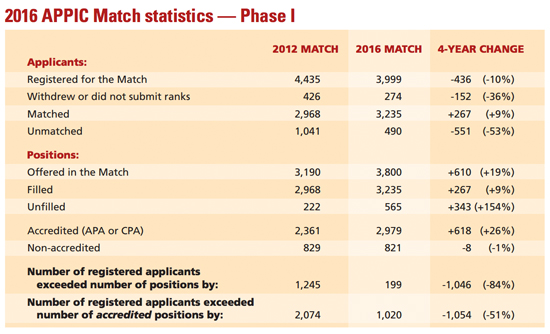
For the first time in decades, the number of psychology internships was greater than the number of graduate students who applied for them, an indication that APA's $3 million stimulus to help alleviate this imbalance is working.
So far this year, 3,800 internship positions were offered and 3,725 students applied, meaning there were 75 more positions than applicants, according to APA Executive Director for Education Jim Diaz-Granados, PhD.
"This is extremely heartening news, and bodes well for students seeking to complete their graduate psychology education," Diaz-Granados says. "We are proud to have been part of an effort across psychology education to make this possible."
APA committed up to $3 million over three years starting in 2012 to help create more accredited internships. As a result of this funding, 29 additional psychology graduate programs have been accredited; 158 accredited internship positions were created; and 134 programs were funded, Diaz-Granados says. Of the internships available this year, 2,979 were accredited by APA, an increase of 618 accredited positions from 2012.
"That being said, there is still a need to increase the number of APA-accredited positions offered to continue to match the number of applicants," Diaz-Granados says.
The "match rate" so far this year is 87 percent, according to the Association of Psychology Postdoctoral and Internship Centers (APPIC), meaning that 3,235 of those students who applied for an internship received one. However, there were 565 positions unfilled in this first phase of the process and 490 applicants who did not match. These unmatched applicants get another opportunity to find an internship in the second phase of the matching process, which is now under way.
"Not matching to an internship can delay and complicate the path to a doctorate for many students, and often has significant financial and emotional consequences," says Nabil El-Ghoroury, PhD, APAGS associate executive director. "Those who secured an internship have reason to celebrate the opportunity to continue their professional training and goals without interruption."