

"We raise each other’s skillset. I learn more about medicine every day and you learn more about mental health every day and it’s enhancing both of our skillsets."

American Psychological Association. (2015, November 10). The advantages of providing psychological services in family practice. https://www.apa.org/health/family-practice
expand all
Primary Care and Common Mental Health Issues
Identifying and treating mood, anxiety, and substance abuse disorders early and addressing psychosocial stressors and health behaviors are increasingly recognized as keys to improving the overall health and well-being of our nation.
- One in four adults in the U.S. will struggle with a mental health issue in a given year (Centers for Disease Control and Prevention, 2011).
- Nearly 40% of premature deaths in the U.S. are due to unhealthy behaviors (Mokdad, Marks, Stroup, & Gernerding, 2004).
- There is a high concurrence of mental/behavioral health problems and physical disorders such as diabetes, elevated cholesterol, asthma, and obesity (Druss & Reisinger Walker, 2011).
- Co-occurrence of mental illness with a chronic illness worsens a patient's health outcomes.
- Both depression and anxiety are effectively treated with brief evidence-based therapy.
The Role of Family Practice Providers in Mental Health Services
Treatment of mental health issues across the lifespan is increasingly provided by family physicians.
- Nearly two thirds of those who need mental health or substance use treatment are first seen in general medical settings (Kessler et al., 2005).
- Family physicians have taken on greater roles in mental health services but may lack the time and skills to fully address the patient's social and emotional needs.
- Despite these efforts, mental health problems are underdiagnosed (Young, Klap, Sherbourne, & Wells, 2011).
- Well-intentioned physicians can disrupt their patient schedules when addressing a mental health concern in an extended visit.
- Referral for mental health assessment and treatment may result in frustration due to inadequate communication between primary care and mental health systems.
- When patients are referred to an external mental health provider, less than half follow through on the referral.
Roles of Primary Care Clinicians in Mental Health Services
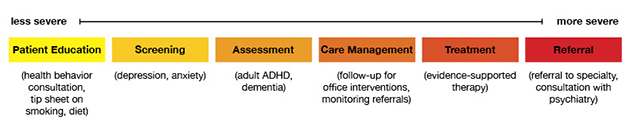
Integrated Behavioral Health and Mental Health Services
Mental and behavioral health are essential to overall health and cannot be separated. Primary care offices provide an opportunity to promote social and emotional well-being. Given the complexities of addressing whole-person health concerns, new models of integrating behavioral health and mental health services into primary care have emerged. These models include:
- Training family physicians to identify mental health disorders.
- Consultation by mental health providers to primary care providers.
- Integration of mental health providers within family medicine practices.
Studies indicate that high-quality mental health services located in family practices are multidisciplinary, collaborative, and more effective than traditional services.
The advantages of integrating mental health providers in family practice settings include:
- Increased confidence among family physicians to explore mental health concerns.
- Availability of resources for consultation and collective decision making.
- Less stigma for those seeking mental health care.
- Improved patient satisfaction with the range of services available in the practice.
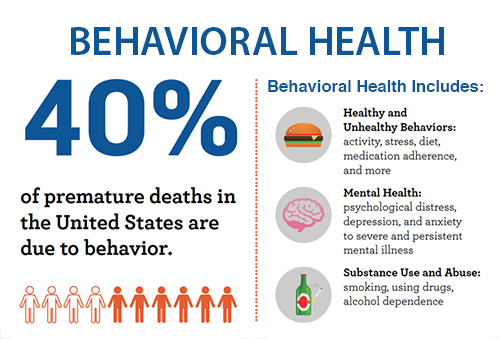
Information from: Mokdad, A.H., Marks, J.S. Stroup, J.S., & Gerberding, J.L. (2004). Actual causes of death in the United States, 2000. Journal of the American Medical Association, 291, 1238-1245. [Correction in: Actual causes of death in the United States, 2000. (2005). Journal of the American Medical Association, 293(3), 298.]
Unique Contributions of Psychologists to Adult Primary Care Teams
Psychologists are uniquely equipped to be an integral part of primary care practices. They can:
- administer and interpret screening and/or assessment tools to identify a mental health problem.
- offer therapy for substance abuse and unhealthy behavioral concerns that arise in a visit.
- coordinate care with schools, employee assistance programs, disability offices, and other agencies.
- train health care teams in motivational interviewing and other strategies.
- offer expertise in assessing the programs implemented.
- collaborate with psychiatry, social work, nursing, health coaches, and community health workers.
“We raise each other's skillset. I learn more about medicine every day and you learn more about mental health every day and it's enhancing both of our skillsets.”
—Alexa Connell, PhD
Psychologist, Assistant Director, Center for Integrated Primary Care, UMass Medical School
References
Centers for Disease Control and Prevention. (2011, September 2). Mental illness surveillance among adults in the United States. Morbidity and Mortality Weekly Report , 60 (Suppl. 3), 1–32. Retrieved from https://www.cdc.gov/mmwr/preview/mmwrhtml/su6003a1.htmopens in new window
Druss, B. G., & Reisinger Walker, E. (2011, February). Mental disorders and medical comorbidity (Synthesis Project Policy Brief No. 21). Retrieved from https://www.rwjf.org/content/dam/farm/reports/issue_briefs/2011/rwjf69438/subassets/rwjf69438_1opens in new window
Kessler, R. C., Demler, O., Frank, R. G., Olfson, M., Pincus, H. A., Walters, E. E., . . . Zaslavsky, A. M. (2005, June 16). Prevalence and treatment of mental disorders, 1990 to 2003. The New England Journal of Medicine, 352, 2515–2523. doi:10.1056/NEJMsa043266
Mokdad, A. H., Marks, J. S., Stroup, D. F., & Gernerding, J. L. (2004). Actual causes of death in the United States, 2000. JAMA: The Journal of the American Medical Association, 291 (10), 1238–1245.
Young, A. S., Klap, R., Sherbourne, C. D., & Wells, K. B. (2001). The quality of care for depressive and anxiety disorders in the United States. Archives of General Psychiatry, 58 (1), 55–61. doi:10.1001/archpsyc.58.1.55
Date created: 2015