

skip to main content

Reorienting the health care system to achieve three interdependent goals — improved patient experience, leading to better health, resulting in lower costs, all carried out within a population-based framework focused on the health of a community — has been the subject of much research (e.g., Berwick, Nolan, & Whittington, 2008). As work has proceeded on this “triple aim,” the additional goal of provider satisfaction — improving the work life of health care providers — has resulted in the quadruple aim (Bodenheimer & Sinsky, 2014). Psychology is uniquely positioned within the health professions to help the system achieve the goals of the quadruple aim.

Individual researchers and groups have addressed each of the components of these goals in a range of studies over the years. Psychologists have long been participating on teams that have produced positive outcomes in terms of clinical improvement and reduced costs resulting from the improved health of patients. They have also addressed the needs of entire patient panels and developed systems to improve providers’ satisfaction with their work. These disparate studies have been compiled in a volume (see Hunter, Hunter, & Kessler, 2014) that encompasses psychological interventions in primary and specialty medical and surgical care, as well as both outpatient and inpatient care.

We know from existing public health research that 45 percent or more of all health outcomes are due to such behaviors as sedentary behavior, poor diet, smoking, substance misuse, stress, and nonadherence to prescribed treatments (World Health Organization, 2009). In addition, the presence of such high-frequency disorders as anxiety and depression result in much higher health care costs for commonly occurring diagnoses such as diabetes or heart disease (Melek, Norris, & Paulus, 2014). Thus, both health behaviors and mental health disorders contribute significantly to overall costs and outcomes. If the health care system is to truly achieve the quadruple aim, it must systematically address behavior change.

The positive impact of psychological interventions on health outcomes and the subsequent reduction in the need for health services was summarized in classic meta-analysis by Chiles, Lambert, and Hatch (1999). This analysis of 91 research studies, conducted between 1967 and 1997 across a range of clinical problems in all age groups, for both inpatients and outpatients, and in both surgical and medical settings, found a decreased use of health services after psychological interventions in 90 percent of the studies, with an average 15.7 percent reduction in costs, whereas costs increased an average of 12.2 percent in control groups. The reduced costs were the result of the decreasing length of inpatient stays for medical and surgical patients and fewer emergency department visits.

The analysis of this data also revealed that planned, evidence-supported psychoeducational interventions yielded greater positive outcomes than open-ended, nonspecific interventions, but all yielded positive results. In the 20 years since the publication of the Chiles et al. study, the field has improved in addressing the needs of both medical specialty clinics and primary care service sites.

There is a critical divide, however, between research-funded random control efficacy trials such as those reviewed by Chiles et al. (1999) and evaluation of the effectiveness of typical health psychology practice. Translation of well-established, efficacious interventions to real-world effectiveness is always a challenge. At times, programs that have been shown to work well over many replications fail to produce results in large effectiveness studies (Solberg et al., 2015).

To survey the current state of clinical practice effectiveness in health psychology, the Office of Integrated Care at the American Psychological Association issued a request for proposals in 2015 to fund psychologists in practice in health care settings in order to evaluate existing clinical data to determine the impact of psychological services on clinical outcome. Over 40 proposals were received and five were funded, which covered a range of clinical services and relied on the analysis of archival billing and electronic health record data. These studies provide a snapshot of the role(s) of psychologists within a rapidly changing health care system — and document the impact and value of the interventions delivered by psychologists.

APA Style leaf logo Cite this in APA Style
American Psychological Association. (2018, June 27). The quadruple aim: The value of psychological services in health care. https://www.apa.org/health/psychological-services-care

expand all

The state of Oregon currently has organized its Medicaid program into 16 coordinated care organizations (CCO) focused on primary care service delivery that includes integrated mental health services. Peterson, Turgesen, Fisk, and McCarthy (“Integrated Care in Rural Health: Seeking Sustainability,” 2017) evaluated one rural CCO caring for 22,000 patients in three clinics, comparing use of medical services by a set of patients — specifically, their use of services for six months prior to and after an initial visit with a psychologist in primary care.

Three separate clinics were reviewed. Clinic A was primarily serving (> 75 percent) Medicaid patients in a low-income area; Clinic B was a larger clinic with a smaller group (20 percent) of Medicaid patients in a mixed-income region; and Clinic C had a smaller group (9 percent) of Medicaid patients, with the remaining patients covered by commercial insurance. Psychology staff were trained in the primary care behavioral health consultant model (Robinson & Reiter, 2007) emphasizing warm, hand-offs, brief solution-focused therapy in 20-30-minute sessions and a planned average of three episodes of care. Claims data from Medicaid were reviewed on 256 unique patients who received psychological care in the three clinics. In the Oregon study, clinics functioned as their own control groups, comparing data before and after introduction of services.

In Clinic A, which had 6,000 Medicaid patients, 1.4 percent saw a psychologist. In Clinic B, with 3,800 eligible patients, 2.7 percent received services, and of the 1,600 eligible patients seen in Clinic C, 3.9 percent received services. There were large reductions in costs for the patients seen in Clinics B and C, with no change seen in Clinic A. The authors contended that reach (Cohen et al., 2015) was a variable that probably contributed to this difference. “Reach” is defined as the percentage of patients in each clinic seen by psychologists. Clinics that have higher reach have a larger percentage of patients receiving psychological services within the clinic, and psychological service becomes more routine. An alternative hypothesis is that a Medicaid clinic, which funds both low-income patients and patients with disabilities, may simply have patients with more complex health or social problems who may not respond strongly to brief services. The overall combined data for the three clinics revealed a savings of $674 per patient for the 256 patients, or a total savings of $172,602 in the six months following the psychological intervention, compared with the six months prior to the psychological intervention. Improved outcome and lower costs, two key components of the quadruple aim, were found here. Using a nearly identical methodology, with a sample of 239 patients, Ross et al. (2018) found very similar savings of $860 per patient per year in a large primary care practice in Kansas City, MO.

The Colorado study by Brown Levey (“Does Integration Change Primary Care Practice and Patient Utilization of Services?” 2016) involved a larger analysis comparing separate outpatient settings: one clinic with available on-site psychology services within primary care and another group of clinics without those services. There were significant differences in the clinic populations that made comparisons more challenging. The intervention group (n = 14,456), which had psychological services available, was younger and healthier on average, with fewer chronic health conditions. Both groups received high-quality primary care. Overall, the intervention group used the emergency department more frequently but had fewer hospital admissions over the three years, as well as shorter length of stays when hospitalized. This research group is continuing their analysis of the data within diagnostic categories to evaluate total cost of care.

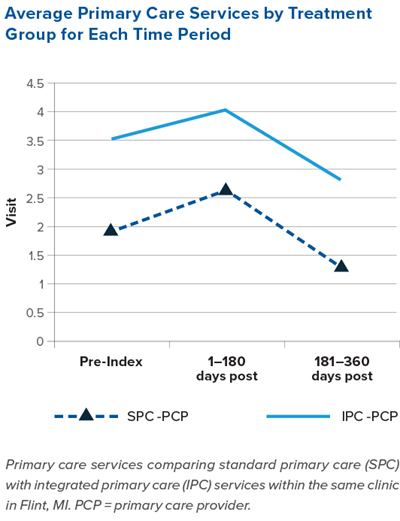
Whereas the Oregon and Colorado studies commenced within the last five years, the Michigan clinic studied by Vogel (“The Value of Psychologists Integrated in the Primary Care Setting,” 2016) has been in operation in Flint for nearly 30 years, with a well-developed, interprofessional team. In this study, Vogel compared two groups of patients in an integrated care clinic whose screenings were positive for depression. The standard primary care group (n = 192) was treated only by their primary care provider and may have had a referral for mental health services to another clinic. The integrated primary care (IPC) group (n = 129) was treated by the psychologist on-site. Groups were equal in age, but the IPC group included significantly more women. More important, in contrast to the Colorado study, in the Vogel study, the IPC group had a much higher rate of chronic health problems and medical diagnoses.

In the well-established program in Michigan, the standard primary care providers have worked in clinic with psychologists and are more comfortable in screening, assessment and treatment of depression, which has been found to be a positive effect in studies of integrated care (Hemming, Hewitt, Gallo, Kessler, & Levine, 2017). It appears from these data that the standard primary care providers refer the more complex patients to their psychologist colleagues who are on-site. In other words, the primary care team has acquired the skills to manage the less complex presentations of depression cases themselves and choose to refer only the more complex cases to the psychologists.

Psychological Services Care Graph

Overall, the data (see Figure 1) do not show a specific difference between patients receiving direct treatment from psychologists and those treated by the primary care providers. Both groups show the same pattern: an initial increase in primary care visits in the first six months following the positive screening and a decrease in visits in the second six months to a level lower than baseline. An overall decrease in emergency room visits and laboratory and diagnostic testing was seen in both groups. The pattern is the same, and the mean costs for the combined group show an overall pattern of reduced costs following an intervention. Thus, the overall summary of this project indicates a trend toward reduction in costs in a program in which psychologists are integrated in care, even for patients not directly seen by a psychologist.

In the management of patients with coronary heart disease, cardiac rehabilitation (CR), which includes physical exercise, medical management of blood pressure and lipids, smoking cessation, and nutritional counseling, has been shown to reduce cardiovascular mortality and hospitalization and improve quality of life. A recent prospective randomized efficacy study (Blumenthal et al., 2016) has shown that adding stress management training to CR enhances the positive benefits of CR and results in better clinical outcome, with a lowered risk of additional clinical events. Patients who received stress management training and CR had fewer deaths, heart attacks (myocardial infarctions), stroke and angina requiring hospitalization. This recent study highlights the potential for psychological intervention in patients who have heart disease, which is the leading cause of death in the United States.

We know that depression and anxiety symptoms commonly occur after a cardiac event (Burg, 2018), and care for those patients has been well researched. Antidepressant medication alone has been found to be no better than placebo in recent studies of postcardiac events (Angermann et al., 2016). Davidson et al. (2010, 2013) have shown that psychotherapy by itself or with medication under the care of a psychologist monitoring progress has the best outcome for these patients.

Carmin, Fontanella, Bower, Golden-Druetz, and Brinkley (“Impact of Psychological Services on Health Service Utilization for Anxious and Depressed Individuals With Coronary Heart Disease,” 2017), reviewed Medicaid claims data for a three-year period in Ohio for patients with diagnoses of anxiety or depression and ischemic heart disease or congestive heart failure. As the Melek et al. (2014) study demonstrated, costs are higher and prognosis worse in patients who have a chronic illness and comorbid depression or anxiety. Risks for cardiac disease events leading to hospital care are higher for patients who have anxiety or depression (Emdin et al., 2016). From claims data, Carmin et al. evaluated the relationship between psychotherapy received after the first admission for cardiac concerns up until the next event (e.g., death, inpatient admission, emergency room visit). Pharmacy claims for both cardiac and psychiatric medications were reviewed, and analysis of up to 14 other physical diagnoses were included in this analysis. Demographic data were also reviewed and analyzed; 10,396 patients were involved in this review.

Overall, the outcome for patients diagnosed with depression (n = 576) and anxiety (n = 4,620) was similar. Those receiving psychotherapy, as indicated by the claims data, tended to live longer. For patients who survived, those receiving psychotherapy went a significantly longer time before an emergency department visit or another hospital admission. The data are quite clear that psychotherapy for these patients has a strong positive influence on their overall health outcome. They have longer intervals until hospital emergency visits or admissions. It appears from the claims data that seeing a psychologist for psychotherapy is linked to fewer readmissions and longer intervals until next hospital contact. Those data are congruent with the research findings.

Type I diabetes (T1D) is the most common endocrine disorder in children and adolescents in the United States. Treatment requires a balance of diet, exercise, insulin injections and monitoring of blood glucose levels. Youths with T1D are at risk of acute conditions (e.g., ketoacidosis) requiring urgent care and hospitalization, as well as long-term complications (e.g., neuropathy and kidney disease). Outpatient psychological interventions have been shown to improve health outcomes (Wysocki et al., 2006) for youths experiencing management difficulties, and comprehensive teams including psychologists have been shown to improve overall health and reduce readmissions (Glasgow et al., 1991) for this patient population.

Price (“Youth With Poorly Controlled Type 1 Diabetes: Do Behavioral Interventions Improve Outcomes and Lower Total Healthcare Costs? 2016) reviewed the data on 1,671 patients served by a regional diabetes program based in a children’s hospital in Delaware to assess all encounters. Of the patients served by the program, 208 (12 percent) required acute care beyond their routine appointments. These patients were compared with the remaining 1,463 who were managing well with their routine follow-up visits. In this pediatric diabetes clinic, psychology staff are available to see patients referred by staff or family, and 317 were followed by psychologists.

The group requiring acute care and experiencing problems in management comprised more African American and Hispanic patients and was more likely to have Medicaid insurance. However, only 35 percent of the group had been seen by a psychologist. Thus, even though psychological treatment was available, the patients who would be helped were not receiving those services. Glasgow et al. (1991) clearly demonstrated that it is possible to provide effective services to a group of patients who have social barriers to care when obstacles to care are directly addressed. At times, simply offering psychological services is not enough; barriers such as transportation need to be overcome.

The research and clinical outcome data for children with diabetes is clear: Psychology services can help, but only if they are accessible and acceptable. The Peterson et al. (2017) study in primary care also found that access to psychology services, in a clinic that was almost entirely serving Medicaid families, may not be enough to bring about change when social needs are high. Both the Price (2016) and Peterson et al. (2017) studies indicated that more needs to be done to address social factors so families can access behavioral services. Increasing access and cultural acceptance are two key components of overcoming health equity barriers, but other aspects of life, including the basics of housing, food, transportation, and education, need to be addressed to achieve true health equity.

This small set of research studies provides a glimpse of the potential, the frustrations and the complexity of integrated care. The Chiles et al. (1999) review suggests that reduced emergency department visits and reduced length of hospital stay can be achieved with structured psychological intervention across a range of clinical samples. Within this set of research studies, some populations, such as the Oregon sample of Peterson et al. (2017), clearly show a return on investment and improved outcomes comparable to those of other large, recently published studies (e.g., Reiss-Brennan et al., 2016).

But both the Oregon study (Peterson et al., 2017) and the Delaware study of children with diabetes (Price, 2016) suggest that for groups with high social barriers, other needs must be met before they can achieve health. The Colorado study (Brown Levey, 2016) demonstrates the difficulty of reviewing existing databases, but within their intervention group are signs of the positive outcome of decreased length of stay. The Michigan study (Vogel, 2016) of a mature clinic that has developed over 28 years shows that primary care providers can effectively screen and treat depression for patients while psychologists in the same clinic can effectively achieve those goals with more complex patients. Both samples showed reductions in the use of health services after six months.

The most striking results come from the Carmen et al. (2017) study of cardiac care, drawn from a sample of over 10,000 patients, which demonstrated that for patients with anxiety or depression and heart disease, delivery of psychotherapy services corresponds to longer lives and less frequent hospital use, mirroring the results of very structured research studies. Heart disease is the number one cause of death in this country, and routine psychotherapy—especially stress management—appears to hold the key to improved outcome. It is important to note that unlike medication interventions, psychological services produced no negative outcomes, and no side effects were reported. Clearly, psychotherapy and psychological services as delivered in the 21st century can help achieve better outcomes at lower costs across a population of patients.

These brief glimpses of real-life clinics, revealed through studies showing outcomes and based on examination of costs and claims data, consistently demonstrate the value of psychology and the benefits that access to psychological services bring to the health care system in the quest to achieve the quadruple aim: improved patient experience, better health, reduced total costs of care and improved provider experience.

Angermann, C. E., Gelbrich, G., Stork, S., Gunold, H., Edelmann, F., Wachter, R., . . . Ertl, G. (2016). Effect of escitalopram on all-cause mortality and hospitalization in patients with heart failure and depression: The MOOD-HF randomized clinical trial. JAMA, 315(24) 2683–2693. doi:10.1001/jama.2016.7635

Berwick, D. M., Nolan, T. W., & Whittington, J. (2008). The triple aim: Care, health and cost. Health Affairs, 27(3), 749–769. doi:10.1377/hlthaff.27.3.759

Blumenthal, J. A., Sherwood, A., Smith, P. J., Watkins, L., Mabe, S., Kraus, W. E., . . . Hinderliter, A. (2016). Enhancing cardiac rehabilitation with stress management training: A randomized clinical efficacy trial. Circulation, 133(14), 1341–1350. doi:10.1161/CIRCULATIONAHA.115.018926

Bodenheimer, T., & Sinsky, C. (2014). From triple to quadruple aim: Care of the patient requires care of the provider. Annals of Family Medicine, 12, 573–576. doi:10.1370/afm.1713

Brown Levey, S. (2016). Does integration change primary care practice and patient utilization of services? [Grant-funded report]. Washington, DC: American Psychological Association, Office of Integrated Care.

Burg, M. M. (2018). Psychological treatment of cardiac patients. Washington, DC: American Psychological Association.

Carmin, C., Fontanella C., Bower, J., Golden-Dreutz, D., & Binkley, P. (2017). Impact of psychological services on health service utilization for anxious and depressed individuals with coronary heart disease [Grant-funded report]. Washington, DC: American Psychological Association, Office of Integrated Care.

Chiles, J. A., Lambert, M. J., & Hatch, A. L. (1999). The impact of psychological interventions on medical cost offset: A meta-analytic review. Clinical Psychology Science and Practice 6, 204–220. https://dx.doi.org/10.1093/clipsy/6.2.204

Cohen, G., Schroeder, J., Newson, R., King, L., Rychetnik, L., Milat, A. J., . . . Chapman, S. (2015). Does health intervention research have real world policy and practice impacts: Testing a new impact assessment tool. Health Research Policy and Systems, 13, 3. https://doi.org/10.1186/1478-4505-13-3

Davidson, K. W., Bigger, J. T., Burg, M. M., Carney, R. M., Chaplin, W. F., Czajkowski, S., . . . Ye, S. (2013). Centralized, stepped, patient preference-based treatment for patients with post-acute coronary syndrome depression: CODIACS vanguard randomized controlled trial. JAMA, 173(11), 997–1004. doi:10.1001/jamainternmed.2013.915

Davidson, K. W., Rieckmann, N., Clemow, L., Schwartz, J. E., Shimbo, D., Medina, V., . . . Burg, M. M. (2010). Enhanced depression care for patients with acute coronary syndrome and persistent depressive symptoms: Coronary psychosocial evaluation studies randomized controlled trial. Archives of Internal Medicine, 170(7), 600–608. doi:10.1001/archinternmed.2010.29

Emdin, C. A., Odutayo, A., Wong, C. X., Tran, J., Hsiao, A. J., & Hunn, B.H.M. (2016). Meta-analysis of anxiety as a risk factor for cardiovascular disease. American Journal of Cardiology, 118(4), 511–519. doi:10.1016/j.amjcard.2016.05.041

Glasgow, A. M., Weissberg-Benchell, J., Tynan, Epstein, S. F., Driscoll, C., Turek, J. & Beliveau, E. (1991). Readmissions of children with diabetes mellitus to a children’s hospital. Pediatrics, 88(1), 98 – 104.

Hemming, P., Hewitt, A., Gallo, J. J., Kessler, R., & Levine, R. B. (2017). Residents’ confidence providing primary care with behavioral health integration. Family Medicine, 49(5), 361 – 368.

Hunter, C. M., Hunter, C. L., & Kessler, R. (2014). Handbook of clinical psychology in medical settings: Evidence-based assessment and intervention. New York, NY: Springer

Melek, S. P., Norris, D. T., & Paulus, J. (2014). Economic impact of integrated medical-behavioral healthcare: Implications for psychiatry [Milliman American Psychiatric Association report]. Retrieved from https://www.coloradocoalition.org/sites/default/files/2017-01/milliaman-apa-economicimpactofintegratedmedicalbehavioralhealthcare2014.pdf

Peterson, M., Turgesen, J., Fisk, L., & McCarthy, S. (2017). Integrated care in rural health: Seeking sustainability. Families, Systems, & Health, 35(2), 167 – 173. doi:10.1037/fsh0000267

Price, J. (2016). Youth with poorly controlled Type 1 diabetes: Do behavioral interventions improve outcomes and lower total healthcare costs? [Grant-funded report]. Washington, DC: American Psychological Association, Office of Integrated Care.

Reiss-Brennan, B., Brunisholz, K. D., Dredge, C., Briot, P., Grazier, K., Wilcox, A. . . . James, B. (2016). Association of integrated team-based care with health care quality, utilization, and cost. JAMA, 316(8), 826–834. doi:10.1001/jama.2016.1123

Robinson, P. J., & Reiter, J. T. (2007). Behavioral consultation and primary care: A guide to integrating services. New York, NY: Springer.

Ross, K. M., Klein, B., Ferro, K., McQueeney, D. A., Gernon, R., & Miller, B. F. (2018). The cost effectiveness of embedding a behavioral health clinician into an existing primary care practice to facilitate the integration of care: A prospective, case-control program evaluation. Journal of Clinical Psychology in Medical Settings. Advance online publication. doi:10.1007/s10880-018-9564-9

Solberg, L. I., Crain, A. L., Maciosek, M. V., Unützer, J., Ohnsorg, K. A., Beck, A., . . . Glasgow, R. E. (2015). A stepped-wedge evaluation of an initiative to spread the collaborative care model for depression in primary care. Annals of Family Medicine, 13(5), 412–420. doi:10.1370/afm.1842

Vogel, M. E. (2016). The value of psychologists integrated in the primary care setting [Grant-funded report]. Washington, DC: American Psychological Association, Office of Integrated Care.

World Health Organization. (2009). Global health risks: Mortality and burdens of disease attributable to selected major risks. Retrieved from https://apps.who.int/iris/handle/10665/44203

Wysocki, T., Harris, M. A., Buckloh, L. M., Mertlich, D., Lochrie, A. S., Taylor, A., . . . White, N. H. (2006). Effects of behavioral family systems therapy for diabetes on adolescents’ family relationships, treatment adherence, and metabolic control. Journal of Pediatric Psychology,31(9), 928–938. doi:10.1093/jpepsy/jsj098

Date created: 2018

Questions?

Please contact:

W. Douglas Tynan, PhD, ABPP
Director, Office of Integrated Health Care
(202)-336-5884

Find a Psychologist in Your Area

Contact your state psychological association. Find them by visiting on.apa.org/.