The VR Personality Project allows kids to listen to virtual characters talk about how they cope with depression. (Photo: Courtesy Limbix VR)
Carter, K. (2019, July 19). VR tackles adolescent depression, homelessness. American Psychological Association. https://www.apa.org/members/content/adolescent-depression-homelessness
Virtual reality (VR) is venturing deeper into the world of mental health with programs designed not only to help patients deal with their own mental health problems like phobias or anxiety, but also to increase their empathy for others who are experiencing difficult situations like depression and homelessness.
One of these programs, the VR Personality Project, is an interactive intervention tool where kids can listen to virtual characters talk about how they cope with depression.
Jessica Schleider, PhD, principal investigator of the Lab for Scalable Mental Health at Stony Brook Universityopens in new window, created the tool. She collaborated with Limbix VRopens in new window, a company that uses VR for treatments of various mental health conditions, to transform it into a VR format. The program is available now at Limbix’s VR Libraryopens in new window.
The main function of the program is psychoeducation (a component of cognitive behavior therapy), which gives kids an opportunity to learn how to understand and cope with depression through what they see in VR. It doesn’t resemble an actual intervention, explains Schleider; it’s more of a guide that uses VR animation to show how the brain can change. The program shows interactions between virtual charactersopens in new window, but unlike VR programs of the past that could only use computer-generated images, these characters are actual people (actors) displayed by live video. “It is a real-world scenario with a real-world experience,” says Sean Sullivan, PhD, former director of psychology at Limbix VR, who is now transitioning to his own health technology product company.
Schleider’s team wrote the scripts for these characters, while Pixvanaopens in new window, a company that works with all types of businesses to apply VR to their professional needs, cast and filmed them. Kids might be able to see someone their own age discuss the symptoms they experienced during an episode of depression, or they might listen to an adult giving other kids advice about what to do or whom to call when they feel depressed. Kids are also encouraged to interact with the characters inside the program by giving them advice on what to do if they are stressed or depressed, based on what they’ve learned, says Schleider.
By entering their age and gender before the program begins, kids get a tailored experience — relatable conversations based on who they are and a virtual character that is similar to them. “They hear stories that we thought, as a research team, would be more relevant, based on their age,” Schleider explains. It’s a choose-your-own-adventure story where the conversations play out differently, depending on what types of situations and depression symptoms kids would typically identify with. “This customization will help them better connect with and empathize with their peers who might also be dealing with depression,” explains Sullivan.
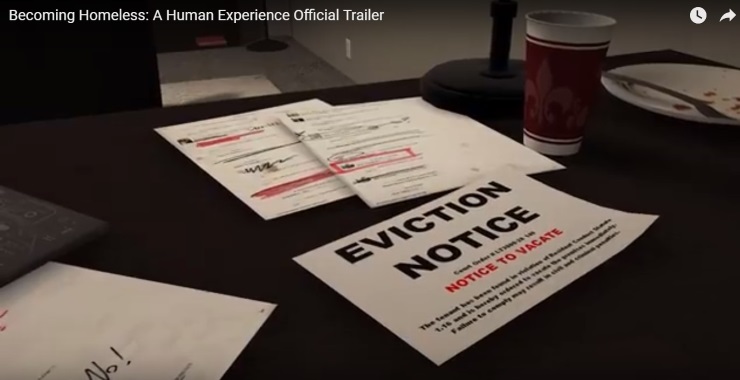
In “Becoming Homeless,” virtual participants experience an actual eviction that leads to homelessness. (Courtesy: Stanford University’s Virtual Human Interaction Lab)
Another program being used to help people understand and share the feelings of others is “Becoming Homeless,”opens in new window which simulates an actual eviction that leads to homelessness. It was created by Stanford University’s Virtual Human Interaction Labopens in new window and is free to download.
Virtual participants in the program find themselves inside their own apartment, with a landlord banging at the door to collect rent. Eventually, participants end up living in their car, and spend a night trying to survive on the street. The experience, even if not real, should help people be more sympathetic to anyone who is going through homelessness in real life.
“These types of VR programs use your senses and movement to trigger experiences inside the VR world,” explains Jeremy Bailenson, PhD, the founding director of Stanford’s lab. “Turning your head and moving your hands is what makes the VR program interactive,” he explains. “If you aren’t doing that, you might as well be watching TV.”
For example, if you jump while you are using the program because you are startled, your character will also jump in the virtual setting. Or if you look at a character in the VR setting, the program will have that character interact with you. In “Becoming Homeless,” if you stare at a suspicious passenger for too long while riding a bus, he might steal your bag.
These new developments are possible through advances in VR, like augmented reality, which adds virtual objects to your real environment, and 360-degree VRopens in new window, which surrounds viewers with the virtual environment so they can turn and look in every direction instead of just staring straight ahead at a screen — a huge step forward from the old VR programs that required boxy headsets that cut off people from reality.
Sullivan says that more changes in VR could include incorporating senses other than sight and sound to the virtual experience. He also anticipates that fields other than mental health will begin to include VR, like sports, corporate businesses, customer service providers and health care. “We’ve been looking at mental health, but VR can also be used for physical health,” he says. Athletes can physically train in VR environments, and surgeons can even use simulated VR environments to learn and practice performing surgeries. “VR is a potentially better way to train any employee,” he adds.
You can also expect more research around VR. Schleider is conducting a clinical trialopens in new window that will examineopens in new window whether teenagers find interacting with VR characters more appealing and more effective than talking to people online.
Technology, Mind & Society 2019
APA’s Technology, Mind & Societyopens in new window conference showcases the most important current research in psychology and other disciplines concerning the interactions of humans and technology — research that moves us toward the goal of ensuring that technology enhances the lives of all people.
Technology, Mind & Society Keynote Speakers
 Sara Czaja, PhD is a professor of gerontology and the director of the Center on Aging and Behavioral Research in the Division of Geriatrics and Palliative Medicine at Weill Cornell Medicine. Czaja’s research interests include aging and cognition, aging and healthcare access and service delivery, family caregiving, aging and technology, and functional assessment.
 Camille Nebeker, EdD, MS is an assistant professor of Behavioral Medicine in the Department of Family Medicine & Public Health, School of Medicine at UC San Diego. Nebeker’s research focuses on community research capacity building and the ethical dimensions (e.g., consent, privacy, data management) of emerging technologies (e.g., pervasive sensors, ubiquitous computing) used in health research.
 Albert “Skip” Rizzo, PhD is a clinical psychologist and director of Medical VR at the University of Southern California Institute for Creative Technologies. He is also a research professor with the USC dept. of psychiatry and school of gerontology. Rizzo has conducted research on the design, development and evaluation of Virtual Reality (VR) systems targeting the areas of clinical assessment, treatment, and rehabilitation across the domains of psychological, cognitive and motor functioning in both healthy and clinical populations.
 Valerie Shute, PhD is the Mack & Effie Campbell Tyner Endowed professor in education in the department of educational psychology and Learning Systems at Florida State University. Her current research involves using games with stealth assessment to support learning — of cognitive and non-cognitive knowledge, skills and dispositions. For more details on her research and publications, read her bioopens in new window on Florida State University's website.
 Kumar Garg is the senior director for technology and society at Schmidt Futures. His four core areas of work include: promoting the positive digital transformation of society by investing in data collaboratives that address concrete societal problems; expanding the number of people that are involved in discovery and innovation; investing in early stage risk-capital in nascent university research, high-potential people, and young organizations; and advancing public policy that sustains and leverages science and technology. He previously helped shape policy for the Obama Administration, serving in a variety of roles in the White House Office of Science and Technology Policy.