The Philadelphia 76ers kneel for the national anthem before Round One, Game One of the NBA Playoffs on August 17, 2020. Getty Images/Photo by Jesse D. Garrabrant.
O'Hara, D. (2020, August 27). Athletes protesting social injustice get support from sport psychologists. American Psychological Association. https://www.apa.org/members/content/athletes-protest-social-injustice
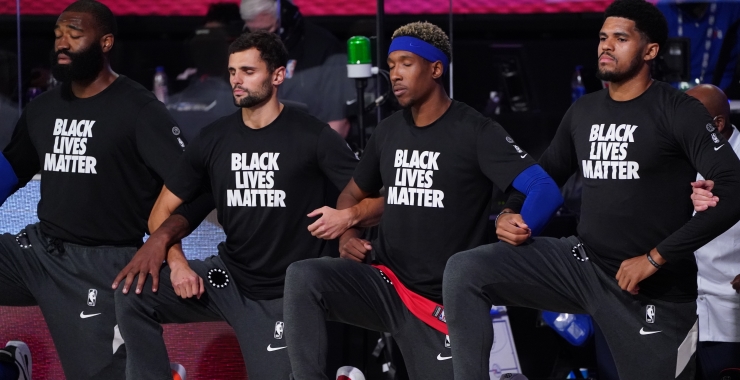
Part of the new normal for some sport psychologists will be working with athletes active in the Black Lives Matteropens in new window (BLM) social justice initiative.
Since the homicide of George Floydopens in new window at the hands of police officers in Minneapolis last May, athletes' protests on behalf of BLM have picked up momentum. Professional basketball players Jaylen Brown of the Boston Celtics and Malcolm Brogdon of the Indiana Pacers marchedopens in new window in their hometown of Atlanta in June; the Women's National Basketball Association (WNBA) dedicated its season to Breonna Tayloropens in new window, shot dead by police in May in her home in Louisville, Kentucky. The Milwaukee Bucks professional basketball team, other teams of the National Basketball Association, the WNBA, Major League Baseball and Major League Soccer boycotted games in August after the shooting of Jacob Blake in Kenosha, Wisconsin. The list of actions goes onopens in new window, at all levels of sport.
“Racial injustices are at the forefront of everybody's mind, even in the midst of this pandemic,” says Angel Brutus,opens in new window PsyD, assistant athletic director for counseling and sport psychology at Mississippi State University in Starkville. “Black Lives Matter has opened up a lot of people's eyes, and athletes are taking the opportunity to identify what their role is and how they might be able to influence the system.”
Their efforts can get results. Student-athletes at the University of Southern California (USC) formed the United Black Student-Athletes Associationopens in new window (UBSAA) this summer. USC's athletic department , partly in responseopens in new window to that group's initiative, established the Black Lives Matter Action Team, to institute “ meaningful and substantive actions and reforms. ”
Two-thirds of Americans support BLM, according to a surveyopens in new window conducted in June by the Pew Research Group, but activism still carries risk for athletes. Former San Francisco 49ers quarterback Colin Kaepernick has become a hero to many by refusing to stand for the national anthemopens in new window, beginning in 2016, to protest police brutality and the systemic oppression of people of color. But Kaepernick lost his jobopens in new window with the team in 2017—and he didn't get another one.
Brutus, a licensed counselor trained in sport and performance, notes that any kind of decision-making around behavior or engagement can have weighty implications for athletes' positions and future. “We're charged with understanding where they are in their processes and helping them see what's going on from a different perspective, to help them zoom out a little to get a glimpse of the big picture,” she says.
More than one way to support Black Lives Matter
Nyaka NiiLampti,opens in new window PhD, vice president of wellness and clinical services for the National Football League, says, “One of the things we love about sports is that it's a platform for change at a lot of levels, but it's important to realize that some athletes are passionate about using their platform for change, while others are not comfortable stepping up to share their perspective.”
The second, reticent group may feel some guilt, she says, especially if they are called out on social media for not speaking up. That rush to judgment and other kinds of external pressure are among the pitfalls sport psychologists can help athletes navigate.
“It takes conversations to arrive at the point where people understand that activism doesn't just look one way,” NiiLampti says.
Athletes need support from their institutions to have those conversations, and that support must come fundamentally from the leadership of the institution and the athletic department, says I.S. Keino Milleropens in new window, PhD, director of mental health and follow-up care for the Professional Athlete Care Teamopens in new window at the Tulane University School of Medicine in New Orleans, Louisiana. “You have to create spaces where athletes can feel safe talking about what they're thinking. They want to be part of a community,” one that takes their concerns seriously.
Not everyone is going to agree, though. What happens then, when other players take issue with athletes who are passionate about BLM?
“Culture is always a part of what we do. It's always part of who we are,” NiiLampti says. “There are some locker rooms where you can have a more open conversation about these things than people might have in the larger population.”
Sport psychologists' job is to help athletes perform better, as individuals and as members of a team; not all are PhD psychologists, but they are trained to facilitate those conversations.
“It's really sport psychology 101—how do you help the group gel around a shared goal?” NiiLampti says.
Biases and blind spots
But the BLM movement does require, more than some other issues, that facilitators take a look at their own biases and blind spots, NiiLampti says. “You have to be comfortable being uncomfortable, because that's what you're asking the group to do.” These conversations can do more harm than good if they're not done well, she says. “If it's not a safe space, or you can't hold it, people will walk away.”
Professional sports are a huge business—or were before the pandemic—and sports earn millions of dollarsopens in new window for colleges and universities, too, though revenues vary widely across schools and sports. Those revenues are the source of athletes' power now as they move toward activism around Black Lives Matter and other issues, but they also highlight the vulnerability of the individual athlete. And this ravaged season has thrown both revenues and careers up for grabs.
One of the UBSAA's demands was for a Black sport psychologist to work with USC's athletes. But Black sport psychologists trained at the doctoral level are not common. (USC's last Black sport psychologist was hired awayopens in new window by a professional football team.) Only about 5.3% of allopens in new window American psychologists are Black.
Miller says, given the shortfall, white sport and performance psychologists can and must step up to help Black athletes navigate the present moment.
“Be authentic. Get comfortable asking questions about what you don't know. People have a need for your services. They're looking for somebody who has warmth and awareness, who's culturally informed, a sound clinician but also an advocate,” Miller says.
A microcosm of society
Many majority-white colleges and universities field teams on which most athletes are Black, and many schools are more diverse than the communities that support them. That's the case at Texas Tech in Lubbock, where Tyler Bradstreet, PhD, is director of clinical and sport psychology. It's nothing new for conversations that begin in the athletic department—in years past, for example, around mental health awareness — to reverberate out into the surrounding football-happy region of West Texas, Bradstreet says.
“We have an opportunity to show people how to have conversations around difficult topics, to move society and demonstrate humanity,” Bradstreet says, and sport psychologists may be able to lead those conversations. At Texas Tech, he says, “As a psychologist, I'm thankful that the athletic department recognizes the value we bring to the table.”
All the psychologists interviewed for this story, in commenting on why athletes seem to be so visible in Black Lives Matter, said, “Sport is a microcosm of society.” It's a truismopens in new window, but also perhaps simply true.
Says Miller, “How we win and lose together—those are hard lessons to teach somebody who hasn't had access to sport.”