Photo by Christa Neu, Lehigh University
O'Hara, D. (2019, July 1). Christopher Liang wants to understand how discrimination shapes identity. https://www.apa.org/members/content/discrimination-shapes-identity
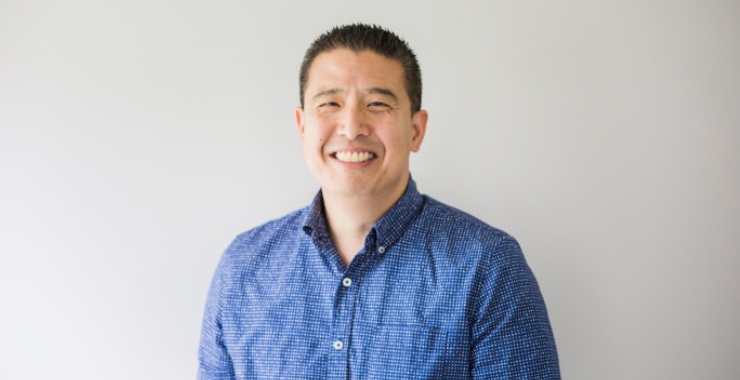
In framing his life and work as a researcher, author, administrator, consultant and educator, Christopher Liang, PhD,opens in new window often looks to his childhood experience as the son of poor Chinese immigrants in Brooklyn, New York.
Taunted and even attacked on occasion as a boy and young teen for being Chinese American, Liang, now associate professor and co-director of the counseling psychology program in the College of Education at Lehigh University (LU) in Pennsylvania, dealt with his pain and confusion by delving into "what it meant to be Asian American," reading books and exploring his dual culture, becoming "inspired and connected" to the history of the Chinese in the United States.
Liang says those experiences sparked his interest in how discrimination shapes identity, the responses people use to cope and what happens to the psychological health of people who are targets of discrimination.
"What I learned from that experience is that we can duck and hide, or we can stand up for ourselves. Racism is real, and we need to fight it," he says.
Liang, the head of LU's Gender, Race, Inclusion and Trauma lab, is also a co-author of the Guidelines for Psychological Practice with Boys and Men (PDF, 444KBopens in new window), published in 2018. He began to study masculinity after seeing clients — when he was in graduate school at the University of Maryland, College Park and during a predoctoral internship in the University of Southern California Student Counseling Center — who struggled to connect with their fathers and young men who were having a hard time expressing their emotions.
"They were raised to tough it out," he says.
Liang wasn't alone in noticing that men were hurting. Alarming statistics have emerged: Men live five fewer years on average than women, are 3.5 times more likely to commit suicide and commit 90 percent of homicides in the country. Men are also less likely to seek mental health care or even to go to a medical doctor.
Research cited in the guidelines Liang co-authored offers some insight, concluding that the more rigidly men adhere to the expectations that our society has set up for them — characterized in part by emotional stoicism, self-reliance to the point of refusing to seek help when it's needed and competitiveness that strays into dominance and aggression — the poorer their mental and even physical health outcomes will be in the long run.
The guidelines attracted attention and even criticism in some circles for calling into question a stoic male ideal, but Liang notes that our society's views on gender have been evolving over the past several decades.
Until recently, in psychology, men and women were only considered healthy if they conformed to traits and behaviors seen as appropriate for their gender, he says. And since no one actually studied women, white, heterosexual men were the default for well-adjusted human beings. Then the second-wave women's movement of the 1960s demanded that psychology consider their distinctive needs, and in 2007, the APA issued Guidelines for Psychological Practice With Girls and Women, which was updated last year.
In the 1950s and 1960s, too, new research on homosexuality, which had been viewed as pathological, resulted in its being removed from lists of mental disordersopens in new window by the American Psychiatric Society in 1973 and by the APA in 1975.
Meanwhile, new research tools were developed that made it possible to measure men's adherence to the masculine role, Liang says, like the Gender Role Conflict Scaleopens in new window; the Male Role Norms Inventoryopens in new window, developed by Ronald Levant, EdD, who with Liang co-authored the 2018 guidelines on boys and men; and the Masculine Contingency Scaleopens in new window.
Increasingly, researchers realized that even the heterosexual male was no monolith. Men of different ethnic, racial, religious and socioeconomic groups — as well as gay, bisexual and transgender men — may have different values and experiences from those of "traditional" white males. Men and boys in those groups may have additional pressures too.
Liang notes, for example, that Miguel Arciniega, PhD, and colleagues have developed a scale, (PDF 107KB)opens in new window for assessing attitudes Latino men bring to their experiences. And Liang and one of his students are developing a measure for Chinese men in China.
"We're using our measures here in studies around the world, which is nice in one way because that shows the reach of our work, but that needs to be complemented with measures that are developed with and for that population that's being studied," he says.
Liang researches not only masculinity, but also how perceived ethnic discrimination affects outcomes for people of color; the intersections of gender, culture and perceived discrimination for both men and women; and the value of school-based interventions in improving the academic performance of students of color. In 2016, he co-edited The Cost of Racism for People of Color, and he is active in Div. 45, the Society for the Psychological Study of Culture, Ethnicity and Race.
Liang is an executive committee member of Resilient Lehigh Valleyopens in new window, a local collaborative group convened by the United Way to address the effects of trauma. He also works with counseling programs in schools in his area, training counselors in cultural competence and the ways that childhood and race-based trauma can come into play in the behaviors of children and adolescents. He was honored as an APA Citizen Psychologist in 2018 for his work with community organizers in Bucks County, Pennsylvania, around diversity, equity and inclusion, and for promoting social-emotional learning in schools in the area.
"One reason why we have so many disparities — in health, education and in the justice system — is because of the unexamined biases we all have," he says.
The counseling psychology programopens in new window Liang oversees at LU is anchored in the scientist-practitioner model. It emphasizes "sensitivity to all different dimensions of identity and experiences," he says. The program's graduates go on to work in schools and college counseling centers, the military, the Veterans Administration system and other government facilities, community health clinics and private practice; they also teach.
Liang says he is gratified to hear from people who have employed the program's graduates that they not only have strong clinical skills, but also take the mission of social justice seriously.
He says, "We hope if they do engage in research, they will think about how to use those really privileged positions to inform the greater good and strengthen communities."