Photo credit: CDR Dan Tarman, US Navy
American Psychological Association. (2022, January 3). Nicholas Grant advocates for equitable care for the LGBTQ community. https://www.apa.org/members/content/equitable-health-care
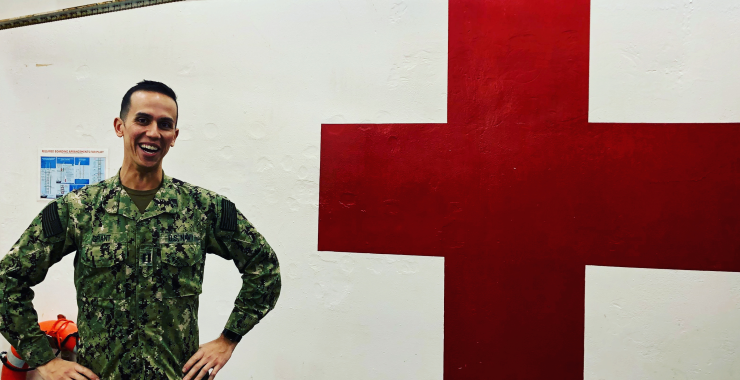
Advocacy on behalf of LGBTQ individuals is a strong thread running through the life and career of clinical psychologist Nicholas Grant PhD, who is presently a lieutenant in the Navy stationed at Pearl Harbor, Hawaii.
A cisgender gay man, Lt. Grant has helped organize gender-affirming care for transgender service people within the U.S. Navy, U.S. Marine Corps, and U.S. Army, in addition to his hefty regular duties as the group psychologist for the Naval Surface Group Middle Pacific. In that role, he serves the mental health needs of roughly 3,000 people on eight naval warships homeported at Pearl Harbor.
Making sure that LGBTQ people “who serve their country in the military have access to affirming and equitable care—for me, that's a motivator, to ensure that we are offering that level of cultural competency,” Grant says.
The Navy’s community of clinical psychologists numbers about 220, and mental health services are available to personnel who want them, Grant says. Education is “one of my top interventions,” because “there is only one of me and many, many Sailors.” Teaching the people he is responsible for how to tell if they are experiencing stress, distress, or a mental health disorder—what's normal versus what is cause for concern—is a favorite topic, he says. A particular stressor for Navy personnel, he says, is that “active duty service requires folks to be dedicated to the mission and able to stay ready for any task they are called upon to tackle at any time.
“The Navy has been a leader in creating inclusive and supportive policies for service members across the board,” he says, and its leadership also understands the value of mental health care.
The U.S. Department of Veterans Affairsopens in new window operates the largest American health system that serves a transgender populationopens in new window. (It’s the largest healthcare systemopens in new window in the country.) There are an estimated 1.4 millionopens in new window transgender adults in the United States, according to the Williams Center at the University of California at Los Angeles, comprising about .5% of the adult population. In all, there are an estimated 13 million LGBTQ people older than 13, about 4% of the total American populationopens in new window. So while the percentages are small, the need for equitable healthcare is significant, Grant says.
An unusual path
In 2016, after completing his training as a psychologist, Grant served as an APA William A. Bailey Health and Behavior Congressional Fellow in the Office of U.S. Sen. Kirsten Gillibrand (D-NY). Grant worked on Sen. Gillibrand's military legislation team for the most part and spent another quarter or so of his time on her healthcare and LGBTQ work. There was some crossover, as the Senate considered President Trump's then-proposed ban of transgender people serving in the military. (The ban went into effect in 2019 and was rescinded by President Bidenopens in new window in 2021.) Grant helped draft proposed legislation and developed a four-hour workshop for the senator's staffers called “Transgender 101,” which presented a basic understanding of “the experiences that transgender Americans face on a day-to-day basis,” he says.
Grant joined the Navy in 2019 in part because he had worked with veterans for much of his clinical training, and because of his experience as an APA Congressional Fellow. It made sense to get some firsthand experience with life in the military, he says.
Grant's path to active duty service as a Navy psychologist was somewhat unusual in that he was a licensed psychologist when he joined. Despite his newness to Navy life, though, late in 2019, he led a mental health team that included two psychologists and three behavioral health technicians onto the USS Abraham Lincoln, an aircraft carrier, to support more than 5,000 members of the ship’s crew, who had learned at the last minute that their already seven-month deployment would be extended, which meant that they would be away from their families for the holidays.
Shortly after that, Grant deployed again with the USNS Mercy, one of the Navy's two hospital ships, to the port of Los Angeles, as part of a mental health team that participated in the initial response to the COVID-19 pandemic. His duties then included counseling, education and clinical assessments for a crew, primarily comprised of medical providers faced with caring for civilians who were sent to USNS Mercy because hospitals on land were overwhelmed—at the same time the medical providers themselves were learning about this frightening new disease and developing safeguards against it.
Grant says he has been told he’s had more experience onboard ships in his first couple of years than many psychologists get in their entire Navy careers. He's halfway through a five-year contract but isn’t quite sure yet what the Navy has in store for him. “I've had a lot of great leadership opportunities,” he says, but adds that the Navy is “definitely an organization that asks for a lot of time, energy and dedication from anyone who volunteers to serve.”
Active with GLMA
In addition to his military work, Grant presently serves as the president of the board of directors of GLMAopens in new window (formerly the Gay and Lesbian Medical Association); he is the first clinical psychologist to serve in that role. Ever since college, he has routinely volunteered with LGBTQ community centers anywhere he has found himself, and he has been active with GLMA since 2016. In 2018, Grant was awarded an APA Citizen Psychologist Presidential Citation for his LGBTQ advocacy. And in recognition of his “deep commitment to using the discipline [of psychology] to promote social justice in general and especially for lesbian, gay, bisexual, and transgender (LGBT) people,” Grant was named a 2021 APA Fellow for Division 44 (Society for the Psychological Study of Sexual Orientation and Gender Diversity).
A Southern California native, Grant is the first in his family to graduate from college. “That's a very important identity for me because I often find I am navigating things without a lot of traditional guidance,” an experience he credits with bolstering his curiosity.
He decided during his first semester of community college to major in psychology, and he didn't waver from that over the whole long course of his education. “The human experience, human relationships, have always piqued my interest,” Grant says.
He completed a master's degree first, but liked the idea of doing research. (He has done some research in minority health.) So he sought out a PhD program, at Palo Alto Universityopens in new window (PAU), Palo Alto, California, that offered an LGBTQ emphasis. He still lives by the mentorship he received from Peter Goldblum, PhD, and Grace Chen, PhD, while studying in that program, Grant says. He received PAU's 2018 Distinguished Alumni Award, three years after he earned his PhD.
Grant’s concern for equitable healthcare doesn't stop with serving LGBTQ people. In his own clinical work, Grant tries to give everyone the best care, never cutting corners. It isn't easy, he says, but “anything that has to do with equity inherently takes more work.”