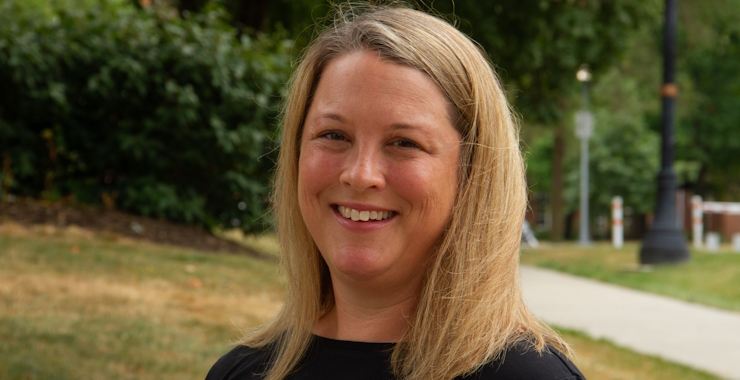
Photo credit: The Ohio State University
Jennifer Cheavens, PhD,opens in new window professor of clinical psychology and a researcher at the Ohio State University (OSU) in Columbus, sees a definite connection between the two aspects of her work—defining and addressing mood disorders that can significantly diminish the lives of people who are affected by them, and exploring the strategies and characteristics of individuals who are flourishing in life.
“The through line for me is this: Can we learn things from people who are doing really well in their lives, and apply them to help people who may be struggling?” Cheavens says.
As a graduate student at the University of Kansas in Lawrence, Cheavens studied with C. R. Snyderopens in new window, a proponent of positive psychology who developed seminal theories around the value of hopeopens in new window and forgiveness. “That was where I cut my teeth,” Cheavens says.
The APA defines hopeopens in new window as “the expectation that one will have positive experiences, or that a potentially threatening or negative situation will...ultimately result in a favorable state of affairs.” Research has shown that more hopeful people have better outcomes and relationships. They tend to set goals and carve out pathways to those goals, “anticipating obstacles and cheerleading themselves as they go,” Cheavens says.
“But what about the low-hope people?” she says. “I think we can teach them those skills” that make high-hope people more successful.
Can hope be taught?
Cheavens, who teaches a class on positive psychologyopens in new window, explored with Snyder how to bring some techniques associated with positive psychology into cognitive therapyopens in new window. With OSU colleague Daniel Strunk, she has found that patients with depression did better when they were treated with cognitive behavioral therapy (CBT) personalized to their relative strengthsopens in new window than did patients treated with CBT that was designed to compensate for their deficits. She also participated in a study of the role of hopeopens in new window as a buffer against psychological distress in pursuit of a goal. And she recently showed, with David Cregg, that performing acts of kindness improves social connectionopens in new window and other markers of well-being, more than common CBT strategies for people with elevated symptoms of anxiety or depression.
However, a meta-analysis she did with Cregg that found that gratitude was not especially effective at reducing symptomsopens in new window of anxiety and depression, even though gratitude is often promoted as a beneficial practice in the mental health field. Cheavens says she found those findings surprising; she’d like to give gratitude another shot. “Maybe we haven’t dosed it correctly or we haven’t given it to the right people,” she says.
Cheavens collaborated on a pilot study of a promising new treatmentopens in new window, Goal-focused Emotion-regulation Therapy (GET), with a few dozen young survivors of testicular cancer, a condition that, even when successfully treated, can confound a young man’s plans for his life. GET, which references Hope Theory, is a 6-session intervention delivered over 8 weeks, designed to improve the ability to reframe goals, regulate emotional responses, and rediscover a sense of purpose.
“One thing that often gets lost in our definition of hope is the importance of tying your goals to your values,” Cheavens says. When something is intrinsically important to a person, even one who struggles emotionally, pathways to realizing that goal are more likely be created, and success is more likely, too, she says. “Let’s get a sense of how confident you are that you can move toward that goal.”
Through the years, Cheavens has done foundational studies on depression and borderline personality disorder (BPD), mental health conditions that can severely hamper an individual’s quality of life.
The APA identifies BPDopens in new window as “a long-standing pattern of instability in mood, interpersonal relationships, and self-image...severe enough to cause extreme distress or interfere with social and occupational functioning.”
Feeling accepted can be therapeutic
Effective treatments are available for BPD now. Dialectical Behavioral Therapyopens in new window (DBT), a 30-year-old variation on CBT, was developed by clinical psychologist Marsha Linehanopens in new window to treat chronically suicidal people with BPD and other complex disorders. Linehan believed that the standard treatments, which emphasized encouraging patients to reject problematic thought patterns and behaviors, were making these patients feel misunderstood and judged, so she added an aspect of acceptance.
Cheavens heads up OSU’s DBT clinic, supervising doctoral students who treat patients there. The clinic uses criteria for BPD set out in the Diagnostic and Statistical Manual of Mental Disordersopens in new window to determine which patients to accept, but Cheavens says the clinic also sees people who are suicidal or otherwise demonstrate severe mood swings.
Cheavens’ work with BPD led her “back to basicsopens in new window,” exploring what healthy emotional management looks like, in order to get a better base for comparison when patients’ emotions spiral. “If you have a lot of variability in your emotions, that can affect social connections and make life more difficult,” she says. In another study,opens in new window she advocated for creating a system to bring the best new treatments into the clinic for mood swings and the impulsive behavior that can accompany them, with an eye to developing more “efficient and flexible” interventions.
For people with less severe forms of BPD, treatments are becoming more efficient and creative. In the past, clinicians might expect to treat a patient with DBT for a year, but recent studies suggest that a 6-month course of treatmentopens in new window might work just as well for some people. Other studies have shown that some patients with depression might need just 12 weeks of therapyopens in new window.
Treatment is an act of hope
Cheavens has been recognized for her teaching and mentoring. “It’s really energizing for me, thinking about, and trying to help, the people who will move the psychological science forward,” she says. These are opportunities to make an impact beyond her own work.
Cheavens’ father’s career was in the Air Force, so she lived in more than a dozen states growing up. She is very close with her family. “It’s probably not a surprise that I think about hope and gratitude and kindness. I grew up with those being important things,” she says. The bottom line in her own work is that she wants to help alleviate suffering. “How do we treat people better, faster, less expensively?”
Says Cheavens, “It’s an extraordinary act of hope for people to come to treatment,” especially if they have tried before. A patient with a history of severe problems might feel hopeless, but that person’s therapist must hang onto hope, she says.