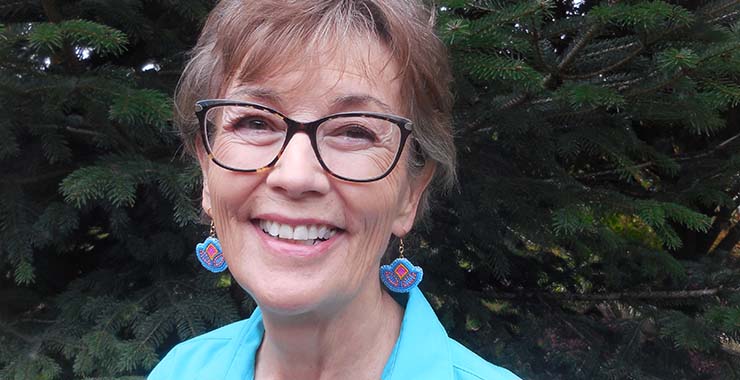
Photo credit: Jack Finney


Iva GreyWolf, PhD, is a Native American licensed clinical psychologist with more than 40 years’ experience in the field of behavioral health. She lives in rural Oregon, where she works to bring mental health services to underserved Native American communities in the continental United States and Alaska. Only a few hundred psychologists identify as American Indians or Alaska Natives (AIAN).
GreyWolf, a fellow in Division 35, is a member of the Fort Peck Assiniboine tribe of Montana and has lived on a number of reservations. An early experience working as a mental health specialist with sexually abused children set her on the path to “serve and advocate for victims of complex trauma,” she says.
“Complex trauma” is a common component of the AIAN experience, GreyWolf says. That is, many individuals have endured more than one harrowing event in the course of their lives. Indigenous people's rates of murder, rape, and violent crime are all far higher than the national averagesopens in new window. And COVID-19opens in new window has sickened and killed so many AIAN people, many of them quite young, that the entire group's life expectancy has dropped nearly seven years. That is not even to speak of the losses and family disruptions these serious illnesses and deaths have caused.
“The mental health fallout from COVID is adding more layers of grief,” GreyWolf says.
Many AIAN individuals live on reservations or in other Indigenous communities that range from rural to remote. That restricts the number of therapists available to work with them, and while telehealth is a great tool with rural patients, GreyWolf says, AIAN homes are often not connected to the Internet. About two-thirds of AIAN people today live in urban areas, but that doesn't necessarily mean they have better access to mental health services. “It varies,” GreyWolf says. Some cities have more to offer than others, and some individuals “get lost between the cultures.”
GreyWolf strives to “create a safe space” for her patients, “finding out what is important to that person and helping them find their path.” AIAN individuals often hold values that were developed hundreds of years ago in the context of a warrior societyopens in new window, including the solemn duty to protect the community and those in one’s care, she notes. It makes sense to view an individual's issues through that lens. As she puts it, “What does it mean to be a warrior today?”
AIAN individuals aren’t all the same, though, she says. While some are rooted in traditional ways and beliefs, others have embraced Western culture and religions. Still others “walk in both worlds,” GreyWolf says. Her approach is to be open-minded and to network with relatives, elders, and clergy, as well as other professional counselors. “There are too many issues and too few of us” to work alone, she says.
Part of her job, as GreyWolf sees it, is to be part of the community, “not to sit in the office and expect people to come to me, but to get out there” and meet her prospective patients where they gather, like the elder center, “have lunch with them, play around with them.” She is also willing to adapt to some of the variations from standard care that her patients bring into her office. GreyWolf has had patients show up to a session with a number of relatives, and has conducted the session in that context. “They're there to learn, and to support the person” who is in therapy, she says of the extra attendees.
These communities have many of the ills that isolation can aggravate, such as substance abuse, food insecurityopens in new window, inadequate housing, limited access to education and health care, and levels of murder,opens in new window suicideopens in new window and traffickingopens in new window that are much higher than those for White Americans. GreyWolf lost a nephew some time ago in a murder that has not been solved. She chairs a task force within Division 35 on Missing and Murdered Indigenous Relatives, named to reflect the fact that Indigenous men and transgender individuals are being taken from the community, as well as a great many women and girls.
With so few AIAN therapists to support the community, GreyWolf plays an active role in helping the next generation prepare. She often mentors Indigenous doctoral candidates through the Society for Indian Psychologists. She believes clinical supervision is vital for those individuals, in part because there are so few of them, and they are so busy. “It's easy to put your self-care at the end of the line,” she says. “They need support.”
Some newly minted AIAN psychologists are going into academia and research, which GreyWolf considers “a very important piece, to have research done by Native people with Native people,” but getting practitioners into the field is her top priority. And that takes commitment, she says, because a career in one of these “extremely underserved areas” can be challenging for professionals, no matter what their background, and AIAN communities need practitioners who are in it for the long haul, she says.
Psychologists who would work with AIAN communities may need to embrace “a remote environment” in which “resources are lacking. You have to create your own entertainment,” GreyWolf says. Practitioners need to be there “because it's something they have a passion for.”
She advises psychologists who don’t identify as American Indians or Alaska Natives to learn and understand the weight of the history that informs the lives of Indigenous people, and to be aware of the many and various ways in which AIAN individuals have been traumatized again and again over the generations. Many of these experiences have disrupted family structures and the transfer of basic life skills. “What has gone on here? How did the people pull together? How did they survive? Because in spite of all the obstacles, we’re still here,” says GreyWolf.
One powerful book about crimes against the Osage Indians of Oklahoma, which GreyWolf recommends, is Killers of the Flower Moonopens in new window, but there are 574 federally recognized tribes, in addition to others recognized by various states. “Each one of our communities has its own unique historyopens in new window,” GreyWolf says. Other works of journalism, academic articles, and fiction and poetryopens in new window written from a Native American perspective can help practitioners begin to understand what life has been like for Indigenous people, past and present.
Says GreyWolf, “I want to know, when I'm serving someone: What is their truth?”
Connect with peers
Save 35% off pay now rates
New products available
APA Merch Store opens in new window
Competitive low rates