 Photo credit: Bob Cullen
O'Hara, D. (2022, April 11). Jane Delgado advocates for personalized health care. https://www.apa.org/members/content/personalized-health-care
Photo credit: Bob Cullen
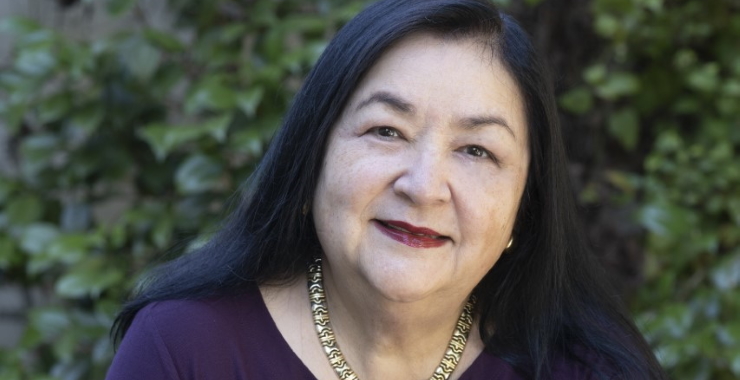
For Jane Delgado, PhD, health care is personal.
“Health is never ‘one size fits all.’ It has to be tailored to the individual and the community,” says Delgado, president and chief executive officer of the Healthy Americas Foundation and the National Alliance for Hispanic Health (NAHH), who trained as a clinical psychologist. “You have to meet people where they are and walk with them.”
Research is key to attaining that individual approach to health, says Delgado, and that research needs to include as many different types of people as possible. In particular, Delgado advocates for Latinx Americans, now more than 18% of the United States population, our largest racial and ethnic minority since 2003, but still mostly ignored by the medical establishment, among others, she says. Delgado uses the term Hispanic for this diverse group of Spanish-speakers, who are usually thought of as hailing from Mexico, Central and South America and the Caribbean, and perhaps Spain; for her, the term covers anyone who identifies as Hispanic and is gender neutral.
“We have to know that we all belong to each other, and all of us to this greater nation,” she says of Hispanics. “Most people don’t realize our size or the economic power our community has. Our impact on this nation is huge.”
An early role in illuminating health disparities
Delgado, a practicing clinical psychologist, has always seen policy as “changing the way institutions work with underserved communities” and as the arena where she could have the widest and most positive effect. Early on, she worked at the U.S. Department of Health and Human Services (HHS) for Secretary Margaret Heckleropens in new window, and helped guide the landmark report on minority health Heckler’s office produced in 1985. The so-called Heckler report called attention to longstanding disparities in healthcare, laid the groundwork for beginning to address them, and “continues to anchor the federal call-to-action to reduce and eliminate racial and ethnic health disparities,” according to a recent updateopens in new window.
“Working for Margaret was one of the most important things I’ve done in my life,” and indeed they went on to be close friends, says Delgado, who also served on former First Lady Rosalynn Carter’s Mental Health Advisory Task Forceopens in new window. Delgado made a point of being nonpartisan in her government career, though. “I thought, if I’m a researcher and a scientist, then I shouldn’t be involved in politics,” she says.
Delgado recently published a perspective articleopens in new window in the New England Journal of Medicine (NEJM) in which she called for “new conceptual models of health,” citing examples of how Hispanic health data had been ignored rather than used to rethink existing models. Delgado wrote, “The challenge is to ensure that the full range of what we know — from genomics to the social determinants of health for each person—is available, valued, and understood.”
The “Hispanic paradox”
Take the so-called “Hispanic paradox,” Delgado says. Even though many Hispanics have risk factors that include low income and education levels, poor or no health insurance, diabetes, and excess weight, they live longer as a group and have less heart disease than non-Hispanic Whites. We don’t know why. “Analysts simply noted that the findings [on Hispanics] did not fit the prevailing conceptual framework for health,” she wrote. Only solid research can dispel the Hispanic paradox, and the data might yield important information about other groups and individuals as well, Delgado says.
But this would have to be new, smart, culturally aware research, she says. Hispanics, like most groups other than White males, have not been well studied historically or included in clinical trials. As she notes in her NEJM article, “clustering diverse groups under a single category homogenizes disparate health experiences” and ignores the effects of other, intersecting traits, like gender or age.
Presently, “the bottom line is that most research is based on a skewed sample of people,” Delgado says. For example, the Heckler report’s salient data had to do with excess deaths, but the standard death certificate in the United States didn’t begin to collect Hispanic data until 1989, four years after the report was published. “We had no meaningful mortality data on Hispanics, other than the fewer than 30% who were foreign born,” to include in the report, she says.
Tailoring health care to the individual and the community
This indifference to big gaps that exist in important data by no means pertains only to Hispanics; it’s pervasive. Even though more women die in car accidents than men, for example, crash test dummiesopens in new window used to test how human beings fare in car accidents are typically modeled on men, Delgado notes. And even when female dummiesopens in new window were introduced in 2011, and even though half of drivers are women, female dummies sit only in the passenger seats. Meanwhile, Americans have gotten heavier, while crash test dummies mostly have not.
COVID-19 has illuminated health disparities , with Blacks and Hispanics being more likely to become infected, be hospitalized, and die than non-Hispanic White people. Some other Americans have taken note, and have reached out to help, and Delgado has been heartened by alliances that have emerged during this period. The Committee of 100opens in new window , a Chinese American leadership group, donated 60,000 scarce N95 masks to the NAHH in the summer of 2020, and the Alliance sent them on to community organizations around the country. When federal money became available to fund vaccination efforts with vulnerable communities, Delgado’s organization helped channel those funds to groups that brought the vaccines to Hispanics at their workplaces, whether those were the blueberry fields of Maine or meatpacking houses in Nebraska. “You have to tailor healthcare to the individual and the community,” Delgado says.
Delgado has written a number of booksopens in new window , including the Buena Salud wellness series, in English and Spanish, focusing on such common concerns as arthritis, maintaining heart health, and most recently, how to cope with depression. In 2015, she received the Food and Drug Administration Commissioner’s Special Citation, the agency’s highest award for those who promote public health.
Working to change institutions
Delgado came to the United States from Havana, Cuba, before Fidel Castro came to power. She was two and half years old and grew up in Brooklyn, New York, speaking Spanish and, eventually, English. One vivid memory is the day her fifth-grade teacher took her out for ice cream, told her she was gifted, and encouraged her to become a psychologist. “You’re very good with the other children,” the teacher told her.
Delgado skipped eighth grade, finished high school in three years, and when she was 16, went away to college at the State University of New York (SUNY) at New Paltzopens in new window. She obtained her PhD in clinical psychology from Stony Brook Universityopens in new window. “I decided that while one-to-one therapy was great, you really needed to change institutions,” Delgado says. While finishing up her dissertation, she got a master’s degree in urban policy science as well. She then went to work at the HHS.
Delgado sees mental health as being an integral part of overall health and best addressed holistically—“mind, body, spirit.” Her mission, she says, is “better health for all.”