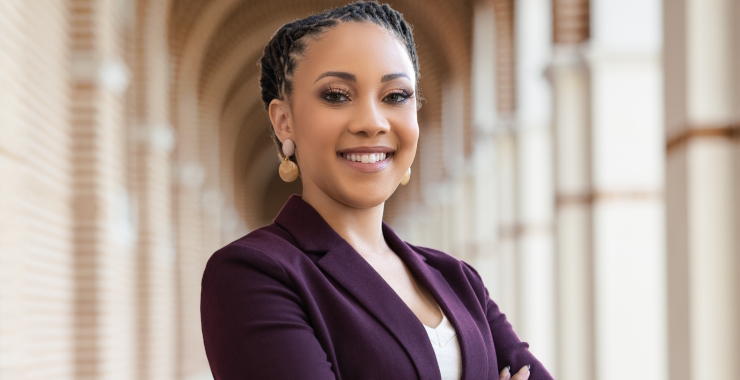
Danielle King, PhDopens in new window, assistant professor of Industrial-Organizational Psychology at Rice University in Houston, Texas, researches resilienceopens in new window, the human capacity to adapt to difficult experiences. She also studies race. For her, those two topics often overlap.
King is a 2022 recipient of the APA Achievement Award for Early Career Psychologists. Last year, she also won a prestigious National Science Foundation CAREER Awardopens in new window, which includes a five-year grant to support her research and service concerning the effects of race-related trauma, like the 2020 murder of George Floydopens in new window at the hands of police in Minneapolis, Minnesota. As part of the study, she will investigate how employers can help workers deal with these “vicariously traumaticopens in new window” experiences.
“I see my work as integrating what we know about stigmaopens in new window and equity and identity into the science of resilience,” says King, founder and principal investigator of the WorKing Resilience Research Laboratory at Rice. Her research centers on workplace behavior, and she teaches graduate-level seminars on work motivation and leadership.
“I’m excited about acknowledging forgotten populations, thinking and talking about people who are not privileged in so many ways, and including diverse voices in my studies,” says King, whom the Association for Psychological Science named a “Rising Star” in 2023.
Resilience is activated by adversity. “I don’t know anyone who hasn’t had to overcome something,” King says. We all admire people who bounce back from misfortune, rather than letting it take them down. Resilience has a strong practical value, too.
Staying the course in difficult times is extremely valuable for organizations, communities and individuals. King notes that, in a workplace, resilience can become not only the desired response to difficulty, but the expected one—an influential measure of a good employee. But focusing on performance as the chief marker of resilienceopens in new window ignores employees’ disparate history and access to resources, and puts them at risk of burnout, she says.
Resilience is not “one size fits all”
“We have to resist the urge as resilience researchers to seek a ‘one size fits all’ solution,” King says. People are all different, with various goals and experiences, and the difficulties they face vary, too. “A natural disaster is different from losing a loved one is different from 10 years of microaggressions [commonplace, subtle racist acts that undermine workers from stigmatized racial groups, for example, in the workplace]. We need tailored programs that address what this person is facing, and my work is going that route.”
King’s most recent researchopens in new window divides resilience into adaptive and maladaptive forms. “Once our being resilient starts to harm our well-being, or harm other people, then it’s maladaptive.”
People misunderstand resilience, King says. It’s not success per se, she says, but rather individuals’ ability to continue to pursue their goals after a setback. Some managers think employees’ goals should be whatever the organization is trying to achieve, but human nature is more complicated than that. People want time for themselves and their families, they want respect, health and a comfortable environment, as well as success at work. Parents steering their families through a crisis—the COVID-19 pandemic, for example—may have to forego short-term goals for a while, like working on a big, important project with a heavy workload and tight deadlines, or accepting a supervisory position that requires being in the office full time, preferring to be at home a couple of days a week. Later, after the crisis has passed and more resources are available, those parents may alter their goal priorities to pursue career challenge and growth. Leaders should be mindful that different goals may be important to employees at different times in their career journey.
Good leaders nurture resilient teams
King believes resilience is not “something you have or you don’t,” but one possible response to adversity. “Being resilient takes energy. Benefits come when we are thoughtful and careful about how we approach it,” she says. Resilience has a better chance of blossoming if the proper conditions are present. Research is ongoing into what those conditions are, but in study after study, social supportopens in new window has been shown to be helpful. “We as humans are wired to connect,” King says.
Good leadership can nurture resilient teams. In one studyopens in new window, King’s team showed that “voice climate”—how comfortable and safe employees feel asking for resources and expressing their ideas, opinions, and feelings in the workplace—makes a big difference in how well team members communicate with one another overall. Effective communication was found to create an environment in which team members were able to learn from one another, and having leaders who framed adversity as a chance to learn and grow made for more resilient teams, King says. In an accepting environment, workers know that if they see something going off the rails, they can speak up without fear of retaliation, she says.
Another studyopens in new window King did recently seeks to foster “antiracist science and practice” by identifying some of the microaggressions that undermine Black workers and limit their access to psychologically safe work environments. This is important, as discriminatory practices have not significantly diminishedopens in new window over the quarter-century they have been researched. Black workers are still routinely harassed for hairstyles, language, and other expressions associated with Black culture, and this harms those employees as well as their teams and organizations.
For Black workers, adversity is chronic
For stigmatized workers, including Black workersopens in new window, adversity is commonplace, and it is not easily ameliorated. “It’s not an event. It’s chronic. And this isn’t just something that happens when you’re out with friends. This is your job,” King says.
She has plenty of examples of resilience in her own family. As a child, she lived through the devastation that Hurricane Katrina brought to her hometown of New Orleans, Louisiana, in 2005, an experience that touched every person in the city to some extent. Black residents in particular suffered catastrophic losses, seeing friends and relatives die, their homes swept away, their communities destroyed—and were offered disproportionately fewer resource to support their recovery. Some people King knew rebounded from that experience, she says, while others did not.
“As a scientist, my work is not about me and my life and my perspective, but it does influence the things I’m curious about,” she says.
One thing she has learned is that “as long as we’re still alive, we still have an opportunity every day to be resilient,” King says. “Until then, our story is not done.”