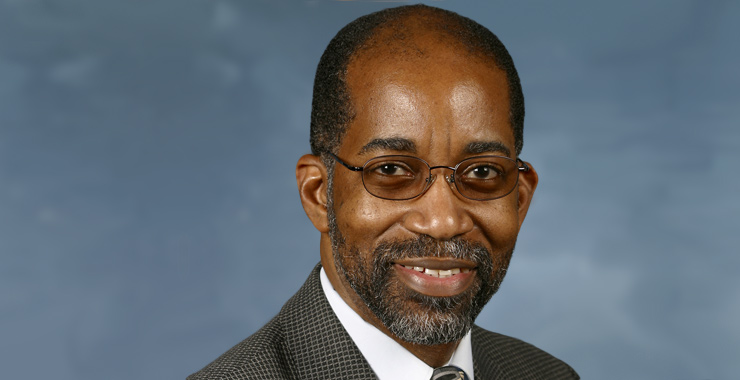
The work of David Williams, PhD, illuminates the damage that discrimination does to individuals, how it hurts their health and prospects, and how it shortens lives.
Williams, a public health professor at the T. H. Chan School of Public Health at Harvard University in Cambridge, Massachusetts, is perhaps best known for the Everyday Discrimination Scaleopens in new window he developed in 1995 at the University of Michigan (U-M) in Ann Arbor. Working with James Jackson, PhD, Williams used the university's ongoing "Detroit Area Study" to look at how social influences like stress and racism affect people's health and outlook on life.
The scale has been adapted and put to wide use assessing the occurrence and effects of discrimination based on race, ethnicity, gender, age or religion in situations like job interviews, trying to obtain a bank loan or interacting with the police. But the kind of treatment the Everyday Discrimination Scale measures is not the most important mechanism of racism, Williams says.
"Racism affects health in profound ways that are over and beyond any of the measures," he says, through systems that have been built up over the years and are now "locked in place, replicating social inequality."
Williams is a sociologist, but he is a social psychologist by training, and he is an APA member. He says he has always been interested in how the two fields come together. Williams has done groundbreaking work in the realm of health disparities, looking beyond obvious associations to find deeper truths. His contributions can be found throughout the APA's 2017 report, Stress and Health Disparities.opens in new window
What we have been comfortable accepting as genetic differences are actually rooted in the precarious nature of life for African-Americans and other disadvantaged people, Williams says.
"Race is not a useful genetic category, but it's a profoundly useful social category. That we know what race we belong to tells us much more about our society than about our biological makeup," he says.
The handicaps of being disadvantaged in America include worse nutrition as children; stress from the anticipation of violence in everyday life; diminished access to good health care; and, more broadly, socioeconomic differences that might not exist if the individuals were not targeted, marginalized and deprived of the tools to make their lives better.
For example, African-Americans are known to be relatively more susceptible to hypertension, or abnormally high blood pressure, than white Americans. In the past, the perception that they were genetically disposed to the condition was common. But Richard Cooper, MD, of Loyola University Medicine—located outside Chicago, Ill.—has shown that the associationopens in new window is not genetic but societal, that not only do black Americans have elevated blood pressure, but so do whites. In fact, white Americans have higher blood pressure than black people living in Africa, Cooper found.
Williams says, "What predicts hypertension is the social context. It's not consistent with a simple black gene causing high blood pressure. While we as a nation focus on the racial differences in health, the gaps in income and education for most health outcomes are larger than the racial gap."
Even so, "at every level of income and education, there is still an effect of race," Williams says; even wealthy black Americans are statistically less healthy than affluent white people. "Health disparities are large and persistent over time. About 220 African-Americans die every day in the United States who would not die if their death rates were similar to those of white people," he says.
Williams identifies housing segregation as the most pernicious agent of racism in our country, a system of public policies and rigged lending practices that channel black people into neighborhoods where no one else wants to live. This happens in every sizable city in the country, and has for many decades, forcing most African-Americans to live in less desirable circumstances than white people do, Williams says, citing the workopens in new window of William Massey and Nancy Denton.
"Even when they are living in the same city, blacks and whites are living under very different environmental conditions," Williams says.opens in new window "If you could eliminate residential segregation in America, you would completely erase black–white differences in income, education and unemployment, and reduce single motherhood by two-thirds. All that is driven by the opportunities linked to geographic space. That is the power of racism. The most powerful mechanism is this one that no one sees."
Taking individuals out of their disadvantaged neighborhoods improves their health, Williams says, but "I don't think that's the perfect model. People shouldn't have to move." He likes "purpose-built communities" like the East Lake neighborhood in Atlanta, Ga., a formerly dangerous, depressed, mostly African-American area with high crime and low school-completion rates. A wealthy patronopens in new window volunteered to help, and East Lake was subsequently transformed physically and otherwise into a safe, pleasant place to live.
Why don't similar interventions happen more often, if they work so well? In part, it is because of what Williams calls "an empathy gap." He says, "For most Americans, we do not care" what happens to black people.
Williams was born in Aruba and reared as a Seventh-day Adventist in St. Lucia in the West Indies. He went to college at the University of the Southern Caribbean in Port of Spain, Trinidad, then came to the United States to attend Andrews University near Berrien Springs, Mich., committed even then "to social justice and working to improve the life of others." He went to Loma Linda University in Loma Linda, Calif., for his master’s in public health. At the Battle Creek Adventist Hospital in central Michigan, he did community health education, first for his field work and subsequently as an employee for a year.
It was there that he began to realize that to be effective, "programs needed to enable people to address all the challenges that they faced in their social environment. I was not focused just on poverty or racism—but on all the sources of acute and chronic stress and adversity in people’s lives," he recalls.
Williams enrolled at U-M because "it was clear that my prior academic training had not prepared me to fully understand and effectively address the challenges linked to living and working conditions that were determinants of poor health in many communities." His mentor in graduate school, he says, was James S. House, PhD.
Williams taught sociology at Yale for six years, returned to U-M for 14 years, and moved to Harvard in 2006.
 David R. Williams, PhD, is a Harvard social psychologist whose work focuses on the relationship between racism and health.