

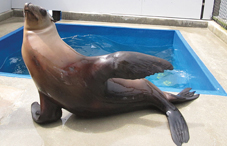

Humans, it turns out, aren't the only mammals with rhythm. Researchers have trained a sea lion named Ronan to bop her head to music, according to a studyopens in new window published in April in the Journal of Comparative Psychology.
The study spawned a YouTube videoopens in new window that's gone viral — more than a million people have watched Ronan keep time to "Boogie Wonderland."
But behind the adorableness is a serious scientific question. University of California–Santa Cruz graduate student Peter Cook and his colleagues wanted to know whether rhythm is unique to humans among mammals.
Researchers used to think that only humans could recognize a beat. But over the past several years, they have found that some speech-mimicking birds, such as parrots and cockatoos, can also do it. That led some researchers to theorize that the neural circuitry involved in speech — particularly enhanced feedback between motor and premotor areas — might also be related to rhythm.
"I thought, someone really needs to test this by seeing if a vocally inflexible animal could also beat match," says Cook. Ronan was just the right subject to try it.
"She's very bright and extremely motivated. She likes mental challenges," he says. "And I had some extra time with her on weekends."
Cook and an undergraduate research assistant trained Ronan to keep a beat in about 30 weekend training sessions over two months. They started with a metronome and worked their way up to songs with many different tempos.
The fact that it worked, Cook says, suggests that the speech mechanism theory may not explain how the brain recognizes rhythm after all. The next step for researchers, he says, may be to find out what other animals can keep a beat, and identify the things that link them.
"Psychologists who study music are very excited about [the finding]," he says. "People want to have an understanding of what drives human rhythmic ability — they have been arguing about this for a long time."
—Lea Winerman