


When clinical and community psychologist Arthur C. Evans Jr., PhD, was appointed commissioner of Philadelphia's department of behavioral health and intellectual disAbility services in 2004, he knew he wanted to apply some creativity to the job.
"I always joke that if we go into some of these communities and say, ‘I'm the mental health commissioner and I'd like to talk to you about mental illness,' everyone will run the other way," he says.
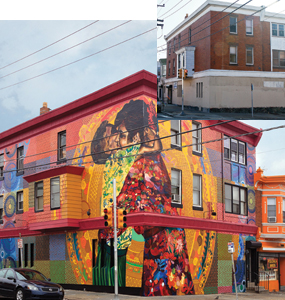 So when he attended a talk about The Philadelphia Mural Arts Program, a citywide effort that's been bringing together artists and citizens for 30 years, it made perfect sense to use a similar format to address issues related to mental health challenges. For one, it had the potential to reduce stigma related to mental health issues by bringing together community members and service recipients. It also could provide an enjoyable, meaningful activity for those with behavioral health conditions or intellectual disabilities.
"Painting murals seemed like it could be a very non-threatening, very engaging way to serve our populations and get our messages across," Evans says. "It's kind of coming in the side door instead of the front door."
The resulting program, Porch Light, was launched in 2008 and has been going strong ever since.
For community member Brenda Carter, attending the weekly lunchtime meetings with peers to help artist Ben Volta brainstorm ideas for a bus-side mural gives her joy and helps relieve her stress. "We just concentrate on the materials and ideas the artist brings in," Carter says. "We don't have to worry about what's going on outside."
Twenty-four murals have already been completed. One, "Personal Renaissance," was painted on the side of a building housing a methadone program and was developed by program clients and neighbors. It depicts the road from addiction to recovery, using symbols from clients' poetry. In keeping with the psychological finding that a good way to break down stereotypes is to work on a joint task with the person you're stereotyping, the project has brought the community closer. The art "really changed people's perceptions about who a methadone patient is," Evans says.
The Yale School of Medicine is conducting a rigorous outcome evaluation in three Porch Light communities. Preliminary results suggest the program provides social-emotional benefits for participants, improves the dynamic between the program and the communities it serves, and increases a positive sense of community in neighborhoods where the murals are being painted, Evans says. These results square with related findings, such as those from a major multistudy research program, The Social Impact of the Arts Project. Headed by historian Mark Stern, PhD, of the University of Pennsylvania, the project documents the positive impact that community cultural providers have in improving the quality of life in urban neighborhoods.
The Porch Light program is just one of many arts-related projects psychologists are joining to better connect with their communities. Other psychologists are conducting community bands, creating free art and performance events, and helping children learn about history through the arts, to name a few.
APA President Nadine J. Kaslow, PhD, who is promoting the link between art and psychology during her presidency, says reaching out to the community through the arts benefits both receiver and giver. She learned that firsthand as an undergraduate at the University of Pennsylvania, where, thanks to a scholarship that required her to bring arts to the community, she created a dance group that visited senior citizens and underserved and sick children.
Smiles were the general reaction, and audiences regularly joined in.
"Part of it was what we brought to them, but more important was what I learned," Kaslow says. "I became much more sensitized to different kinds of people and their needs."
Mirrors of the mind
In another effort that blends psychology and community art, in 2012 Los Angeles psychologists Pamela McCrory, PhD, and Terry Marks-Tarlow, PhD, launched "Mirrors of the Mind: The Psychotherapist as Artist," a multiplatform exhibit that features music, dance, poetry and lectures, all with psychological themes, such as the role of empathy in art. McCrory and Marks-Tarlow are now hosting the event for the third year.
The exhibit is a way to change people's perceptions of psychologists, says McCrory. "To the outside world, a psychologist is frequently seen as the archetypal blank slate that sits somewhat machinelike, exploring and interpreting the inner worlds of others," she says. "When we share our art, it offers people a glimpse into the richness and depth that lie beneath the professional exterior — not just the creativity and talent, but also the sensitivity, vulnerability and very human side of those who have dedicated their lives to helping others."
Meanwhile, psychologist and artist Lillian Cartwright, PhD, is using the arts to connect with children from economically disadvantaged homes as a volunteer for Achievement Via Individual Determination (AVID), a college-readiness system now serving some 4,300 schools nationwide. At one of these sites, in Fort Bragg, Calif., Cartwright and community organizer Janet Self are helping children to create or simply appreciate art, their contribution to an overall learning-enrichment strategy overseen by educator Gail Porcelan. Last year, children looked at pictures of sculptures by Ruth Asawa, an internment camp survivor, inspiring them to make sculptures out of wires. Other projects have included creating Picasso-inspired murals and studying Georgia O'Keeffe.
Although the team's goal is to provide children with materials to enhance their "cultural capital" and educate them about certain time periods and topics, Cartwright's favorite part of the experience is spending time with the children. "I'm just one of the gang," she says. "That's the successful part of it for me."
Banding together
Other psychologists are reaching their communities through music. University of California, Berkeley, psychology professor Robert W. Levenson, PhD, takes a break from his research on emotions and aging to conduct the Albany Jazz Band, an East Bay ensemble that includes lawyers, judges, researchers and the occasional high school or graduate student. The group plays a range of big band tunes including those by Glenn Miller, Quincy Jones and Gordon Goodwin.
Conducting a band that is harmonious in sound and spirit requires him to be part professor and part community psychologist, says Levenson, who started directing the band in 2007.
"The creative process gives people the opportunity to be really collaborative and supportive, but it can also make people competitive," Levenson says. "My challenge is to create an environment where people can do well and have a good time and that appeals to their better side."