

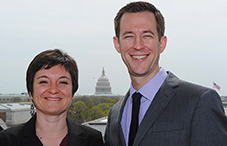

APA's 2014 congressional fellows have just finished their year: Irina Feygina, PhD, worked in the office of Sen. Michael Bennett, D-Colo., and Joshua Wolff, PhD, served in the Majority Health Policy Office of the Senate Committee on Health, Education, Labor and Pensions.
Before her APA fellowship, Feygina trained in social psychology at New York University and had just finished a postdoctoral research fellowship at Rutgers University's Center for Green Building. On Capitol Hill, she worked on energy and environmental issues, including development and financing of clean energy and energy efficient technologies and programs, advanced biofuels, declining forest health and wildfires in the American West.
Feygina enjoyed hearing the full spectrum of perspectives on the charged issue of energy. "It afforded me a view of how these many parts of the system interact, depend on each other, distribute power and contribute toward the challenges of maintaining a balanced and resilient system in both the short and long term," she says.
She says she was particularly struck by how often politics can stand in the way of good policy. Yet she also saw significant success, such as the creation of powerful conservation programs in the Farm Bill that will protect the Colorado River Basin and reduce wildfire risk in nearly 100 national parks.
The skills she gained through her psychology training — such as active listening and the ability to embrace multiple perspectives — were helpful while working in the legislative environment. "I have greatly enjoyed meeting with constituents and have repeatedly received appreciation for the depth and quality of our interactions," she says.
Now that her fellowship is complete, Feygina hopes to work in a government, nonprofit or industry position that will blend her research on behavior, critical thinking on social issues and focus on energy and the environment. "My training, in particular my focus on the interaction between institutions, groups and individuals, has served me well," she says.
Wolff was the Jacquelin Goldman congressional fellow, a position funded by the American Psychological Foundation through a bequest by Jacquelin Goldman, PhD, to support psychologists with expertise in child development.
He earned his doctorate in clinical psychology from Biola University and completed two years of postdoctoral fellowship work at Boston Children's Hospital and Harvard Medical School. His work there focused on families and children diagnosed with chronic and life-threatening medical conditions. His most recent research focuses on religiosity, health risk behaviors and sexual minority youth.
On Capitol Hill, Wolff worked on a range of issues, including mental health parity, implementation of the Affordable Care Act and funding for more traumatic brain injury research. Day to day, this meant meeting with lobbyists and constituents, researching the effects of policies, attending legislative negotiations, helping to organize congressional hearings, and many other activities. He also worked with the office on confirmation hearings for President Obama's nominations for the U.S. surgeon general and the secretary of health and human services.
His psychological training prepared him well for Capitol Hill. Wolff's research and statistics experience allowed him "to understand the strengths and weaknesses of studies in the stream of information from various groups and media." His background also helped him advocate within his office for mental health issues within ongoing health-care conversations and in policy recommendations.
Before his fellowship, Wolff viewed Congress as very partisan and he expected little interaction with staff from across the aisle. But he was surprised by the collegial relationships. "[I learned about] negotiation, appropriate compromise and improving communication with persons who may have differing opinions," he says.
After the fellowship, Wolff accepted a position as assistant professor at the Adler School of Professional Psychology's Chicago Campus, where he continues to pursue work that combines his clinical, research and public policy training. "I now realize how important it is for mental health professionals to make their voices heard in the political process," Wolff says.
Micah Haskell-Hoehl is a senior policy associate in APA's Public Interest Government Relations Office and administrator of the Congressional Fellowship Program.