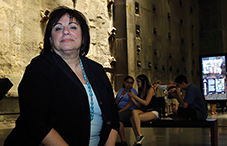

On the morning of Sept. 11, 2001, psychologist Billie Pivnick, PhD, was preparing to see patients in her Greenwich Village office when a plane struck the first tower of the World Trade Center. Her first patient called to cancel, saying she was going to help. Her second patient came in, frantic because her partner, who worked in the World Trade Center, wasn't answering her phone. Pivnick could relate: She couldn't get in touch with her husband, a criminal defense attorney, who was in court either in a World Trade Center building or a few blocks away near Foley Square.
"So while I'm listening to the patient, I'm also in my own panic," Pivnick remembers.
Meanwhile, her sons — ages 8 and 12 at the time — were watching the violent scene unfold from the 12th-story window of their school in Brooklyn.
Fortunately, the family returned home safely. Her husband, who had been near Foley Square when the first plane hit, ended up among the masses running across the Brooklyn Bridge as the first tower fell. He picked up their boys at school and met Pivnick at home in Brooklyn hours later.
"When I finally reached home and was in my husband's arms, I could cry and mourn," says Pivnick, who had walked home across the Manhattan Bridge. "Then I had to work on pulling my own children together because they had witnessed this thing."
As a clinical psychologist specializing in loss and trauma, Pivnick knew how to do that. For one, the family helped to raise money for new firefighter equipment so they could "do something active … to try to reverse the helplessness," she says. She and her sons also became regular visitors to a firehouse that had lost eight men in the attacks. Today, one of Pivnick's sons is a first responder and the other is studying to become an emergency medical technician.
"I do believe the experience imprinted them in a very fundamental way," she says.
In the years since the tragedy, Pivnick, who has worked on several museum exhibits, including at the Museum of Science and Industry in Chicago and the Connecticut Science Center, has been using these same skills on a broader scale: To help design the National September 11 Memorial Museum, which opened in June near the site of the attacks. As the consulting psychologist to the design firm Thinc Design, Pivnick spent five years working with exhibition designers, curators and other museum professionals to help inform the museum's visitor experience. The goal? "To make it alive enough to feel the emotions and the reality of what went on, but not so alive that it's unbearable," she says.
Pivnick talked to the Monitor about the museum and her role in its design.
What does the museum look like?
There are really two main exhibits. The first exhibit, the memorial exhibit, has an outer perimeter where you see all of the many photos of the people who perished lined up as far as the eye can see, as well as an inner sort of sanctum, which is dimly lit, where people may contemplate the lives of individuals we lost. In the outer area, there are touch screen tables where you can call up the name of someone you want to remember or learn more about. You are also given the option to project that person's story on the wall of the inner room. We thought of it as "the zone of the many and the zone of the one"; the idea was to create an opportunity for some intersubjective witnessing so that while you're feeling your own pain, you're also aware that other people are suffering, too. The whole spirit of the museum is how to honor these multiple perspectives, multiple narratives and multiple points of view on the history behind it.
The museum's second exhibit is historical. It's telling the story of the day. You walk through the day chronologically and you are able to make choices: You can stay on the perimeter with the facts or you can have a more intensely emotional experience by looking at personal artifacts found on the site. You can also choose to look at photos of people who jumped or hear voices of some of those terrible, awful wrenching phone calls, which are so much more distressing because they feel so present.
How do you even begin a project like that?
You begin with listening. That's what we do as psychologists. We listen, we look, we assess and that's where I started. The museum development staff hosted "conversational series" with various stakeholders, including those representing families of victims, first responders and the neighborhood to get their opinions on the design as it was being considered. I kept a notebook. I took notes at all the meetings. I also sat in on design team meetings so that we could develop a common language.
Even before that, when Thinc Design founder Tom Hennes was in the final stages of competing for the museum design job, I spent a few days telling him about the visitor experience at other memorial museums, such as Yad Vashem in Israel. We talked about the importance of creating lots of exits so people don't feel claustrophobic and decided to build in tissue boxes in key places in the museum so people could feel "safely held," similar to the idea that psychoanalyst Donald Winnicott talks about in which there is a certain amount of containment within which people can re-experience very troubling emotions but still feel safe.
In what other ways did psychology inform the museum's design?
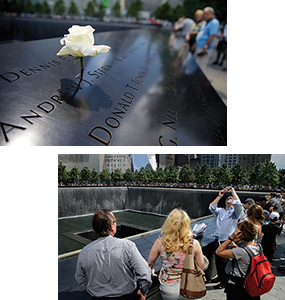 One thing we were very concerned about was the effect of overstimulation on visitors who had already been traumatized or were depressed. Obviously, this will not be all of the visitors — many visitors will come from other parts of the world, people will come who were born after Sept. 11, 2001, because they want to understand the history or they want to touch history in some way.
But for people who see the museum as a memorial, we felt it was very important to help move them "from shock to think," meaning that you have to make the absent more present in order to ultimately make it more absent. We wanted to create a narrative arc and obviously this wasn't just going be words — it's a very large space. We thought about it choreographically, too. So during the entry sequence, you come through this long corridor where you hear the voices of people talking about where they were on 9/11 and how they first heard about the attacks. You see them located on maps, identifying what parts of the world these voices are coming from.
Then people go from there down a 70-foot ramp into the exhibits. When they come out at the end, there's the opportunity for them to sign a piece of steel electronically, which creates a kind of mirror image to the entry narratives where the signatures are on a map projected on the wall. People can leave their mark on the site. They can turn passive into active, which is one way you help people cope with trauma — you help them find active mastery of an experience of powerlessness. We also provided booths for them to tell their stories in response to the museum's exhibits, where they were on 9/11, or any other story they want to tell. At the end of it, by signing the piece of steel and kind of reorienting themselves, they're able to say, "But I'm here now," and it brings them back to the present in case the exhibits sort of collapsed time for them and they felt stuck in the past.
From a psychological point of view, you're talking about working with procedural memory, not just semantic memory. Memories start out as fragments — sound fragments, visual fragments, kinesthetic fragments — and so we're giving people a chance to experience these things individually before they have to make meaning out of it and create a larger representation that will now include what they learned from the museum experience, too.
How did your clinical experience come into play during the design process?
I made a lot of referrals [for design team members], that's the first thing. I also discovered disjunctions between the story and the way we were representing the story, just as one might discover in a patient's trauma narrative. In other words, when something didn't make sense, we stopped and tried to understand what was missing. Just like in therapy, when an emotion is uncovered and experienced, you find words for it and you put it back into the narrative. The emotions should inform the exhibit itself, not just get enacted in the team meetings.
For example, one day the design team was looking at some preliminary designs that were kind of flat and lifeless. The chief designer was very frustrated and he took a piece of wood and he walked briskly across the room and forced the wood through a piece of foam core and said, "This is what's missing!" very vehemently. And of course it was the violence. We were working so hard to keep from re-traumatizing people that we had left out some of the shock and surprise and violence. Once we were able to recognize that the emotion had been really drained out of the design, the team very quickly developed a new design vocabulary and the exhibits became more vertical and jutting, incorporating more of the discordant elements of the real experience.
Whenever we hit one of those impasses, one of those gaps in the narrative, we tried to understand what was in that space. What were we missing? What was the emotion? What was the part of the story that we weren't telling? Inevitably, some new awareness would come and we'd be able to deepen the story or change the design in some way that was meaningful.
How did you cope with the intensity of the work?
I was in my own therapy, of course. One should not do a project like this without having a lot of emotional support. You can get too easily flooded and I felt it was important to separate out my own personal reactions from those in the team and those on the tapes we were listening to. That's part of our work as clinicians: We learn to do those things so that we're able to feel like our own instrument is accurately attuned.
When you're working with an individual, not every session every week for four years has that level of intensity and drama. If anything, it's like the difference between running a mile and running a marathon: You have to change the way you approach the project.
What do you want visitors to take away from the museum?
Tom and I thought about the museum as a way to help manage everything that collapsed on Sept. 11, 2001. It was more than just the buildings — they were iconic symbols that collapsed. There was a collapse in a lot of our reasoned dialogue in this country, our ability to talk about things. [There was a] collapse in time where people are still stuck in the past and haven't been able to come back into the present if they were traumatized. And there was a collapse of intersubjective meaning — listening to other and different points of view, other people's beliefs. The mourning in many ways has only been in fits and starts and hopefully that mourning conversation will start now with this museum.
Of course, the real goal is to make the experience bearable for people so that they can remember, which is the essence of mourning, and move on. If we accomplish anything beyond that, then so much the better for society.