

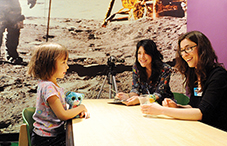

 As a Baltimore-area mom of two young children, Lisa Feigenson, PhD, has long been a fan of the Maryland Science Center, the city's waterfront science museum. But as a developmental research psychologist at Johns Hopkins University, she also used to find it puzzling that the museum — like many others — seemed to pay so little attention to behavioral science.
"I take my kids to science museums, and they predominantly represent what we know about things like planets and stars and dinosaurs," she says. "Aside from a few visual illusions, there's relatively little about the science of the mind."
Now, Feigenson's getting a chance to change that. Three years ago, Maryland Science Center staff asked her to take part in a program that brings psychological science to the public by hosting behavioral researchers who conduct studies onsite and explain their work to visitors.
The program, called the Living Laboratory Initiative, began in 2005 at the Museum of Science, Boston. Three years ago, the organizers received a National Science Foundation grant to expand it to other museums and science centers. Today, there are 16 sites around the country, and at each one the museums are working with local universities to bring researchers onto the exhibit floor to conduct real-time research.
The Living Laboratory consortium is the largest example of behavioral scientists working with science centers and museums to bring researchers and the public together under one roof.
"These kinds of collaborations are amazing two-for-ones," says Marta Biarnes, a co-principal investigator of the NSF grant who co-founded the program at the Museum of Science, Boston, in 2005. Researchers get access to a constant, reliable stream of participants for their studies. "And from the museum's point of view, having scientists on the floor is just an amazing opportunity for us to engage our visitors."
An open lab
At the Museum of Science, Boston, the living lab is housed in the Discovery Center, a 30-year-old hands-on exhibit area where young children can do chemistry experiments, watch live animals at close range and more. In 2005, Biarnes and her colleague Becki Kipling had the idea to bring in the behavioral science researchers as a way to engage parents as well as children in learning more about how science works, by introducing them to the work done by developmental psychologists who study a topic close to parents' hearts — children.
Today, eight labs from Boston-area colleges, universities and hospitals conduct research at the museum. Each is assigned a three-hour shift once a week, so there's often a researcher on the museum floor.
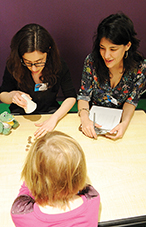
Peter Blake, EdD, a developmental psychologist at Boston University, for example, studies how children learn to share and develop a sense of fairness. He's examined that in a series of "sticker studies" at the museum. These studies are a variant of the "dictator game" from behavioral economics research. Blake gives children something they value — stickers — and then offers them the chance to give some of the stickers away to another child. He and his colleagues have looked at how different factors, such as age, how much the child likes the sticker and whether his or her parents are watching, affect the child's behavior.
The study is popular with kids. "There were Saturdays when there was a line of people waiting to play the sticker game," Blake says. For his part, Blake has published several papersopens in new window based on the museum research. In one, he found that among 3- to 6-year-olds, the older children were far more likely than younger children to give away at least one sticker, and at all ages kids were more likely to donate their least favorite stickers than their favorite stickers.
Blake has also discovered benefits to the museum work beyond publishing studies, including improving his ability to explain his work to a wide audience.
"You learn to talk directly to people with no research experience. And not talk at them — it's a conversation," he says. Parents will often ask him questions he hadn't considered, such as about the effects of parenting on the topics he studies. And he has learned to deliver a quick but accurate explanation of his research. "You want to convey the complexity of the science, but tailor it to the audience."
The researchers also get to draw on the expertise of the museum's education staff, who give them feedback on how to present their research to visitors in an engaging way.
In Baltimore, Lisa Feigenson has found other benefits as well. She is studying how surprise plays a role in shaping children's learning. Researchers have long known that babies and young children look longer at surprising events, but haven't been sure why. Feigenson hypothesizes that the longer looking time may reflect an opportunity for the babies to learn something new, because they realize they made a wrong guess about what would happen and want to learn why. Consistent with that idea, she and her students conducted a study in which they showed young children surprising events — like objects disappearing in one place and reappearing in another — and found that children learn better after a surprise.
In addition to improving her public outreach skills, Feigenson says the museum setting adds other dimensions to her research. She conducts her studies in a small area that's separated from the main museum floor by a waist-high wall — so there is some separation, but visitors are constantly wandering by to watch the proceedings.
"Most of our research is done under very controlled lab settings. It's less clear whether those same abilities can be demonstrated under loud chaotic settings like the museum floor," she says. "So this gives us a little bit of a different window into some of the [phenomena] that we are interested in studying."
Indeed, Blake says, it's important for researchers working in museums to think about how the setting will affect their work and to tailor their studies appropriately. For example, because of the high potential for distraction, he doesn't conduct any studies there that require more than seven minutes of a participant's time.
"It does put some limitations on what you can do," he says. But the flip side of that is that he can run studies with 350 participants much more efficiently than if he had to recruit hundreds of families to come to his lab.
An observational approach
Setting up mobile labs is just one way psychologists are working with science centers and children's museums. Maureen Callanan, PhD, a developmental psychologist at the University of California, Santa Cruz, has been conducting mostly observational research at the Children's Discovery Museum of San Jose for more than 15 years.
Callanan studies cognitive and language development in young children and is particularly interested in how language develops in the context of everyday conversation. She had been studying parent-child interactions in her lab and in her participants' homes, but at one point in the late 1990s, she realized that a children's museum could provide a fertile ground for her observational studies.
When she and her team approached museum staff with the idea, they were nervous it would be dismissed as a hassle. "But we were surprised by how excited they were about the idea," she says. "They really wanted to know about our research and thought that it could be useful for them."
In one of her first studies at the museum, Callanan asked parents for permission to record their conversations as they walked through an interactive science exhibit. Then she looked at the ways in which parents interacted with boys and girls while taking in the displays. She found that parents were three times more likely to engage their sons in explanations of the science than they were their daughters.
Callanan published her results in Psychological Scienceopens in new window in 2001. At the same time, the findings inspired the museum's staff to develop a new exhibit called "Alice's Wonderland," which used the character Alice to present the same science content as the original exhibit. The idea was that having a female character present the science would give parents the subtle message that it was relevant to girls as well as boys. Callanan and her students then observed families in the new exhibit and found no differences in the ways parents talked to their sons and daughters there.
Since then, Callanan has continued to work with the museum on projects that contribute to her theoretical research on cognitive development and help the museum evaluate and refine its exhibits. Recently, she helped develop a new exhibit on mammoth bones by evaluating families' conversations as they walked through a prototype of the exhibit.
"That was a really interesting collaboration because the exhibit goals aligned with my research goals," she says. "The museum wanted to know how to help children understand the role of mammoth bones as scientific evidence. And I was really interested in how children, through everyday interactions, learn to think and ask questions in [a scientific] way."
That kind of collaboration, she says, illustrates the potential benefits when psychologists and museums work together — and is one of the reasons this kind of work is expanding.
"People have caught on that this is a potentially valuable resource for everyone," she says.