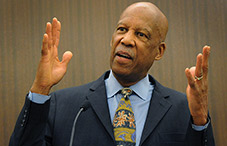

In 1957, when Terrence James Roberts, PhD, and eight other teenagers became the first black students to attend classes at Little Rock Central High School in Little Rock, Arkansas, they confronted a mob of more than 400 protesters.
So began their "year of sheer hell," Roberts said during APA's 2014 Annual Convention in Washington, D.C., on Aug. 9. "Whatever you might possibly consider that one human being could do to another, that happened to us — daily."
Through resilience and faith, Roberts eventually graduated from Los Angeles High School and went on to earn a PhD in clinical psychology in 1976. In 1999, he and the other members of the Little Rock Nine were awarded the Congressional Gold Medal by President Bill Clinton. Roberts is now retired from the faculty of the Antioch University Los Angeles and is principal of the management consulting firm Terrence Roberts Consulting.
At the convention session, sponsored by APA's Committee on Ethnic Minority Affairs, APA President Nadine J. Kaslow, PhD, awarded Roberts with a presidential citation for "his dedication as a civil rights pioneer and a psychologist devoted to the advancement of social justice and racial equality."
Although life has changed for black Americans in the United States since Roberts's high school days — and has changed in large part due to his and others' courage — it hasn't changed enough, he said during his talk.
"The law is now on my side, but still I am forced to contend daily with the ongoing violence of social and cultural exclusion, demeaning ideological belief systems, invidious institutional practices, implacable psychological barriers, ahistorical and pseudoscientific research designed to support claims of white supremacy and well-meaning others who suggest that I ‘overreact,'" Roberts said.
But Roberts encouraged audience members to be resilient — and to take action. "Instead of despair," he said, "I offer you the opportunity to learn as much as you can, develop a strategy and intervention, and move forward confidently with the assurance that whatever you do will, in concert with what others do, be sufficient to alter the course of history."
— Anna Miller