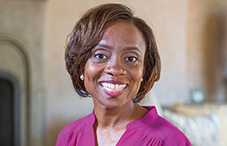

When Jennifer L. Eberhardt, PhD, was in middle school in Cleveland, Ohio, her family moved from an all-black neighborhood to an all-white one. "The neighborhoods were within biking distance, but they were worlds apart," she says. "That experience was really transformative, and led me to think about issues of racial inequality."
Now, as a social psychologist at Stanford University, Eberhardt is still thinking about those issues. She studies how subtle, often unconscious racial biases influence people's impressions and behaviors, especially within the criminal justice system. For her pioneering research, she was honored in September with a prestigious MacArthur Fellowship. Also known as a "genius grant," the award comes with a $625,000, no-strings-attached prize.
Consciously or unconsciously, many people associate African-Americans with crime, Eberhardt says, and that bias can affect behavior in surprising ways. She and her colleagues have found, for example, that when white volunteers were primed to think about crime, they were more likely to focus their attention on black faces and away from white ones. In a related experiment, white volunteers who were shown images of black faces were better able to identify a blurry image of a gun (Journal of Personality and Social Psychologyopens in new window, 2004).
Such subtle associations can have not-so-subtle effects on criminal justice, Eberhardt and her colleagues have found. In one study, white participants read about a juvenile defender convicted of rape. When the offender was described as black, participants were more likely to support harsher punishments for juvenile offenders in general than they did when he was identified as white (PLOS ONEopens in new window, 2012). In another unsettling finding, Eberhardt and colleagues studied African-American defendants convicted of killing white victims. They found defendants who looked more stereotypically black (with darker skin and broader noses, for instance) were more than twice as likely to receive the death penalty as those who looked less stereotypically black (Psychological Scienceopens in new window, 2006).
In some ways, Eberhardt's findings aren't unexpected. "I think most people are conscious of the black-crime association," she says. Still, many don't fully appreciate how that association can affect their own perceptions and decisions. Indeed, she's found that people who are low in prejudice are just as likely as those high in prejudice to be influenced by these ingrained biases — including police officers.
Now, Eberhardt is looking for solutions. For starters, she's talking to "people in the trenches," she says, including litigators, police officers, inmates and community leaders. She's working with police in Oakland, California, to help analyze their data on racial profiling. And she's co-directing a new center at Stanford, known as SPARQopens in new window (Social Psychological Answers to Real-world Questions), to bring academics and practitioners together to tackle social problems. "Everyone has a story to tell, and a perspective that can enrich the research," she says.
Eberhardt says receiving the MacArthur award has bolstered her motivation. "The work I do can be depressing. It is hard to do year after year, day after day," she says. "With the award, I've heard from people far and wide about how important this work is. I have a renewed energy."
That energy comes at a key time. With recent high-profile events such as the shooting of an unarmed black teenager by a white police officer in Ferguson, Missouri, the topic of racial injustice has risen to the top of the public's radar. Though they are difficult stories to hear, Eberhardt says, she's pleased that people are paying attention.
"These are significant and long-standing problems, but I do feel hopeful," she says. "I feel like we're at a moment where we have the capacity to really move the needle."