
 For more than 40 years, Sesame Street's Cookie Monster sent crumbs flying as he wolfed down any cookie within his reach. But last season, the TV show's pint-size viewers saw something different. Cookie Monster wanted to join the "Cookie Connoisseurs Club," and to do so he had to learn how to control himself around cookies. So Cookie Monster — and by extension Sesame Street's preschool audience — spent the season learning new tricks and strategies to savor the cookies slowly rather than scarfing them down with abandon.
The plot is funny, but it's based on serious science. In a series of studies that began in the late 1960s and continue today, psychologist Walter Mischel, PhD, found that children who, as 4-year-olds, could resist a tempting marshmallow placed in front of them, and instead hold out for a larger reward in the future (two marshmallows), became adults who were more likely to finish college and earn higher incomes, and were less likely to become overweight.
So what's the lesson to take from this? It's not that the marshmallow test is destiny and that preschoolers who fail it are doomed, Mischel says. Instead, the good news is that the strategies the successful preschoolers used can be taught to people of all ages. By harnessing the power of executive function and self-control strategies, we can all improve our ability to achieve our goals. Today, Mischel's lessons are being applied on Sesame Street and in inner-city charter schools, among other places.
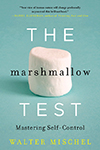
Mischel talked to the Monitor about his decades of research and his new book, "The Marshmallow Test: Mastering Self-Control," that sums them up.
Why is this research important?
To me it's a matter of helping kids to have the freedom to make choices. Whether or not they choose to eat the marshmallow, if they know how to wait for it, is up to them. But they should have the ability to have a real choice.
It doesn't mean that you spend your whole life self-controlling, obviously. A life that's all self-control can be as dismal as a life without any self-control. But it means that you need to have the skills plus the motivation if you want to really optimize your opportunities.
What first drew you to studying this?
It began when my children were young. I was a young faculty member at Stanford, and my three daughters were very closely spaced in age, between 2 and 5 years old. And I saw this remarkable progression that every parent sees, where their children go from clearly not having any self-control competencies, to, by the time they're 4 or 5, being able to control themselves reasonably well in many situations, and even do things like wait for dessert.
This drew me to the questions of how self-control is mastered, how it develops naturally, and what we can do to increase it in our children or ourselves. What are the mental, and — years later — what are the brain mechanisms that make emotional self-regulation and behavioral self-regulation possible?
It is really the story of resistance to temptation — the story of Adam and Eve in the Garden of Eden — that I was interested in. So that's how the marshmallow test was born.
Did you have any inkling back then that you'd be following these then-4-year-olds for the next half century?
Not in the slightest. I was just interested in the mental and behavioral processes that allow kids to self-control. I published a series of experiments in the '60s and '70s and '80s on that, and those studies in my opinion are in many ways more interesting than the follow-up findings that yes, kids who are good at self-control and delay of gratification become grownups who are good at self-regulation and self-control, and that there are substantial differences in outcomes that show that self-control is an extremely important cognitive and emotional skill set.
The good news is that this cognitive and emotional skill set is eminently teachable, particularly early in life. It's great in preschool; it's great within the first few years of life. It's great in adolescence even. And it continues to be a skill set that can be developed even when we're quite mature adults.
Have you found the same effect in other populations?
Yes. To me one of the most exciting findings is in kids from the South Bronx. We've done five-year studies with them, and found that self-control ability has very important protective effects against our own vulnerabilities. So, for example, people who are highly sensitive to exclusion and rejection often find themselves in a pattern that they are so anxious and worried about rejection that they actually behave in ways toward their friends and partners that make them get rejected … so it's a self-fulfilling prophecy.
Well, we followed kids from the South Bronx for five years, and found that the ones who have high rejection sensitivity, but who are able to wait to get a big bag of M&Ms a week later rather than settle for a few M&Ms now, are much better at not being, for example, as inclined toward aggressiveness. They're able to control their reactions, and so they don't see the same result from their rejection sensitivity. So, self-control has this protective effect that's hugely important, and I think that's very important for clinical psychologists to have in mind. It implies that teaching kids to improve self-control skills can have a protective effect because it allows them to deal better with whatever their own "hot spots" are.
What are some ways those skills can be taught, especially to children?
They can be taught in many interesting and child-friendly ways. A particularly good example of that are studies that Michael Posner and his colleagues at the University of Oregon reported in the Proceedings of the National Academies of Sciences in 2005. They worked with 4- to 6-year-old kids, and the idea was to help them acquire better executive function skills using a computer game. For example, in one of the exercises, there's a cat in a rainstorm. The children's job is to use a joystick that controls an umbrella to keep the cat dry as it runs around. So this is teaching executive function: I have a goal, I have to keep the umbrella over the cat's head, I can't get distracted and start looking around, I have to keep that umbrella over the cat's head.
Posner and his crew found that five sessions of 40 minutes each with these kids led to substantial increases in their executive function and executive control, and even some increase in nonverbal IQ measures.
And, of course, there's the work with Sesame Street.
They asked me give a talk, and I wound up working with them in a minor advisory role. We decided to create situations in which Cookie Monster must learn to control himself because he's got a new goal, which is to join the cookie connoisseur gourmet club — for which you have to wait for your cookies. So Cookie Monster learns strategies, for example "framing" the marshmallows and pretending that they're just a picture, because if it's just a picture you can't eat it. Cookie Monster also comes up with the idea that if he imagines the cookies are smelly fish, then he won't want them. And so on.
The idea is for kids to be exposed to strategies that teach them what executive control is, while they're having fun.
What's crucial to remember is that there are two components to applying this work. One is that kids need to know how to do it — they need to have the cognitive control skills. But they also need the motivation to do it — they have to want to change. And that is exactly what every therapist will tell you. You don't get very far unless people want to change their behavior.
Is it as effective for kids to learn this from Sesame Street as it would be for them to get it from their parents or in the classroom?
I'm not aware of systematic comparison studies that would compare that. But it doesn't hurt to go on all fronts.
At the same time, it's also wonderful that they're being implemented, for example, in the KIPP schools in New York, which I've also been involved with. There, the strategies we're talking about, including the development of the skills that are involved in building character qualities like grit and persistence, tolerance of frustration, gratitude, optimism, excitement and energy as you enter a project … all of these things are being incorporated in many school programs by educators. And I think that's the most exciting way to go.
For preschool-age children, there's a very interesting study reported in Scienceopens in new window in 2007 by Adele Diamond and her group, on Tools of the Mind, which is a program for teaching executive function and executive skills to preschoolers. It turned out to be highly effective for kids from highly impoverished, high-stress areas.
So there's a huge amount of evidence that's accumulated from brain studies, behavioral studies and educational studies that makes it very clear that there are methods for enhancing the kinds of skills and qualities and emotion regulation that kids need if they're going to do well in school.
How do parents develop these skills in their children?
Step one is, if you want your children to have self-control, you need to model it. If you make promises, you need to keep them. You can't expect kids to delay gratification if you're breaking your own promises to them. Kids also need to learn that their behavior has consequences. If they behave in constructive and creative ways, the consequences are good. And if they behave in destructive ways, the consequences are not so good. They need to become aware that there's a relationship between what they're doing and what happens to them so that they can develop a sense of agency, a sense of mastery and a sense that they can control their own behavior.
One last question: Are you still following the original participants from the Stanford marshmallow study?
Yes. They're now between their very late forties and early fifties. And we are in the middle of a study, in collaboration with a team of economists from Harvard University, where we've administered to a sample of about 110 of the original Stanford kids a very extensive set of economic outcome measures, in order to see what's the relationship between maintaining these two different patterns of high self-control over the life course versus low self-control over the life course, and economic outcomes.
Now, those are the two trajectories we've studied — consistently high control and consistently low control. But if I had another lifetime, and funding, I would also study the kids who start high, which means they demonstrated that they have good executive control in the original marshmallow study, but over the years they've gone down and down in self-control. And those who start low and went high over the life course. Those are smaller trajectories, but they exist, and they are the ones that we don't know much about.