

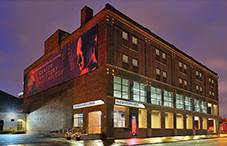

Some of psychology's most historic artifacts haven't been on public view in years simply because there hasn't been a place to display them. Now, thanks to a $3.5 million gift from psychologist and philanthropist Nicholas Cummings, PhD, and his wife, Dorothy, a treasure trove of items — including the personal letters of William James and Carl Jung, the "shock generator" Stanley Milgram used in his obedience experiments, and much more — will soon be on permanent display.
The Cummings' gift will enable the Center for the History of Psychology at the University of Akron to more than quadruple its public exhibit space from 1,700 to 8,000 square feet by the summer of 2016. The center will also be able to build a new library space and reading room for scholars. In addition, the gift will support an endowment to fund a full-time associate director. The revamped center will be named the Drs. Nicholas and Dorothy Cummings Center for the History of Psychology.
"The significance of this gift is that we can really do so much more to give psychology away, which is maybe a trite phrase but an important one," says David Baker, PhD, director of the center and a psychology professor at the University of Akron.
The center was founded nearly 50 years ago as the Archives of the History of American Psychology by University of Akron professors Marion White McPherson, PhD, and John Popplestone, PhD. As the only repository of its kind, the collection quickly outstripped its space — and its funding. For many years, the archives were held in the school's psychology building, and then in the basement of an old department store.
"We were content-rich but resource-poor," says Baker, who succeeded Popplestone as director of the center in 1999. "When I started, I was truly overwhelmed by the amount of material we had."
The archives now include thousands of personal papers and manuscripts from more than 700 noted psychologists, more than 8,000 psychological tests, and a rare book collection that dates to the 16th century. It also includes more than 2,000 objects, including such iconic ones as the "bobo doll" from Albert Bandura's studies of aggression in children, a "Skinner box" that was used to study operant conditioning in rats, some of Herman Rohrschach's original ink blot tests, and a prison door and uniforms from the Stanford Prison Experiment.
In 2005, the archives received a 75,000-square-foot building on the edge of the University of Akron campus as a gift from a local shipping company that no longer needed the space. An earlier gift of $1.5 million from the Cummings family, along with other donations, allowed the center to begin renovations and open a small public exhibit space in 2010. The center has also developed curriculum guides based on its material, welcomes students on school field trips to its exhibits, and organizes occasional conferences and workshops on psychology history and archival preservation topics. It was named a Smithsonian affiliate in 2002, one of about 200 museums throughout the country that work to share resources between the Smithsonian and other independent museums and archives.
Making sure that future generations have access to the archives' rich trove of materials inspired the Cummings's donation. "I'm now 90 years old and I've seen the fellow psychologists that I've worked with for the past 65 years passing away," Nicholas Cummings says. "It won't be very long before the history is lost if we don't work to preserve it."
Cummings, the 1979 APA president, had a long and successful career, first as chief of mental health for Kaiser Permanente from the 1950s through the 1970s, and then as the founder of American Biodyne, a mental health managed-care company. In recent years, he has waded into controversy, writing an op-ed column in USA Today in 2012 arguing that sexual reorientation therapy is not always unethical and can sometimes work when people undergo it willingly. (APA disagrees. "The scientific evidence is insufficient to support such therapies, and promoting such therapies contributes to the societal stigma on homosexuality," says Clinton Anderson, PhD, associate executive director of APA's Public Interest Directorate. Cummings, however, says his argument is misunderstood. "I spent many years in my career fighting for the rights of gays and lesbians," he says. "I simply don't believe that anything is 100 percent. So the concept that absolutely no one is able to go from homosexual behavior to heterosexual behavior troubles me.")
"Nick is not afraid of controversy," says Baker, adding that Cummings "does not want to in any way force our programming or present psychology in a certain point of view."
Indeed, Baker says, the center's mission is to gather and make available all of the history of psychology.
"Our byline is ‘exploring what it means to be human,'" he says. "The lay public is interested in that, and it's meaningful in a different way to a psychologist. And all constituencies and audiences can come together in our space."