
In response to changing testing environments, technological advancements and other trends, APA and its partners have revised the Standards for Educational and Psychological Testing.
Aimed at test developers, sponsors, publishers and users, the standards cover tests and assessments used in clinical practice, industry and personnel decision-making, school psychology, certification and licensure and educational assessment, both at the individual level and in large-scale accountability testing. The American Educational Research Association, APA and the National Council on Measurement in Education have published the standards collaboratively since 1966. The standards are considered the "gold standard" on testing and assessment practices.
Last revised in 1999, the standards have undergone a six-year revision process involving a panel of experts and multiple rounds of public feedback.
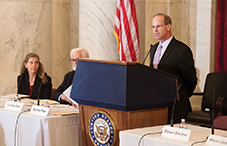
"Our charge was not, ‘Let's rewrite the standards from the ground up,'" says psychologist Lauress L. Wise, PhD, principal scientist at the Human Resources Research Organization and co-chair of the Joint Committee for the Revision of the Standards, who spoke at a Sept. 12 Capitol Hill briefing on the standards. "It was, ‘Let's focus on areas where there have been changes and the standards need a fresh look.'"
The resulting 2014 standards have three major changes:
- A new emphasis on fairness. In previous editions, the notion of fairness in testing individuals with disabilities, different linguistic and cultural backgrounds and other characteristics was scattered across various chapters. The new edition devotes an entire chapter of the foundations section to fairness, giving it as much prominence as validity and reliability in good testing practice. The chapter also expands the concept of fairness to include everybody, not just special populations, says Joint Committee Co-chair Barbara Plake, PhD, a professor emerita of educational psychology at the University of Nebraska. In addition to concerns about fairness for those with disabilities and diverse linguistic and cultural backgrounds, the revised standards also focus on such areas as age and gender.
- Information about new and emerging technologies. Since the last edition, there have been many technological developments, according to psychologist Laura S. Hamilton, PhD, a senior behavioral scientist at the RAND Corp. and a member of the Joint Committee. Tests are now taken, scored and reported out via computers, for example. In addition, tests can now be tailored to match the ability of individual learners. As a result of these and other trends, the 2014 standards address such issues as test security, scoring of open-ended items and automated score reporting.
- An expanded discussion of how tests can be used to hold students, educators and others accountable. No Child Left Behind, the Race to the Top legislation and other policies made it necessary to expand the standards' treatment of high-stakes testing, said Hamilton. The stakes aren't just high for students, she said. There's also a growing emphasis on measuring teacher effectiveness, so the standards explore that issue, too. In the behavioral health arena, health systems are increasingly using depression inventories and other mental health measures to assess how effective providers are. The goal of this new information is to stop people from using tests for purposes that they're not designed for, said Hamilton, adding that the need for evidence supporting specific test uses goes up as the stakes get higher.
Rebecca A. Clay is a journalist in Washington, D.C.