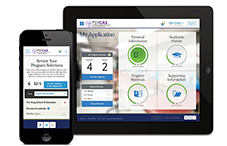

Applying to graduate school will soon be easier than ever before. This month, APA debuts its Centralized Application Service for Graduate Psychology, or PSYCAS, an online cloud-based applications management system that will digitize every stage of the graduate psychology application process and allow a prospective graduate student to apply to multiple schools with one application.
PSYCAS is available at no cost to any graduate-level psychology program across the discipline that registers for the service, and APA and PSYCAS staff will provide in-person training, ongoing customer support and online tutorials on how to use and customize PSYCAS to a department's needs.
Applicants will simply submit a single copy of their transcripts*, letters of recommendation and other supporting materials to PSYCAS, along with a list of the schools and programs they want to apply to. Applicants pay $100 for the first school they designate and $40 for each additional school or program — a cost-saving measure for those applying to multiple schools that have application fees as high as $90 without the centralized service. PSYCAS will then digitize the materials, verify all transcripts* and generate the student data that each program requires, such as customized GPAs for prerequisites or specific types of courses.
PSYCAS staff will field all applicant queries about outstanding recommendation letters, deadlines or the status of an application at a specific school. Applicants will also be able to check the status of their application and all of their supporting materials at any school via their computers, tablets or smartphones.
The system also offers numerous benefits to graduate departments and faculty, enabling them to:
- Access all applications anytime. Rather than wading through lots of individual files for applicants and their materials, faculty can view all the applications they need to evaluate in one place from their computers or mobile devices. "If you're sitting in an airport between conferences and realize you have the time to read one application, you have it with you," says Garth A. Fowler, PhD, associate executive director for graduate and postgraduate education in APA's Education Directorate.
- Spend less time writing letters. A professor who is writing a letter of recommendation for a student only has to upload one copy of the letter. "When you have 10 students applying to 10 programs each, letter writing can really increase your workload," says Mary Beth Kenkel, PhD, a member of APA's PSYCAS advisory panel and dean of the college of psychology and liberal arts at the Florida Institute of Technology.
- Spend more time analyzing applications. Having to do less paperwork and field fewer questions from applicants means faculty have more time for recruitment and in-depth analysis. "When you don't have to spend time on some of those rote, redundant processes, you can dedicate all that time you save to other parts of the process," Fowler says.
- Target their communications. PSYCAS offers tools to help departments reach out to applicants at various stages of the process. For example, a department can email applicants who didn't complete their applications, or invite applicants with a specific GPA or higher to tour the university or come in for an interview.
PSYCAS will also help programs capture data over time, so that they can compare applicants from year to year or their applicant pools to national data.
"This will also give our entire discipline information on who is applying to graduate school, what that pipeline looks like, what their strengths are and where they are coming from," says Kenkel.
APA unveiled PSYCAS to graduate psychology departments during APA's 2014 Annual Convention in Washington, D.C., and will roll the system out slowly as schools decide if it's a tool they want to use, starting with the 2015 fall admissions cycle, says Fowler.
"We know we can't get all 600 graduate programs overnight," he says. "It's a slow build process with the soft launch and we hope to have a larger number of participants by the fall of 2015."
Psychology is not the first field to streamline its application system. Liaison International, the company that will provide the data support for PSYCAS, runs two dozen CAS services, including NursingCAS for nursing school applicants with the American Association of Colleges of Nursing, and CSDCAS for audiology program applicants with the Council of Academic Programs in Communication Science and Disorders.
Interested in bringing PSYCAS to your school? Contact Daniel Michalski, PhD, assistant director of graduate and postdoctoral education..
Find the answers to frequently asked questions about PSYCAS and dates for webinars and training sessions online.
*This article was edited after publication. A single test score report is not available at this time.