

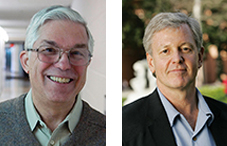

For J. Bruce Overmier, PhD, psychology is obviously a science, technology, engineering and mathematics (STEM) discipline.
"Experimental psychology is no different than experimental chemistry," says Overmier, a professor emeritus of psychology at the University of Minnesota in Minneapolis who was originally trained as a chemist. Both disciplines attempt to discover the natural laws governing the actions of "unobservables," whether electrons or human motivations, and study the effect of manipulating them, he points out.
But the public doesn't always see psychology as a hard science, which is why one of APA's strategic goals is to increase recognition of psychology as a STEM discipline. To further that goal, APA's Board of Educational Affairs (BEA) launched the BEA Outstanding Graduate Teaching of Psychology as a Core STEM Discipline Award in 2014. The award, which will be given every three years, recognizes the contributions of graduate-level professors whose teaching and scholarship exemplify psychology as a core science among the STEM disciplines.
"So often, the public forgets that psychology is a STEM discipline," says BEA Chair Jodie Ullman, PhD, a psychology professor and special assistant to the provost at California State University at San Bernardino. "We want to remind people that psychology is a STEM discipline and to celebrate outstanding faculty members who teach psychology as a STEM discipline."
The response to the inaugural call for nominations was so great that the expert panel tasked with choosing a winner had a hard time selecting just one, even after members had winnowed the nominees down to two, says Garth Fowler, PhD, associate executive director of APA's Office of Graduate and Postgraduate Education and Training "They were both of such exceptional quality, they couldn't single out just one," says Fowler. "They decided, ‘Why not do two?'"
Overmier split the award, which includes a $2,500 honorarium, with John "Jack" McArdle, PhD, a senior professor of psychology at the University of Southern California in Los Angeles.
What stood out in Overmier's nomination was the number of students he has mentored and his commitment to lifelong mentorship, says Ullman.
"What was particularly noteworthy was the way he kept up with mentoring his students as they moved through their professional careers," she says.
Now retired, Overmier spent his teaching career emphasizing the importance of the scientific method. To underline psychology's role as a science, he says, he would explain to students what makes science science, how science proceeds via the testing of hypotheses and how basic science builds into applied science. Another message? The excitement of scientific discovery.
Overmier will use his share of the award money to support his own and students' research and to advocate on behalf of psychological science.
McArdle's award recognizes his status as a role model for psychology students, says Ullman.
"He's just an outstanding quantitative psychologist," she says. "He's an incredibly strong scholar himself in structural equation modeling and longitudinal methods." In addition to recognizing McArdle's own scholarly contributions, the award celebrates his role in training the next generation of quantitative psychologists.
McArdle plans to use his share of the award money to purchase a new computer to help with his research on cognitive decline in older adults.
For more information about the award, which is one of three graduate and postgraduate awards BEA gives out, visit APA Awards.
Rebecca A. Clay is a journalist in Washington, D.C.