For the past 10 years, the number of psychology doctorates and master's degrees awarded in the United States has been steadily rising. What types of institutions are granting these degrees?
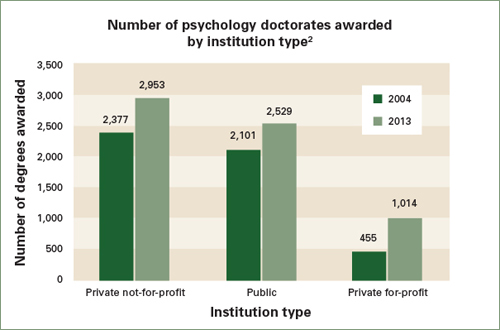
- In 2013, private not-for-profit institutions awarded the most doctorates (2,953), representing 46 percent of all doctorates awarded that year. This was an increase of 24 percent since 2004.1
- Public institutions awarded the second highest number of doctorates in 2013 (2,529), representing 39 percent of all doctoral awards — an increase of 20 percent since 2004.
- Private for-profit institutions awarded the fewest doctorates, but their rate of growth was greater than the other institution types. The number of doctorates awarded by these institutions grew from 455 to 1,014, a 123 percent increase over the past decade.
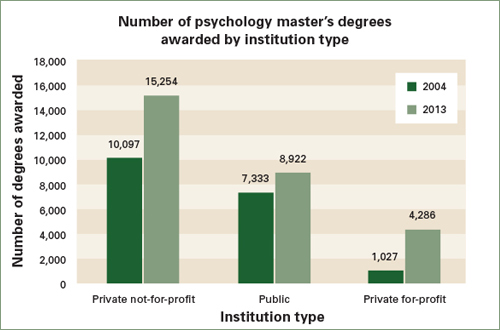
- Private not-for-profit institutions granted the most master's degrees (15,254), representing 54 percent in 2013, an increase of 51 percent since 2004.
- Public institutions granted the second highest number of master's degrees in 2013 (8,922), representing 31 percent awarded that year. That's a growth of 22 percent over 10 years.
- Private for-profit institutions granted the fewest master's degrees, but had the greatest growth rate over 10 years, increasing by 317 percent with 1,027 master's awarded in 2004 to 4,286 in 2013.
— Peggy Christidis, PhD, Karen Stamm, PhD, Andrew Nigrinis, PhD, and Mariquita Mullan, PhD
1 IPEDS doctoral degree categories were used to identify types of doctoral degrees. Definitions can be found in the IPEDS glossary: https://nces.ed.gov/ipeds/glossary.
2 U.S. Department of Education, National Center for Education Statistics, Integrated Postsecondary Education Data System (IPEDS). (2004–13). Completions Surveys. [Data files and dictionaries]. Retrieved from https://nces.ed.gov/ipeds/opens in new window .