

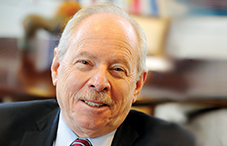

Alan Leshner, PhD, began his career as a researcher and professor at Bucknell University, studying the effects of hormones on behavior. But after 10 years there, his interest in broader, multidisciplinary questions and his desire to champion science among the public and policymakers led him to transition to the policy world.
Over the years, Leshner has held many high-profile leadership positions, first at the National Science Foundation, where he worked from 1979 to 1988, then as deputy director and acting director of the National Institute of Mental Health from 1988 to 1994, and director of the National Institute on Drug Abuse from 1994 to 2001.
In 2001, he became CEO of the American Association for the Advancement of Science (AAAS) — the world's largest general scientific society — where he aimed to expand the group's leadership role in science, both nationally and internationally.
Leshner officially retires on Feb. 17 — former New Jersey Congressman Rush Holt will replace him.
Leshner spoke to the Monitor about his career, his advice for new psychologists, and how psychological scientists can help policymakers and the public understand and appreciate their research.
Let's start with a broad question: What is the public understanding of and support for science today, and how have you seen that change over time?
We are in one of the most difficult times we've had in science. First of all, public understanding of various scientific findings is not vastly different than it was a long time ago, and it would be better if the public had a more accurate understanding [of specific scientific facts]. But the biggest hole, really, is that the public doesn't understand the nature of the enterprise. What they're missing is an understanding of how science works, so that they can better discriminate what is and isn't science.
How can we increase that understanding?
Scientists have to reach out and engage with the public, through meeting with and by giving talks to community groups, retirement homes or churches, mosques or synagogues. But when they do, they have to make sure that they're not just talking about individual findings. Instead, they need to describe how science functions and what is — and isn't — science.
The other thing that I worry about is that right now, there are many issues that are what I would call threats to the public's trust of science, such as conflicts of interest or overstating results, or scientific misconduct. These are very rare events within science. But that doesn't mean they don't tarnish all of science when they occur. So in spite of the fact that people admire scientists, they're not so sure how trustworthy we are. In the scientific community, we have to make sure the public understands that we are doing more to keep our house in order.
Are these trust issues the reason we are in a difficult funding climate or is there more to it than that?
There are other funding priorities and we do a lousy job of advocating for our work. It's relatively difficult to mobilize the scientific community to advocate. Scientists are busy. They're worried about their individual grants and they don't understand that they need to be a part of the larger process.
But we need scientists to go out to their policymakers and explain what they're doing and how important it is, and how it's helping meet national needs. And that's very hard for people. Many scientists think that because what they do is interesting and provocative, society should support it. Well, society has to worry about a lot of other big issues as well.
You've spent the past 13 years doing this kind of advocacy work at AAAS. How did you move from being a research psychologist and professor to heading this multidisciplinary scientific society?
I started out as a physiological psychologist, with a broader-than-usual grounding in physiology and biology. After graduate school [at Rutgers University], I went to Bucknell University, where I studied hormones and social behavior in diverse species. But my interests were always broader than just the scientific question that I was trying to answer. So for example, when I wrote a textbook, an introduction to behavioral endocrinology, I was interested in seeing if there were ways to create a model of the mechanisms through which hormones affect behavior. I've always been interested in the broadest question, and then working down to the specifics.
Later I went to the National Science Foundation for a year as a "rotator," a temporary position in the psychobiology program. Because I came from a small liberal arts university, I was asked to staff a study that the NSF advisory council was doing of whether undergraduate institutions fare worse in getting their proposals funded than research universities. And that was when I discovered I was very interested in policy questions, and that I was as much or more a generalist than I was a specialist.
And what has been your overarching goal as you've led these organizations?
My view of leadership is that the task is to push elephants up the hill, over the edge and onto the ledge. However, every leader gets a limited number of elephants. And when you're done pushing your elephants you have to get out of the way.
And what have your elephants been?
To expand the leadership role and presence of whichever organization I'm leading, both nationally and internationally. This involves meeting with and convening other leaders both in science and in other fields, in the United States and beyond. It also involves sharing the perspective of science, in op-eds and public speeches. I was hired at AAAS to do that. And in the process, we've clarified its mission and what its priorities are. We've put AAAS through a fairly tortuous planning process, which has resulted in something called the Transformation Initiative, which is preparing AAAS for its next iteration. That will involve moving away from being a print-centric publisher to become a multimedia communication organization, increasing our science advocacy work on Capitol Hill, and expanding our career services for members. And having done that, it needs someone who will spend five to 10 years leading it. And that's not me. And so now what I have to do is get out of the way.
How has your background as a psychologist affected your work as a leader?
It's not irrelevant that both of my parents were clinical psychologists, as are my wife and my sister. Everybody was a clinician but me. So even though I have no training or credibility as a clinician, I actually think that living with clinical psychologists has helped a bit with management, has helped with clinical insight.
It's been interesting because things have changed in the perception of psychology over the years. When I first came to Washington, people really didn't think that psychology was very scientific. When somebody would ask, "What do you do?" I would say, "Well, I'm sort of a psychologist, but I'm the scientific type." But [psychologists] don't have to do that anymore. All you have to do is say that "I'm a psychologist, and my background is scientific psychology."
The scientific community has recognized that behavioral science is a science. And in the policy world, people recognize that behavioral scientists bring something to the discussion that otherwise would be lacking.
So given that, how can behavioral scientists best advocate for the limited federal funding available now, especially at a time when brain science seems to attract more attention?
My view is that behavioral science is much better respected than behavioral scientists tend to think. But I do have some concrete ideas for things that they could do better. One is stop saying "behavioral and social sciences" and instead talk about the individual disciplines like psychology, sociology or anthropology. Behavioral science is pretty much one or two or three flavors. Social science is far more diverse. And behavioral science and social science have different kinds of methodologies, and so they should not be lumped together.
Secondly, in the NIH context, stop saying "behavioral and biomedical research." There's no reason to separate them like that — behavioral research is biomedical. It's concerned with the brain and the mind, and those are just as medically relevant as hearts and kidneys. When you cut them off or put them into a separate category, they become a target, because people say, "Oh, so it's not real research." And that's bad.
The third suggestion is focus much less on the distinction between behavioral research and brain research. By 2014, we know that you don't have a separate mind and body. The mind is a product of the workings of the brain. And so when you're studying the mind, or cognitive function if you want to call it that, sometimes you worry about the brain piece and sometimes you don't.
I'll give you the concrete example: there was the Decade of the Brain [an interagency federal initiative that lasted from 1990 to 1999] and there was the Decade of the Mind [proposed by scientists in 2007 to build on the work of the Decade of the Brain]. Well, that's dumb. Now frankly neither of them gained any real traction. But making them discrete is not only scientifically inaccurate, but it's asking to get hurt.
One last question. What advice would you offer for psychological scientists who are just starting out?
I think that as younger scientists progress, they need to recognize their responsibility to interact with the rest of society, as I discussed before. Because we want to make sure that there are ready receptors for the products of our work. Or why else are we doing it?
I also think that young scientists need to understand, though their mentors hate this, that there are many careers open to them that go beyond just research professor like their mentors. There are scientists working in virtually every profession and they can bring their unique perspective, or way of thinking, to problem-solving in almost any domain.