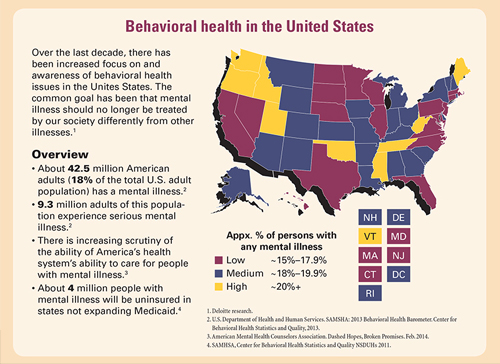
Thanks to the Affordable Care Act (ACA), an estimated 62 million Americans now have access to mental health and substance use disorder benefits through Medicaid. Most health plans must now cover preventive servicesopens in new window, such as depression screening for adults and behavioral assessments for children, at no additional cost.
It's all a result of the growing body of evidence that addressing behavioral health can improve patient outcomes and save money, says Tom Steiner, a director at Deloitte Consulting LLP, which provides strategic and operational advisory services to managed-care companies and other health-care decision-makers. Part of Steiner's job is to inform payers across the health-care system about new trends in the marketplace.
"As more and more money is going toward mental and behavioral health care, people are further prioritizing it to figure out whether there's a better way to provide that care more effectively and efficiently," says Steiner.
Last year, in an effort to build awareness of the benefits of psychological services within the country's new health-care system, APA's director of integrated care, W. Douglas Tynan, PhD, reached out to Steiner to inform him about the advantages that integrated health care provides to patients and offered to work with him to build awareness of integrated care among his managed-care clients.
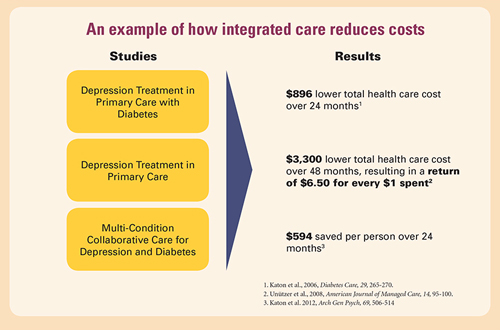
"Deloitte was intrigued that we could actually come up with something that might benefit their managed-care clients," Tynan recalls. "They saw potential in the evidence that when we focus on helping patients become happier and healthier, they use fewer hospital services and make fewer trips to the emergency department," Tynan says.
In December, Tynan teamed with Steiner and Deloitte psychologist Penny Brierley-Bowers, EdD, to deliver a webinar exploring integrated health-care delivery models to members of the Association of Community Affiliated Health Plans. The organization comprises 57 health plans in 24 states and serves primarily Medicaid populations. The team presented a similar webinar to nearly 150 members of the Medicaid Health Plans of America, the leading industry association for Medicaid health plans.
Presenters discussed the high cost of unmet behavioral health needs — estimated at about $70 billion annually — and explained how patients who have both chronic medical and behavioral health conditions cost significantly more than those with only a chronic medical condition.
"This is an emerging field and we're learning something new all the time," Brierley-Bowers says. "Doug had direct access to the most up-to-date information because APA is a leading source for best practices in behavioral health care. This is a valuable partnership for us."
The organizations hope to present additional webinars over the coming months.
Amy Novotney is a journalist in Chicago.