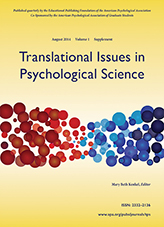
 APA is proud to announce the debut issue of
Translational Issues in Psychological Science
(TPS), the first journal developed and co-published through a partnership between graduate students and mentors.
APA is proud to announce the debut issue of
Translational Issues in Psychological Science
(TPS), the first journal developed and co-published through a partnership between graduate students and mentors.
The inaugural issue is focused on the causes and consequences of sleep disturbances and sleep loss.
"The mission of TPS is to see how psychological science contributes to important topics of the day, and it seems anytime you read a newspaper or journal article, sleep, or the lack of sleep, is a priority topic," says Mary Beth Kenkel, PhD, the journal's editor-in-chief and dean at the College of Psychology and Liberal Arts at the Florida Institute of Technology.
The journal is free to student members and will be sent to them electronically.
The idea for the journal came in 2009, when APA leadership asked APAGS's student science committee to think about ways to involve more students.
"They said to dream big, and we started coming up with ideas that would benefit both students and psychological science," remembers Michael Scullin, PhD, now assistant professor of psychology and neuroscience at Baylor University, who served on the student committee at the time.
Scullin — who is largely credited as the inspiration for the journal — saw two benefits of a student-run journal: giving students a reputable publication that they would want to read and offering them a training ground for publishing, reviewing and editing psychological research.
This inaugural issue includes 11 manuscripts and 60 trainee reviewers who worked with experienced associate editors.
Drexel University graduate student Caterina Mosti says her work on TPS enabled her to better understand the submissions process. "I learned about collaborating with other editors and received feedback on my editorial style," she says, "including whether my critiques were helpful and what I could expand upon for authors."
University of Southern California graduate student Bruna Martins said reviewing others work helped her grow in her own writing. "To be able to read your own papers and think of the constructive criticism they might be met with gives us the power to strengthen and improve papers prior to publication," she says.
The learning process extended to the experts, who said the trainees' professionalism and enthusiasm made the process as fun as it was instructional.
"I was inspired by working with these incredibly brilliant, motivated and motivating editors and reviewers," says Hawley Montgomery-Downs, PhD, associate professor of psychology at West Virginia University. "Ostensibly it was about them learning, but frankly the seasoned faculty have a lot to learn as well."
The articles in the debut issue include:
- "Behind Sleepy Eyes: Implications of Sleep Loss for Organizations and Employees," by Christopher Budnick of Northern Illinois University in DeKalb and co-authors.
- "The Teen Sleep Loss Epidemic: What Can Be Done," by Natalie Rossi and Rebecca Gómez, PhD, of the University of Arizona.
- "‘Do I Really Need a Nap?' The Role of Sleep Science in Informing Sleep Practices in Early Childhood Education and Care Settings," by Sally Staton, PhD, of the Queensland University of Technology, in Brisbane, Australia, and colleagues.
- "Vulnerability to Stress-Related Sleep Disturbance and Insomnia: Investigating the Link with Co-morbid Depressive Symptoms," by Ivan Vargas at the University of Michigan at Ann Arbor and colleagues.
Visit APA Journals for more information about TPS and sample articles.
— Stacy Lu