


Since 1986, Health Volunteers Overseas has brought health-care volunteers to underserved countries to boost local providers' skills and professionalism — in essence, to help them better serve their own people.
But when Bhutan's lone psychiatrist, Chencho Dorji, MD, appeared unannounced one day in 2008 at the nonprofit organization's headquarters in Washington, D.C., Director of Program Support Kate Fincham was unable to grant his request to add a mental health project to the group's agenda.
"I'm sorry, we can't — we don't have the resources or connections in the mental health community," Fincham told him. While the organization had established relationships with many professional medical associations, it lacked the same kinds of relationships with mental health groups, she said.
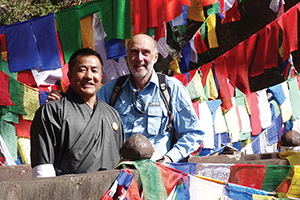
Bhutan volunteer Dr. George Burns with Wangchuk, a volunteer substance-abuse counselor.
Dorji had personal reasons to help people with mental health needs. His brother Damchoy, a Buddhist monk, had done well in his calling until one day he began to hallucinate and act violent. Bhutanese culture — and Dorji's family — assumed the behavior was caused by spirit possession. But in chatting with an Indian colleague, Dorji came to understand that his brother had schizophrenia. He entered medical training in Australia as soon as he could, earning his degree in psychiatry in 1999.
Dorji persisted in his efforts with Health Volunteers Overseas. He eventually convinced the Bhutanese government to give mental health volunteers free housing and visas, giving the organization the green light to proceed. The organization began to contact professional mental health organizations that could reach out to their members. One of them was APA, which became an associate member of Health Volunteers Overseas in 2012.
"At that time, there were not many opportunities for psychologists to help build mental health systems in other countries," says Merry Bullock, PhD, director of APA's Office of International Affairs. "We were delighted to let our members know that these possibilities now existed."
The program has been so popular, in fact, that the mental health project in Bhutan is booked until November 2016. (However, interested psychologists should applyopens in new window any time, as it takes a while to process applications and prepare for a trip like this, Fincham adds.)
Undiagnosed mental illness
Health Volunteers Overseas launched its first mental health project in Bhutan in 2009. Since then, 17 mental health volunteers — nine of them psychologists — have trained physicians, psychiatric nurses, paramedical staff and students who work at the country's main referral hospital, in the capital city of Thimphu.
Compared with medical projects, the mental health work requires an extra level of commitment, says Fincham.
"It's pretty straightforward to teach someone how to fix a broken bone or perform a particular kind of surgery," she says. "It's a lot different when you're talking about mental health issues."
Because of this, mental health volunteers are required to work for at least three months in the country, she notes.
Stints are rigorous, rewarding and sometimes surprising, say psychologists who have volunteered for the project. The clients who come to Thimphu often travel long distances from rural villages and tend to have longstanding undiagnosed mental health issues. Emotional problems are often masked as physical ones, and it's rare for a mental health provider to see clients more than once, given the number of people who need care — a far cry from the private office-based therapy of the West.
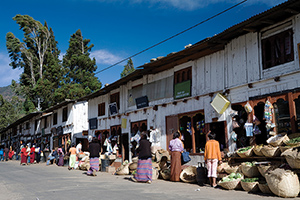
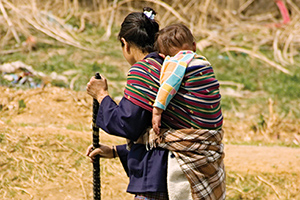
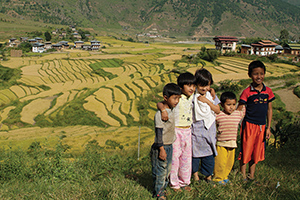
Bhutan's mental health needs have grown more visible since 2008, when the king declared this peaceful, isolated country a democracy. As the small nation of about 754,000 opened up to the outside world, young people had more access to drugs and alcohol. The country also has its share of anxiety, depression and psychotic disorders, with 300 to 550 people a year entering the hospital's psychiatric ward since 2010. These problems are embedded in a society that is poor and facing the erosion of extended family networks as it attempts rapid modernization.
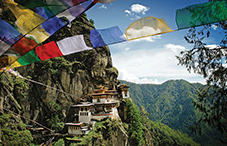
That said, the country is an inviting place, volunteers say. With its riveting backdrop of the Himalayan mountains, ancient Buddhist temples and gentle citizenry, Bhutan grows quickly on anyone who visits there, says clinical psychologist and volunteer George W. Burns, an adjunct professor of psychology at the Cairnmillar Institute in Melbourne, Australia.
"The culture is based on compassion; the ultimate goal of life there is to be happy," he says. "The Bhutanese are very compassionate, very caring people. They want to be happy. They want you to be happy."
Clinical work
For a number of years, Dorji was the only doctoral-level mental health provider in the country. Today, Bhutan has an additional native-born psychiatrist and three visiting psychiatrists. There are no psychologists yet except for the volunteers.
The clinical work includes treatment for alcoholism, including medical detoxification and psychoeducation, and for anxiety and depression that tend to manifest themselves psychosomatically.
"Even in the inpatient unit, people's symptoms were often things like headaches, dizziness and back pain," says Amy G. Nitza, PhD, an Indiana University-Purdue University psychologist who volunteered in Bhutan last year. "Directly expressing emotional distress is not typically seen as culturally appropriate."
One woman, for instance, came in complaining of a choking sensation. When Nitza talked to her a little more, she learned the woman's husband had beaten up their child, and the child was disabled as a result.
While the woman saw no apparent connection between her symptoms and her family conflict, her choking sensation gave her a reason to go to the hospital and to get her husband's attention. "Indirectly, I think getting her husband's support was something she needed in order to work through their other difficulties," Nitza says.
Volunteers also dive into plenty of nonclinical work. Burns, for instance, has trained and supervised staff in counseling skills, helped staff to conduct and publish research, and is helping Bhutan's Ministry of Health create job categories for psychologists and counselors — a move that will give Bhutanese students who study mental health abroad opportunities for jobs when they get home.
Meanwhile, Nitza developed and conducted a substance abuse counseling workshop for peer counselors, who are the go-to people for substance abuse treatment since there are no licensed professionals who do that work. She also collaborated with medical professionals and professionals at Bhutan's Ministry of Health to write a substance abuse treatment manual that will be used by the ministry to train substance abuse counselors across the country.
"These are examples of the kind of sustainable, country-wide impact that a [Health Volunteers Overseas] volunteer can have," she says.
That said, Western volunteers are somewhat limited in what they can do in a culture based heavily in Buddhist philosophy and traditional medicine, Burns says.
"That's why we desperately need Bhutanese-trained psychologists who know the culture, who know the language, and who can adapt aspects of the West to fit in with their background," he says.
In terms of personal enrichment, volunteers get back at least as much as they give, Burns adds.
"It's a country where values rate higher than dollars," he says. "If you're about to step on an ant, they'll literally stop you with a hand out in front of you. That's so refreshing to see."
Tori DeAngelis is a journalist in Syracuse, New York.