

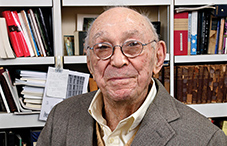

In October 1915, a baby was born blind to Polish immigrants in New York City. His father would die before the child reached his teens. An unlikely recipe for success, perhaps, but Jerome S. Bruner's story is hardly one of Dickensian hardship.
Cataract surgery at age 3 restored his sight. When Bruner was 12, his father died, but he was able to leave his son an inheritance from a successful watch-making business. That enabled his higher education — and Bruner made the most of those gifts. He earned a BA from Duke University in 1937 and a PhD in psychology from Harvard University in 1941. In the years that followed, he made seminal contributions to cognitive and educational psychology.
Early on, Bruner explored the ways that experience affects perception. His paper "Value and Need as Organizing Factors in Perception" (Journal of Abnormal and Social Psychology, 1947) reported the finding that children were more likely to overestimate the size of coins than cardboard discs — and the greater the value of the coin, the more likely the children were to overestimate its diameter. What's more, poor children were significantly more likely than rich children to overestimate the size of coins. In other words, both value and need influenced the way the children perceived the world around them.
Through research and observation, Bruner understood that human behavior is always influenced by the world and culture in which we live. His work helped move the field of psychology away from strict behaviorism and contributed to the emergence of cognitive psychology.
Bruner eventually turned his attention to developmental and educational psychology, with an interest in how children learn. He argued that the goal of teaching isn't to pass on knowledge, but to teach students to think and solve problems for themselves. He promoted a so-called "spiral curriculum," in which students learn basic concepts and then circle back to revisit them again and again as more complicated concepts are added over time. He is credited with coining the term "scaffolding" to describe the structured instruction between child and teacher that allows students to develop progressively greater skills and knowledge.
Bruner held faculty positions at Harvard, where he directed the Center for Cognitive Studies, and at the University of Oxford. In 1965, he served as APA president. In 1991, he joined the law school at New York University to explore an interest in how the law defines "appropriate" behavior.
Approaching his 100th birthday, Bruner spoke with the Monitor from his home in New York City to reflect on his career and the course of psychology.
How did you get started in psychology?
As a kid, I was always interested in what made people come to their conclusions. But I found much more interest in reading novels. Somewhere along the way I got to thinking about what was really going on inside people's heads. My literary friends, writers and novelists, had as much influence on me as psychologists did.
My father left me a sum of money to take care of my education, as far as I wanted it to go. After my father's death, my mother invested in some fairly risky shares. When the crash came in 1929, she didn't get wiped out, but she didn't have any extra. Fortunately my father had left me my own bequest in his will to cover my education.
When I was an undergraduate, I always felt I had to cover up the fact that for my age, I was quite a rich kid. It was embarrassing. Having come off lucky that way, I felt I had some responsibilities to the society in which I lived — that I should be paying back.
I went to Duke University as a way of showing my independence. Duke at that point had just got in buckets of money and had a very distinguished faculty. One of my teachers was the great William McDougallopens in new window. I had the great good luck of recognizing early on that the group of young psychologists there were the best you could find anywhere.
How did you get interested in perception?
Being born blind, and not getting my sight until I was operated on at age 3, gave me a feeling that your first impression came via your senses, but as you grew older you learned somehow to be prepared for certain kinds of situations. So your senses were not just concerned with the new, but also concerned with the confirmation of what you expected.
At Harvard, I began discovering there were wonderful techniques you could use to study perception. One, for example, was the tachistoscope, an apparatus that presents visual displays to a person down to a hundredth of a second. I had the good luck of having some good friends at the Massachusetts Institute of Technology, and they built me one of the first tachistoscopes. We could show people pictures at the speed of recognition. We found [that people's ability to recognize the objects in the photographs] depended not only on the nature of the input, but also on the nature of the values that the object represented.
You were an early pioneer of cognitive psychology. Why were you driven to move in that direction?
I've always been a constructivist. Nothing that is out there in the world is there in and of itself. You're always constructing it, and some of the rules of construction have to do with conforming to those with whom you have to live. No matter what we do, we are expressing the rules of the culture in which we live.
I wanted to have a psychology that somehow was not just about what came in through the senses right here and now. On the other hand, I knew those were the components of a more complicated behavior. And I turned in the direction of wanting to know about our capacity for registering the world. The world was there and we brought our input and processing of that input. I had the feeling this was one of the sources of [humankind's] freedom and liberty, and why literature was so important, not only aesthetically but also politically. It is the capacity to dream up a range of possibilities.
How has psychology changed over the course of your career?
[When I began,] it was going through a strict behaviorist, sensorimotor type of thing. But then it started moving in the direction of how experience related to the world in which we lived. On the one hand, we have innate properties as human beings, and perceive things in certain ways, but we're also extremely susceptible to cultural norms. We're conflicted, and sometimes neurotically so. I think psychology has now gone through its cultural revolution.
How would you describe the current state of psychology?
Psychology today is such a split field. There's a split between those who think the objective is to prove how objective and how rigorous psychology can be, which means cutting down anything that sounds too spirited, too mental. And on the other hand, we have those who want to take the mentalistic part of it and make it powerful, elegant and somehow discovery-oriented.
Psychology's task now is to blend the facts that we're cultural, but at the same time, we're human beings. We're learning to put these together in an overall sense, but a lot of psychologists avoid doing this. It's one of the reasons why psychologists tend to be so isolated on their campuses.
You'll be turning 100 this year…
Yes! Isn't that nifty?
Why have you lived so long?
I don't know. I've always had an athletic side to me. I'm an extremely good squash player, and in college I was a quarter-miler. I've always been very physical.
What other interests have inspired you, outside of psychology?
I'm a very skilled sailor. I'm the first Oxford professor in history who sailed a sailboat across the Atlantic to take up his post. The sea fascinates me. It has since I was a kid. I remember the guy who ran the boatyard in the town I grew up in on Long Island, right on the edge of New York City. Frank taught me all kinds of things. A boat is a challenge in a way.
What's the secret to your success?
It may come from the fact that there was an opening of the eyes, and I mean that in the literal sense. Being born blind, having my sight restored, made me sensitive to the new. I remember a gal once told me, ‘Jerry, you're a curious bastard.' Well, I'm anything but a bastard — but maybe there's something in that. The secret of people continues to fascinate me.