



A new national mental health campaign, founded by APA member Barbara Van Dahlen, PhD, is urging Americans to recognize signs of suffering among their loved ones, co-workers, neighbors and themselves in an effort to change the culture of mental health in America.
The Campaign to Change Direction seeks to make the way we talk about mental health care in this country as common and open as the discussions we have about our physical ailments.
"Many people in this country are fighting to put one foot in front of the other just to make it through the day — and often they don't ask for help because they're worried about how it will look," said first lady Michelle Obama, who added her voice to the campaign at a March 4 summit in Washington, D.C. "At the root of this dilemma is the way we view mental health in this country. When it comes to mental health conditions, we often treat them differently from other diseases like cancer, diabetes or asthma. And that makes no sense.

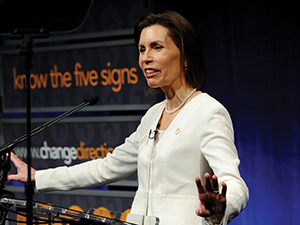
"It's time to tell everyone who's dealing with a mental health issue that they're not alone, and that getting support and treatment isn't a sign of weakness, it's a sign of strength."
The Campaign to Change Direction was inspired by discussions at the 2013 White House National Conference on Mental Health, held shortly after the Sandy Hook Elementary School shootings in Newtown, Connecticut. The campaign urges Americans to watch for these five signs of emotional suffering that may indicate people need help:
- Their personality changes.
- They seem uncharacteristically angry, anxious or moody.
- They withdraw or isolate themselves from others.
- They stop taking care of themselves and may engage in risky behavior.
- They seem overcome with hopelessness and overwhelmed by their circumstances.

If someone does appear to be suffering in any of those ways, the campaign encourages everyone to reach out, offer to help, provide hope and follow up often. The campaign also asks individuals, communities and corporations to take a pledge to join the effort, educate our families, our neighbors and our employees to learn the five signs.
The Change Direction campaign is a new initiative of Give an Hour, a national network of mental health professionals who volunteer services to troops and families affected by post-9/11 conflicts in Iraq and Afghanistan, founded by Van Dahlen in 2005.
"Not long ago, most Americans didn't recognize the signs of heart attack, but now everyone knows what to look for," says Van Dahlen. "That is the norm. It's become common to talk openly about so many physical health issues, such as the fact that you get a colonoscopy if you're over age 50, or your recovery from cancer. This campaign seeks to create a common language that will help remind everyone that our mental health — like our physical health — is just part of being human."
APA is a founding member of the campaign, joining partners that include the federal Substance Abuse and Mental Health Services Administration, Aetna, the Case Foundation, Logistics Health Inc., the American Psychiatric Association, the National Association of Social Workers and Booz Allen Hamilton.
"Emotional health issues can directly impact business; in other words, healthy employees are more productive and engaged. Like most other companies, we want our employees to feel and perform their best," says Andrea Inserra, senior vice president of Booz Allen Hamilton.
The effort is quickly picking up steam. While Van Dahlen's goal for the launch was to get enough participating organizations to reach 1 million people with messages about the five signs, by the time of the launch, the campaign had signed 52 organizations as partners. Two weeks after the launch, that number had doubled.
"We already have pledges to reach over 30 million people in the next five years," says Van Dahlen.
Approaching mental health as a critical component of overall well-being will not only change the way we talk about it, but also how our health-care system approaches it, said APA CEO Norman B. Anderson, PhD, who spoke at the summit. 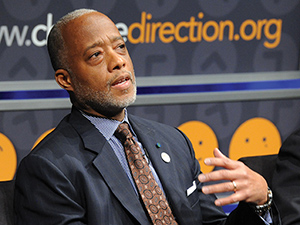 . "That's comprehensive health care."
APA member Arthur Evans Jr., PhD, commissioner of the Department of Behavioral Health and Intellectual disAbility Services for Philadelphia, also participated in the kick-off event. He is a member of APA's Committee for the Advancement of Professional Practice.
The need for such a campaign is dire. While one in five Americans has a diagnosable mental health condition, many are often unable to acknowledge their mental health struggles because they feel ashamed of them or fear being stigmatized by others.
It's a predicament Van Dahlen has seen often while working with veterans and their families. The key is to reach out with support. "We assume everyone knows what they can do to get help, but they don't," says Van Dahlen. "We need to help them navigate and access care."
She encourages psychologists who want to take a more active role in the campaign to download campaign materials from the website and post them in community centers, churches, synagogues and other places people gather. "Take these resources and tools into the settings where we live and educate our citizens. State associations can take the lead in their states to launch community efforts. There are currently several community efforts underway — it is an exciting time to join this movement," she says.
Van Dahlen acknowledges that the psychology field's emphasis on patient confidentiality has helped to keep mental health care in the shadows. "I only started talking about my own family history and my mother's schizophrenia in the past few years," she says. "I think we need to share our stories, but the question is, how do we do this while also protecting privacy and confidentiality? We need to talk about this as a profession. We can model doing things in a different way."
For more information on the campaign, visit Give an Houropens in new window.