



When Raymond D. Fowler, PhD, took the helm of APA as CEO in 1989, he was facing perhaps the most challenging time in its history. APA was in financial peril due to its purchase of Psychology Today magazine, and ongoing disputes between academics and practitioners had led a group of members to leave and form the American Psychological Society.
In this difficult time, Fowler was a "calm presence," says Frank Farley, PhD, APA's 1993 president. "With Ray's leadership, we made it through the storm."
By the time Fowler retired 13 years later, in 2002, APA's membership had grown from 105,000 to 155,000, its finances had recovered, and central office staff had moved into a new building in downtown Washington, D.C.
"The qualities he had were the qualities that were needed during that time," Farley says.
"The field has lost a great leader, who was an inspiration and role model to psychologists around the world," says Norman B. Anderson, PhD, who succeeded Fowler as APA's CEO. "Ray's lifelong dedication to psychology was deep, and his imprint on the American Psychological Association, and on the growth of the field internationally, are incomparable. More personally, it was a great privilege for me to learn from him before and during my time as CEO. He was a true friend and mentor."

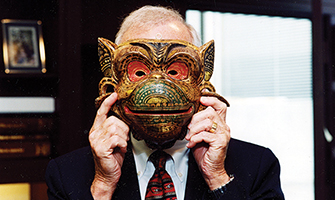
Left: Under Dr. Fowler’s stewardship, APA bought land near the Capitol and built its current headquarters building. Right: Dr. Fowler was known for his African art collection — and sense of fun. (credit: Lloyd Wolf)
Fowler, who died in March after a long illness, was born in 1930 in Jasper, Alabama. He graduated from the University of Alabama in Tuscaloosa in 1952 and earned his PhD in clinical psychology from Penn State in 1957. He then joined the faculty at the University of Alabama in Tuscaloosa, where he taught until 1987 and served as department chair from 1965 to 1983. He was known for his work on substance abuse, criminal behavior and personality assessment, including developing programs to reduce juvenile delinquency and establishing assessment systems and rehabilitation programs for prison inmates in Alabama.
His long career in psychology leadership — which included stints as president of the Alabama Psychological Association and of the Southeastern Psychological Association, and as APA treasurer from 1982 to 1987 — culminated in his election as APA's president in 1988. The next year, he took on the full-time job of APA's executive vice president and chief executive officer. In that position, "He led APA through a quite remarkable organizational transformation," says Pierre Ritchie, PhD, a former secretary-general of the International Union of Psychological Scientists. "He positioned the organization to take on a leadership role in all sectors of psychology like it never had before."
Fowler was also keenly interested in international psychology, Ritchie says, and helped APA forge partnerships with psychologists and psychological associations around the world.
He was also a mentor to generations of students and colleagues, says APA Past President Nadine Kaslow, PhD. "He encouraged me to think about running for president long before I would have thought of it myself," she says.
Colleagues also remember his strong support for students at APA, including advocating for the creation of the American Psychological Association of Graduate Students and for adding a voting member of APAGS to the APA Board of Directors.
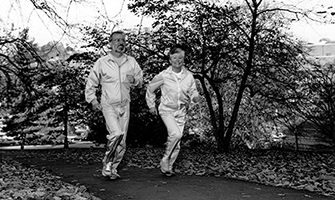

Left: Pictured here with his wife Sandy, Dr. Fowler founded the Running Psychologists in 1979, and Ray’s Race has been held at every APA convention since. Right: Dr. Fowler became active in the 1960s on APA’s Council of Representatives, shaping a governance career that led him to a seat on the Board of Directors, a stint as treasurer from 1983 to 1987 and eventually APA’s presidency in 1988. He became APA CEO in 1989.
"He knew that students were not just our future, but also our present," says Kaslow.
Today, Fowler is also remembered each year at Ray's Race, the 5K run at APA's Annual Convention he founded in 1979. A fitness enthusiast, Fowler was an advocate for the positive effects of exercise, says Martin E.P. Seligman, PhD, APA's 1998 president.
Seligman recalls a trip he took with Fowler to Australia during which Fowler gave a talk on the effects of exercise on physical and mental well-being.
"The next day all of us went out and bought pedometers," Seligman says. "Ray was very persuasive. He got people to act."
In addition to his wife, organizational psychologist Sandra Mumford Fowler, Fowler is survived by five children and four grandchildren.